Your parents earn too much — but they're not paying your way
Services Australia says you're dependent. Your parents' income disqualifies you from Youth Allowance. But the rent is yours, the groceries are yours, and the textbooks are yours. You're caught between a government rule that assumes your parents will help and a household budget that says otherwise.
You could spend weeks piecing together the rules from dozens of government pages — or you could open the Independence Pathway System and see every route to independent status in one place, with the worksheets that turn confusing criteria into a clear, evidence-ready claim.
What's inside the guide
- All 12 independence pathways mapped out — age 22 automatic qualification, the 30-hour full-time work test, regional gap-year earnings, unreasonable to live at home, orphan, refugee, state care, de facto or married, dependent child, and more. The pathways are covered in chapters with the statutory rules explained in plain language.
- Work History Tracker — a structured week-by-week log designed for casual workers juggling multiple employers. Record your shifts, then use the guide's calculation method to check your average against the 18-month, 30-hour threshold. No more guessing whether your irregular rosters add up.
- Regional Earnings Calculator — for students whose family home is in a qualifying regional area and who must live away for full-time study, the guide covers the 14-month earnings period, the 75% Wage Level A National Training Wage rate that applied when the employment period began, and the parental income threshold.
- UTLAH Safety Protocol — for students who cannot safely live at home, the guide explains Forms SY015, SY016 and SY017, who qualifies as a third-party referee, and how to structure a statement that supports your claim without escalating a dangerous situation.
- Evidence guidance — pathway-specific evidence material throughout the guide, plus a dedicated UTLAH checklist for Forms SY015, SY016 and SY017.
- Review Roadmap — rejected? The guide covers the Authorised Review Officer reassessment, the recommended 13-week window, what happens to backpay if you're late, and how to apply to the Administrative Review Tribunal if the internal review doesn't go your way.
- Income Testing Explained — once you're assessed as independent, your payment depends on your own earnings and assets, not your parents'. The guide explains the personal income free area, the taper rates, and the Student Income Bank so you know what to expect.
- Agency Communication Log — record the date, officer, reference number, discussion and promised follow-up for each interaction with Services Australia.
Who this guide is for
- Students aged 18–21 whose parents earn too much for Youth Allowance but aren't funding their living costs
- Gap-year workers calculating whether their hours and earnings meet the independence criteria
- Students in unsafe home situations navigating the UTLAH process
- Parents helping a child build an application they can't afford to get wrong
- Campus welfare officers and youth advocates looking for a current, accurate reference
Why the free information isn't enough
The Services Australia website is accurate — but it's built for caseworkers, not for 19-year-olds trying to figure out whether their gap-year hours count. The independence rules are scattered across more than two dozen web pages, each written in policy language, with no worksheets, no evidence checklists, and no guidance on what to do when a claim is rejected.
Generic student guides are worse: many still reference the Administrative Appeals Tribunal (replaced by the Administrative Review Tribunal in October 2024), confuse the away-from-home rate with actual independence, or repeat outdated income thresholds. AI prompt services generate appeal letters that hallucinate social security law.
The Independence Pathway System takes the official rules and turns them into a sequence you can follow: identify your pathway, gather the right evidence, calculate your hours or earnings, lodge with confidence, and know exactly what to do if the answer is no.
Your claim, step by step
Open the guide and start with the Pathway Finder in Chapter 2. It walks you through each independence test and identifies which ones apply to your situation. Then move to the relevant chapter for the rules and evidence to gather, with worksheets for the calculations. When your documents are ready, the lodgement chapter covers the myGov submission process and what to expect from Services Australia's processing timeline.
If you get a rejection, the review chapters take you through the ARO request and, if needed, the ART application — step by step, with timeframes and what to include.
Satisfaction guarantee
Full refund, no time limit. If the guide isn't what you expected, email [email protected] and we'll refund you — no questions, no deadline.
Free checklist or the full guide?
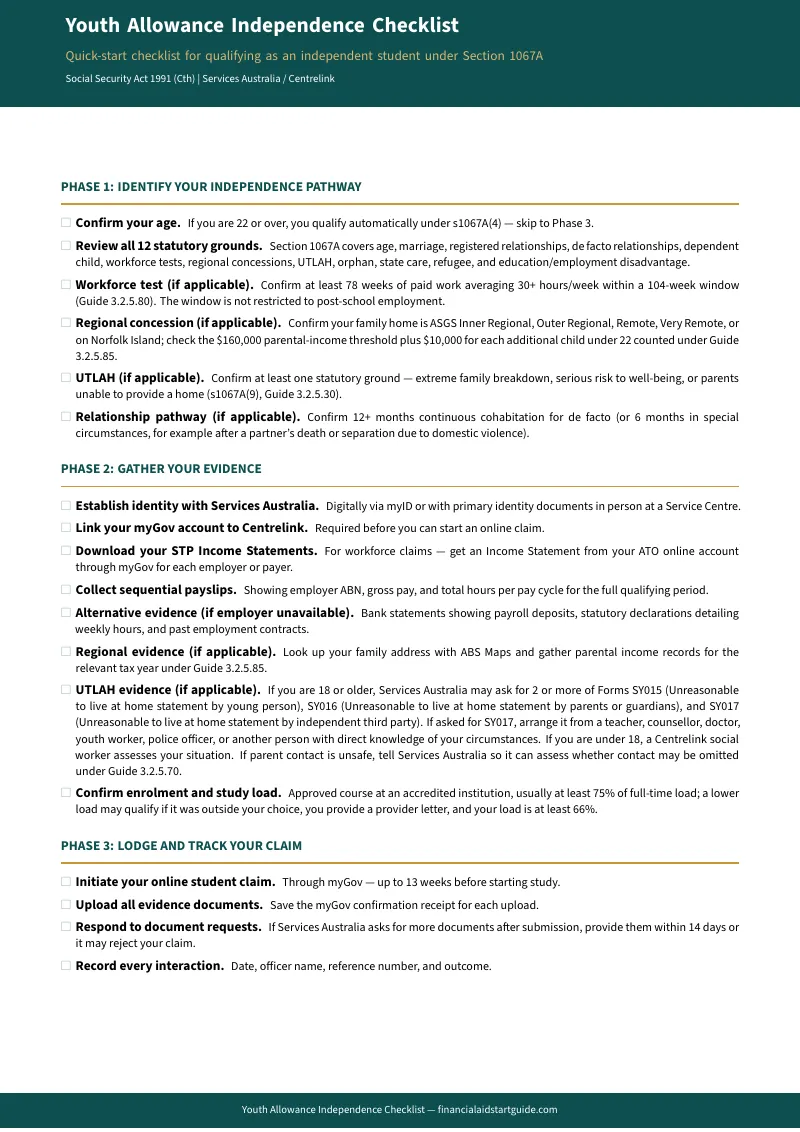
The free Youth Allowance Independence Checklist gives you a two-page overview of the criteria and key evidence items for common pathways. It's a good starting point if you want to see what's involved before committing.
The full guide goes further: worked calculation examples, the UTLAH safety protocol, the review roadmap, and every worksheet and tracker in the system. It's a one-time purchase — — with a full refund, no time limit.
Independent educational publication. Not affiliated with, endorsed by, or connected to Services Australia, myGov, or any Australian government agency. Free help is available through your university welfare office, community legal centres, and the Services Australia Youth and Students line (132 490).
Frequently Asked Questions
What if the rules change after I buy?
We update the guide when the rules change. Email us any time, even years later, and we'll send you the current edition free.