HECS, FEE-HELP, Indexation, Repayments — Every Rule in One Place
You enrolled, accepted your offer, and assumed the loan was sorted. Months later you discover the eCAF passkey email ended up in spam, your TFN didn't match the ATO's records, and your Commonwealth Supported Place is about to be cancelled — with upfront fees due instead.
Or maybe you're years past university, watching your HELP debt rise every June even though your employer withholds tax from every pay cycle. The ATO pages explain indexation. StudyAssist explains census dates. Your university explains re-crediting. None of them explain the full picture — how these pieces connect, what happens when, and what to do when something goes wrong.
The HELP Loans Process Map
This guide maps HECS-HELP, FEE-HELP, SA-HELP, and OS-HELP alongside the separate VET Student Loans scheme, the roles of your provider, the Department of Education, and the ATO, and dozens of statutory deadlines — in the order you'll actually encounter them, from your first course offer through to the day your debt reaches zero.
Instead of reading across five government websites and hoping you haven't missed a step, you get one document that shows where you are, what matters next, and exactly who can help you fix it if something breaks.
What's Inside
- HECS-HELP vs FEE-HELP comparison — the real differences between Commonwealth Supported Places and full-fee places, including where the 20% FEE-HELP loan fee applies and where it doesn't
- eCAF submission walkthrough — finding the passkey email, matching your name and date of birth to ATO records, and submitting before your provider's census date locks in the debt
- Borrowing limit tracker — how the Combined HELP Loan Limit works, what myHELPbalance actually shows, and why a tax-return repayment doesn't instantly restore your available balance
- Post-census re-crediting roadmap — the statutory three-limb special circumstances test, the evidence standards that providers and the Administrative Review Tribunal look for, and the 12-month application window after the day in a provider's notice that withdrawal took effect or, if no such notice is given, after the period in which the unit was or was to be undertaken
- Indexation and debt reduction explained — the permanent CPI-or-WPI cap, the 2025 retrospective 20% reduction, and step-by-step instructions for checking both adjustments on your ATO account
- The marginal repayment system — how compulsory repayments are calculated on income above the minimum threshold, the timing gap between employer PAYG withholding and actual debt reduction, and when voluntary repayments make sense
- VET Student Loans — how VSL differs from university HELP on fee caps and progression rules, and the under-18 parental-consent requirement unless the student has received Youth Allowance and is independent within the meaning of Part 2.11 of the Social Security Act 1991
- Free-help directory — who to call at your provider, the ATO, Legal Aid, and student advocacy offices for every type of problem the guide covers
- 6 printable worksheets — a census date and eCAF tracker, a CAN verification sheet, a special circumstances evidence planner, an annual reconciliation log, a repayment income calculator, and an agency contact log — fill them in by hand as you work through each stage
Who It's For
- Students enrolling for the first time who need the eCAF and loan setup done right before census
- Parents helping a student through enrolment and wanting to understand the system their child is borrowing from
- Graduates and working professionals trying to make sense of their ATO debt balance, indexation adjustments, and compulsory repayments
- Anyone who withdrew from units after census and needs the re-crediting rules, evidence standards, and appeal deadlines in one place
- Students or former students checking whether the 2025 debt reduction and new indexation cap are reflected correctly on myGov
Why Not Just Use the Free Government Pages?
You absolutely can — and you should. StudyAssist, the ATO, and your university's student services are the first places to go. This guide doesn't replace them; it organises them.
The problem is that the official pages are written for different purposes. StudyAssist explains loan types in isolation. The ATO explains repayment thresholds without mentioning census dates. Your provider explains eCAFs without explaining what happens to your ATO debt after you graduate. If you're trying to solve one specific problem — a failed TFN validation, a missed census date, a confusing indexation spike — you end up bouncing between websites, trying to assemble the sequence yourself.
This guide puts the full sequence in one document, cites the original sources so you can verify everything, and includes checklists you can print and work through step by step.
What This Guide Does Not Do
It does not write appeal letters, provide legal representation, give formal tax advice, or promise any specific outcome. No guide can guarantee that a re-crediting application will succeed or that the ATO will adjust your balance. Decisions rest with your provider, the ATO, and the Administrative Review Tribunal. Where you need professional help, the guide tells you exactly where to get it — for free.
Satisfaction Guarantee
Full refund, no time limit. If the guide doesn't help you, email [email protected] and we'll refund the purchase — no questions asked.
Get Started
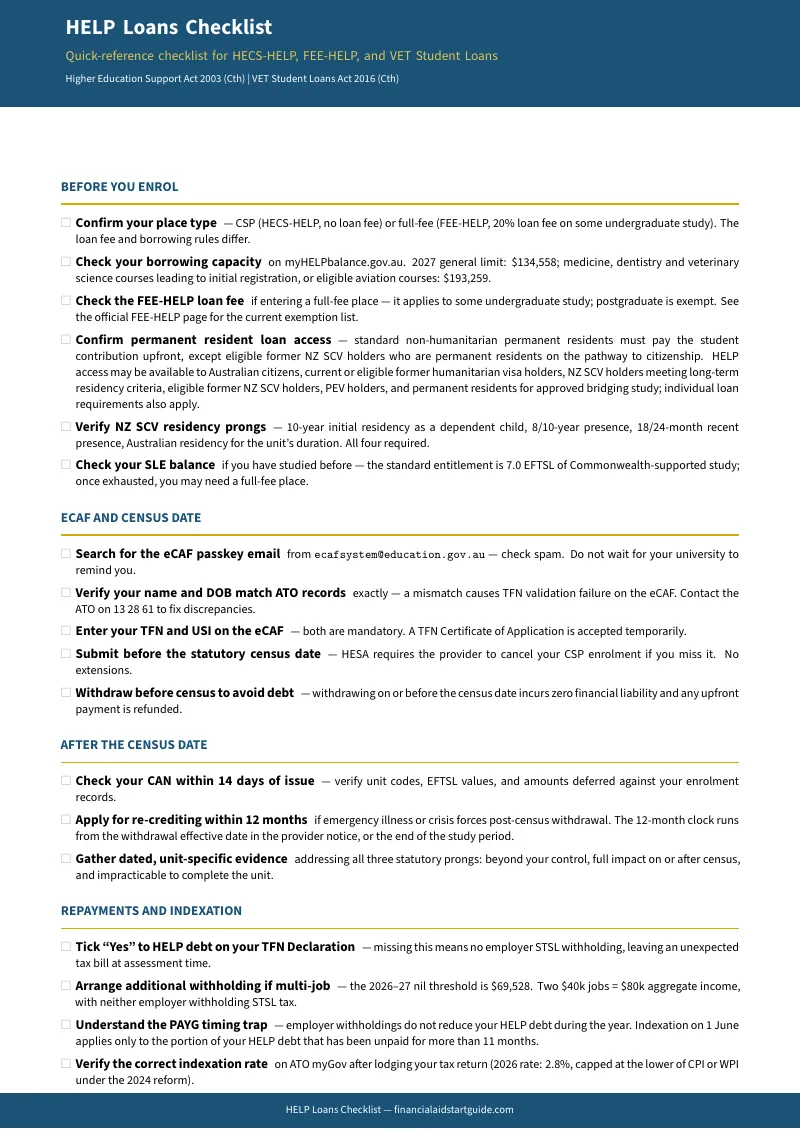
Download the free HELP Loans Checklist for a one-page summary of the key dates and steps. If you need the full guide — with the eCAF walkthrough, the re-crediting roadmap, the indexation worksheets, and the repayment explained from first principles — get the complete HELP Loans Guide for and start working through it today.
Frequently Asked Questions
What if the rules change after I buy?
We update the guide when the rules change. Email us any time, even years later, and we'll send you the current edition free.