Your placement starts soon. The income gap starts immediately.
You got the placement confirmation. Thirty hours a week, unpaid, for weeks or months. Your employer can't hold your shifts. Your rent doesn't pause. And somewhere between the university portal, Centrelink, and the ATO, there's a payment worth up to $338.60 a week that you might be entitled to — if you can work out how to apply for it correctly.
The Commonwealth Prac Payment exists to close that gap for teaching, nursing, midwifery and social work students on mandatory placements. But the rules are scattered across the Department of Education, your university's financial aid office, the HES portal, Services Australia and — if you're a VET nursing student — the DEWR Your Career site. Nobody gives you the full picture in one place.
The Placement Evidence Toolkit
This guide is a structured walkthrough of the entire Commonwealth Prac Payment process — from checking which of the three qualification pathways applies to you, through calculating your four-week evidentiary period, to reporting the payment on your tax return and to Centrelink. It replaces the hours of tab-switching between government websites, university FAQs and Reddit threads with a single reference you can print, annotate and follow step by step.
What's Inside
- Three qualification pathways mapped out — the Income Support Payment route (you receive an eligible payment such as Youth Allowance, Austudy or ABSTUDY Living Allowance), the Need to Work route (you've averaged more than 15 hours a week during the four study-period weeks and meet the Income Test), and the exceptional circumstances route (medical conditions, disability or caring responsibilities affect your ability to meet eligibility requirements). Each pathway has its own evidence requirements, and the guide walks you through the right one.
- Means test worked examples — how to identify your four continuous study weeks, exclude university vacation recesses, aggregate income from multiple casual jobs and scholarships, and check whether your gross weekly total sits under the indexed cap. Includes examples for students with irregular shift patterns and those receiving equity bursaries.
- Portal-by-portal application steps — whether your university uses the centralised HES portal, an internal system like MyCQU or UConnect, or whether you're a VET nursing student applying through the DEWR Your Career site. The guide covers what each channel requires and how the evidence upload works.
- Payment timing and withdrawal rules — the weekly rate, how universities schedule disbursements, what happens if your placement is deferred, and when a provider may seek to recover payments for placement weeks not completed.
- Tax and Centrelink reporting — the CPP is classified as assessable ordinary income by the ATO, with no PAYG tax withheld at source. If you're also receiving a Centrelink payment, the guide explains how to report CPP income to Services Australia and understand how it may affect your payment.
- Review and escalation contacts — what to do when your application is held, delayed or rejected, including the evidence options for a formal review and the institutional contacts at HES, your university, and DEWR.
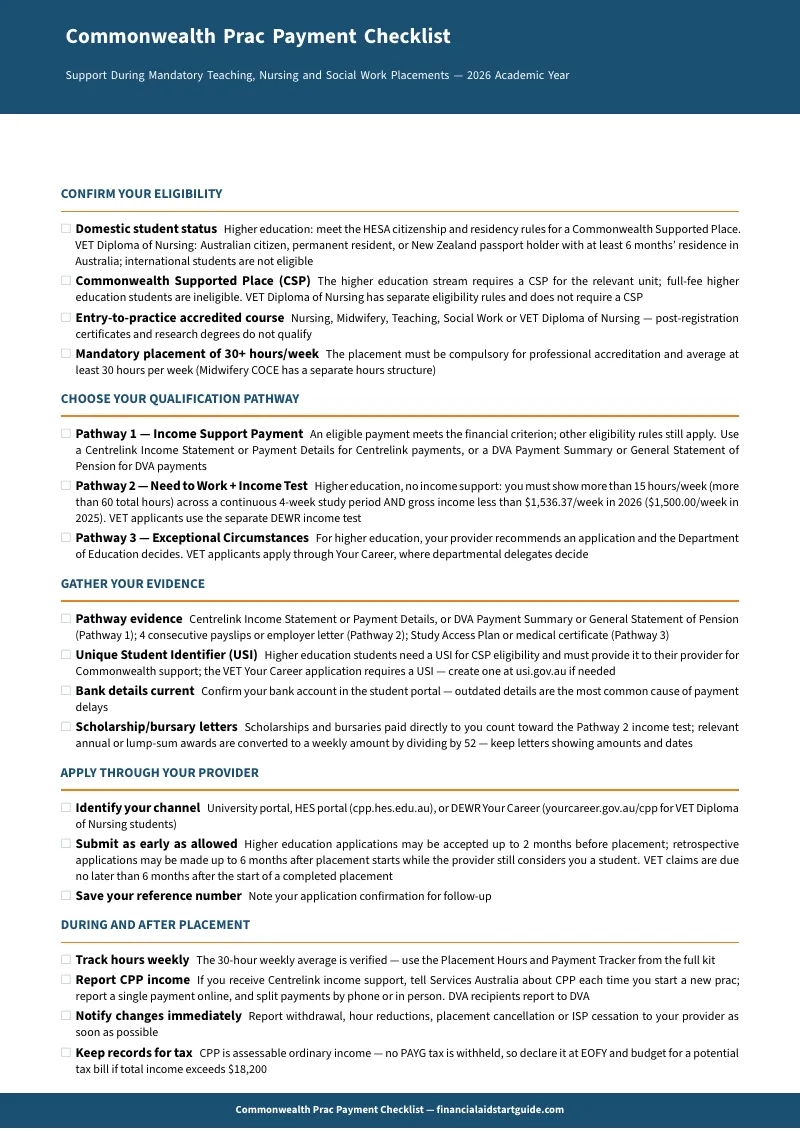
- Free readiness checklist — a printable two-page checklist covering eligibility criteria, required documents and key deadlines, so you can audit your readiness before you even log in to a portal.
- Five printable worksheets — Eligibility Self-Assessment Worksheet, Evidence Assembly Checklist, Placement Hours and Payment Tracker, Tax and Reporting Planner, and Application Review Worksheet. Print them, write on them, take them to the portal.
Who This Is For
- Teaching, nursing, midwifery and social work students about to start a mandatory placement and losing income while they're off work
- Parents helping a dependent student understand the means test — parental income does not count toward the CPP means test, but families accustomed to Youth Allowance rules often assume it does
- Mature-age and independent students who cannot afford weeks without pay and need to get the application right the first time
- VET Diploma of Nursing students applying through the DEWR Your Career portal, which uses a different system from university applications
- Students whose application has been delayed, held for further evidence or rejected, and who want to understand the review process and their options
Why Not Just Read the Free Government Pages?
The official Department of Education page outlines the program rules — then tells you to contact your university. Your university's page explains its own portal — but not how the means test calculation works when you have two casual jobs and a scholarship. Services Australia manages your Youth Allowance — but doesn't process CPP applications for university students. The Your Career site handles VET nursing students — but not anyone in a Bachelor or Master degree.
Each source covers its own piece. None of them gives you a start-to-finish workflow that connects the eligibility check, the evidence calculation, the portal submission and the post-payment reporting into one sequence. Generic Centrelink guides on Etsy and Gumroad compile public agency pages but don't address the dual-pathway rules, the evidentiary period calculation or the institution-specific portal variations that make the CPP different from standard income support.
This guide bridges those gaps. It consolidates the rules from the legislation, the provider guidelines and the university-specific requirements into structured steps, worked examples and evidence checklists — so you spend your pre-placement weeks gathering documents, not trying to piece together which website applies to you.
Satisfaction Guarantee
Full refund, no time limit. If the guide doesn't help you, email [email protected] and we'll refund you — no questions, no deadline.
Get Started
Download the free readiness checklist to see what documents you need and whether you're likely eligible. Ready for the full walkthrough? Get the complete Placement Evidence Toolkit for and have every step, calculation and contact in one printable guide before your placement starts.
Frequently Asked Questions
What if the rules change after I buy?
We update the guide when the rules change. Email us any time, even years later, and we'll send you the current edition free.