A Centrelink debt letter lands in your myGov inbox. What you do next decides whether you pay thousands you may not owe.
You reported your income. You kept studying. And then a notice arrived saying you owe Services Australia money — sometimes hundreds, sometimes thousands of dollars — with recovery already underway.
The debt may be correct. Or it may be a calculation error buried in fortnightly income attribution, a parental income reassessment that used the wrong tax year, or a study load change that triggered an overpayment because your university reported late. The only way to know is to audit the numbers yourself — and the official forms give you no guidance on how to do that.
The Debt Review Preparation System
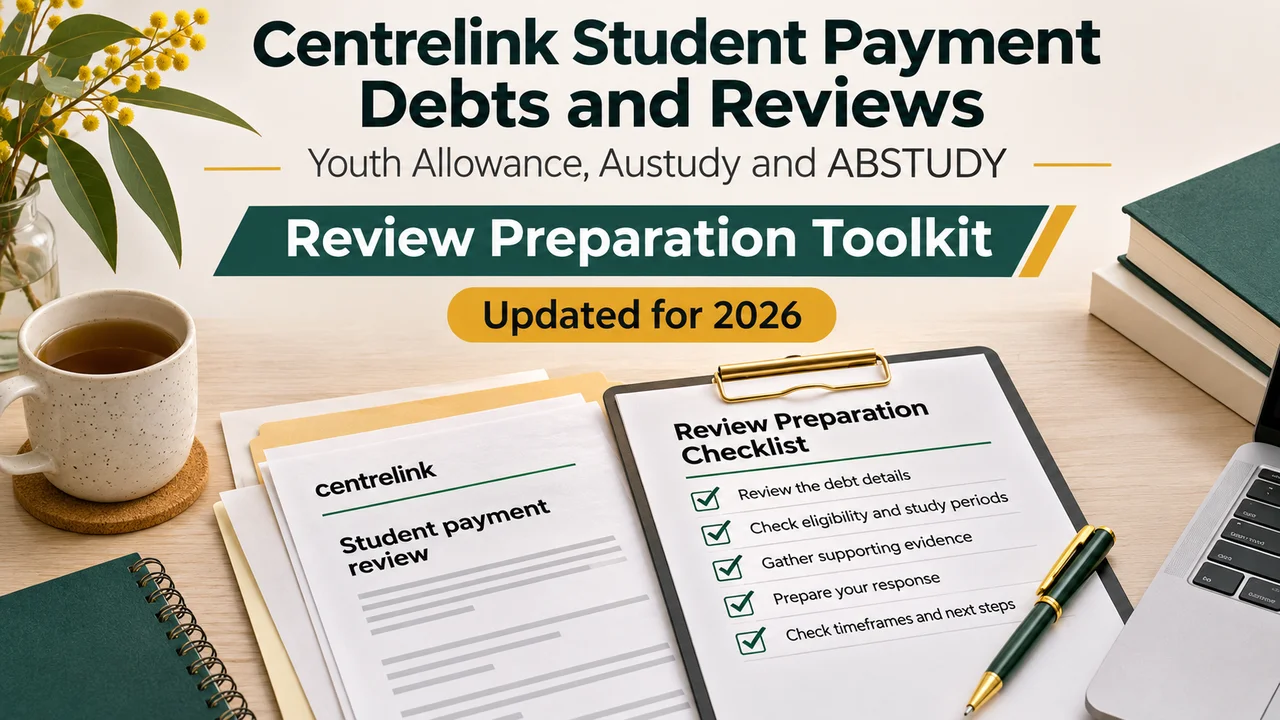
The Centrelink Student Payment Debts and Reviews guide is a self-help preparation toolkit that organises the entire review process into a structured, step-by-step workflow — from understanding why the debt was raised, through building your evidence file, to lodging a formal review and managing repayments while you wait.
This is not legal advice and not a substitute for free legal help. It is a plain-language workbook that takes the scattered rules across Services Australia's website, the Social Security Guide, and the Administrative Review Tribunal's procedures, and puts them in the order you will need them — with worksheets to audit the numbers and checklists to track every deadline.
What's Inside the Guide
- Decision Mapper — identify your exact decision type (debt, rate reduction, claim rejection, cancellation) and which review form applies: SS351 for Youth Allowance and Austudy, SY054 for ABSTUDY
- Five Common Debt Triggers Explained — study load drops, gross-vs-net income errors, pay period misallocation, parental income reassessments, and relationship status changes, each with the statutory basis and what to check
- Income Reconciliation Worksheet — a structured self-audit table to compare your payslips, bank statements, and employer records against Centrelink's fortnightly calculations, fortnight by fortnight
- Evidence Portfolio Checklist — a category-by-category list of the documents Authorised Review Officers and the ART weigh most heavily: university enrolment confirmations, ATO Notices of Assessment, medical certificates, third-party declarations, and more
- ARO Internal Review Walkthrough — how to request a formal review, what the 13-week backdating rule under section 109 means for most Youth Allowance and Austudy rate and entitlement decisions, how to write your statement of reasons, and what to expect from the process
- Administrative Review Tribunal (ART) Guide — applying for external review after October 2024, preparing your evidence binder for a self-represented hearing, the 90-day time limit after an ARO or SME decision listed for student-assistance decisions, and the section 312 exception for ART reviews of decisions about recovering amounts paid under a current or former special educational assistance scheme
- Debt Waiver and Write-Off Provisions — the statutory grounds for waiver (including special circumstances, small debts, and sole administrative error), write-off criteria, and how to apply
- Repayment Management Tools — requesting a pause on debt recovery while a review is pending, negotiating affordable repayment rates, understanding standard withholding percentages, and what happens if you are no longer receiving a Centrelink payment
- Communication Log Template — a ready-to-use tracker for phone calls, receipt numbers, staff names, uploaded documents, and response deadlines
- ABSTUDY-Specific Pathways — the separate review and escalation rules under the Student Assistance Act 1973, including when debt decisions go to the ART and when eligibility decisions go to the Minister
- Robodebt Legacy Chapter — how to check whether a historical debt was affected by the unlawful income averaging system and the refund process
- Free Help Directory — state-by-state contact details for Legal Aid, Economic Justice Australia member centres, Welfare Rights Centres, and campus student union caseworkers
Who It's For
- Students on Youth Allowance, Austudy, or ABSTUDY who have received a debt notice, rate reduction, or claim rejection and want to understand whether the decision is correct
- Parents who help a dependent student manage Centrelink — especially after a parental income reassessment generates an unexpected debt
- Independent or estranged students navigating the review system alone, without family support
- Adult returners on Austudy whose part-time work created income apportionment debts
- Anyone preparing evidence and paperwork before meeting with a free legal service or campus caseworker
Who It's Not For
This guide is an educational workbook for self-preparation. It is not suitable if you are facing criminal fraud allegations, prosecution proceedings, or a matter involving family violence that requires specialist legal intervention. These situations need immediate free legal representation through Legal Aid or a community legal centre — and the guide includes those referral contacts.
Why Not Just Read the Government Website?
You can. Every rule in this guide comes from publicly available legislation, the Social Security Guide, and official Services Australia and ART pages. The government does not hide the information.
What the government does not provide is a structured workflow. The official pages explain each rule on its own page, written in legislative language, without a logical sequence. When you receive a debt notice and need to respond, you face dozens of disconnected pages — the debt recovery rules in one place, the review forms in another, the ARO process on a third, the ART application somewhere else, and the waiver provisions buried in the Social Security Guide.
The guide puts every step in the order you will meet it, with worksheets that make the audit practical and checklists that make sure you do not miss a deadline. It is what a well-prepared student's folder looks like before they walk into a Legal Aid appointment — and it cites the free services that can take things further if you need them.
Free Legal Help Is Always Available
Formal internal reviews and first ART reviews of Centrelink decisions are free. The guide does not replace these services — it helps you prepare for them:
- Economic Justice Australia (EJA) — the peak body for social security legal centres across Australia
- Welfare Rights Centre NSW, Social Security Rights Victoria, Basic Rights Queensland and member centres in every state
- Legal Aid in your state or territory — free legal advice and representation for eligible individuals
- Campus student unions and welfare services — caseworkers and legal officers at your university
- Administrative Review Tribunal (ART) — applications for first review of Centrelink decisions are free
Satisfaction Guarantee
Full refund, no time limit. If the guide does not help you, email [email protected] and we will refund you in full — no questions, no deadline.
Get Started
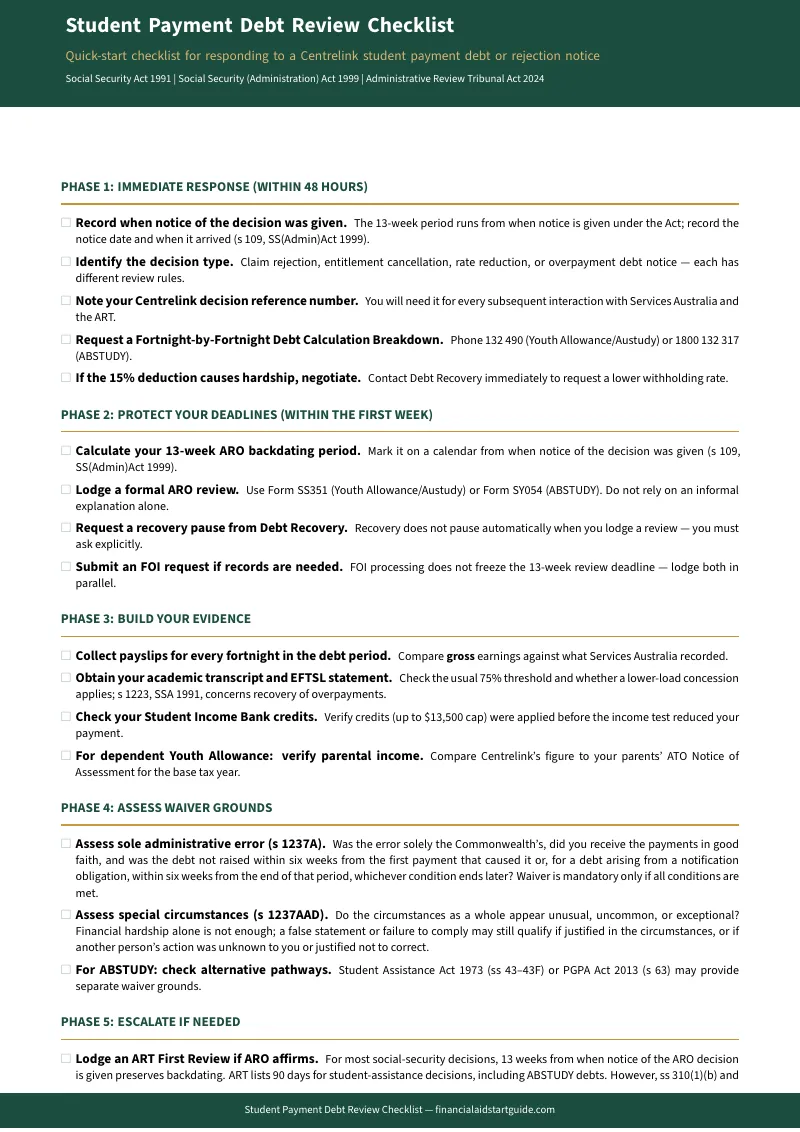
Download the free Student Payment Debt Review Checklist to start organising your case right now — it includes the key dates, deadlines, and free legal contacts for your state.
When you are ready for the full review preparation system — the worksheets, the evidence audit, the step-by-step ARO and ART guides, and the repayment management tools — the complete guide is available as a one-time purchase with instant download.
Frequently Asked Questions
What if the rules change after I buy?
We update the guide when the rules change. Email us any time, even years later, and we'll send you the current edition free.