The rules are scattered across dozens of pages. Your deadline is not.
Your child has a place at a boarding school hundreds of kilometres from home. Or you have been accepted into university and need living support while you study. Or you are starting an apprenticeship and need help covering tools and travel. ABSTUDY can help — but the information you need sits across the Services Australia website, the ABSTUDY Policy Manual (hundreds of pages written for public servants), scattered claim forms (SY018, SY019, SY021, SY032), and community forums where well-meaning advice from Youth Allowance threads gets the ABSTUDY rules wrong.
Submit an incomplete claim and it sits in an unassigned processing queue while your semester starts without you. Miss the 85% attendance threshold and your School Term Allowance is withheld for the following term. Report your partner's income incorrectly and your Living Allowance drops to zero without warning.
The ABSTUDY Claim Navigator puts every rule in one document — in plain language, with the evidence checklists, means-test worksheets, and travel-booking steps that turn scattered government pages into a claim you can prepare before you lodge.
What's inside the guide
- Award Selection Decision Chart — ABSTUDY has seven Awards: Schooling A, Schooling B, Tertiary, Part-time, Testing and Assessment, Masters and Doctorate, and Lawful Custody. Full-time Australian Apprentices are covered under the Tertiary Award. The chart walks you through your age, study level, and living situation to identify which Award applies, so you lodge the correct claim form from the start.
- Identity and Eligibility Chapter — explains the three elements of ABSTUDY status (descent, self-identification, community acceptance), that Centrelink normally accepts your declaration during the claim, and when it may request evidence if your status is uncertain. Claims stall when identity evidence does not meet the requirements — this chapter helps you prepare the right documents if they are requested.
- Income and Means Test Calculator Worksheet — a two-page printable for the parental income test (which tax year, the family threshold, the taper rates), the personal income test and Income Bank, and the partner income test: a 60-cents-per-dollar reduction above the applicable threshold for recipients aged 21 or younger and a 50-cents-per-dollar reduction for those aged 22 or older. Fill in your figures to estimate how income affects your Living Allowance before you lodge.
- Independence Assessment Guide — a one-page printable of the criteria for qualifying as independent under ABSTUDY policy, including the de facto relationship rules (which differ from Youth Allowance), Unreasonable to Live at Home provisions, and workforce independence. Tick every route that may apply and list the evidence you will lodge. If you qualify as independent, the parental income test does not apply — but declaring a partner triggers the partner income test.
- Boarding and School Fees Allowance Chapter — the higher School Fees Allowance rate for students living away from home and what documentation the boarding school needs to provide. The guide also explains the School Term Allowance 85% attendance rule for eligible Schooling A students (applied to second and later payments, counting school-approved absences).
- Boarding and Travel Planning Sheet — a one-page landscape log for term travel (boarding school/hostel Travel Authorisation Booking form requests at least 10 days before individual travel, with urgent travel exceptions; Form SY032 for reimbursement) plus School Term Allowance attendance against the 85% rule for eligible Schooling A students. Boarding families coordinate multiple trips per year — the sheet tracks their travel booking windows and SY032 lodgement; families claiming School Term Allowance can use it to track attendance.
- Incidentals and Supplementary Allowances — which allowances are paid automatically and which require a separate application, Incidentals Allowance for apprentice tools and equipment, and the payments most applicants do not know they can claim.
- Document Collation Checklist — a one-page printable of identity, enrolment, income, independence, boarding, fares and incidentals evidence, with columns for date lodged and how it was lodged. A complete pack avoids the processing-hold queue.
- Claim Tracking Log — a one-page landscape log for every call, myGov upload and service-centre visit: date, channel, officer or reference number, what was discussed, and the follow-up due date.
- Claiming Through myGov Step-by-Step — supporting documents, early claims up to 13 weeks, and phone or in-person options. SY018 is for parent/carer claims for secondary students aged 15 or younger at home, or primary students aged 14 on 1 January. Secondary students at home attending non-government schools use SY019. SY019 is also the general form for secondary, tertiary and Australian Apprentice claims. Remote-area school boarders aged 15 or younger use SY092; part-time claims, full-time student or apprentice Incidentals Allowance claims, and Testing and Assessment claims use SY021; lawful-custody claims use SY022, with the course provider completing SY108 for essential course-cost reimbursement.
- Review and Appeal Preparation Guide — a one-page printable for requesting a formal review (no time limit on ABSTUDY eligibility decisions), the Authorised Review Officer pathway within Services Australia, Ministerial review for eligibility decisions, and Administrative Review Tribunal applications for debt-recovery decisions under the Student Assistance Act 1973 (90-day deadline). Tick the route that applies and list the evidence and dates; free legal help is listed through Economic Justice Australia and Welfare Rights Centres.
Who this guide is for
- Parents and guardians of secondary students — especially boarding families coordinating School Fees Allowance and travel bookings, and Schooling A families tracking School Term Allowance attendance
- Dependent tertiary students and their parents preparing the parental income test for the first time
- Independent or estranged students establishing independence through de facto relationship, Unreasonable to Live at Home, or other criteria
- Adult returners and postgraduate students checking whether a Masters or Graduate Diploma qualifies and how partner income affects their payment
- Australian Apprentices claiming Incidentals Allowance and reporting casual earnings alongside training wages
- Community advocates and Aboriginal student support officers helping multiple students organise their claims
Why the free information isn't enough
The Services Australia website is accurate — but it was not built for first-time applicants. Eligibility rules sit on one page, the means-test thresholds on another, boarding school fees on a third, and the fares booking process on a fourth. The ABSTUDY Policy Manual is comprehensive but runs to hundreds of pages of policy language designed for Centrelink decision-makers. Community forums try to fill the gap, but users routinely apply Youth Allowance rules to ABSTUDY — ABSTUDY eligibility follows its Policy Manual, while overpayment recovery is covered by the Student Assistance Act 1973. Youth Allowance and Austudy are governed by the Social Security Act 1991, and their eligibility, independence, and review rules differ in ways that matter.
The ABSTUDY Claim Navigator takes the official rules and puts them in the order you will meet them: identify which Award applies, check your eligibility and identity evidence, work through the means tests, prepare your boarding and travel documentation, lodge with confidence, and know exactly what to do if the answer is no.
Your claim, step by step
Start with the Award Selection Decision Chart to confirm which ABSTUDY Award applies. Then work through the identity and eligibility chapter to understand the three status criteria and when Centrelink may request evidence if your status is uncertain. Use the Income and Means Test Calculator Worksheet to estimate your payment — the parental, personal, or partner income test, depending on your situation. If you are a boarding family, the Boarding and Travel Planning Sheet tracks your travel booking windows and SY032 claims. If you claim School Term Allowance, use it to track attendance against the 85% rule. Assemble evidence on the Document Collation Checklist, then the claiming chapter walks you through myGov submission. Record every contact on the Claim Tracking Log.
If your claim is rejected, your payment is suspended, or you receive a debt notice, the Review and Appeal Preparation Guide and the review chapters cover the formal process — from Authorised Review Officer request through to Ministerial review or the Administrative Review Tribunal — with the timeframes and free legal referrals at each stage.
Satisfaction guarantee
Full refund, no time limit. If the guide is not what you expected, email [email protected] and we will refund you — no questions, no deadline.
Free checklist or the full guide?
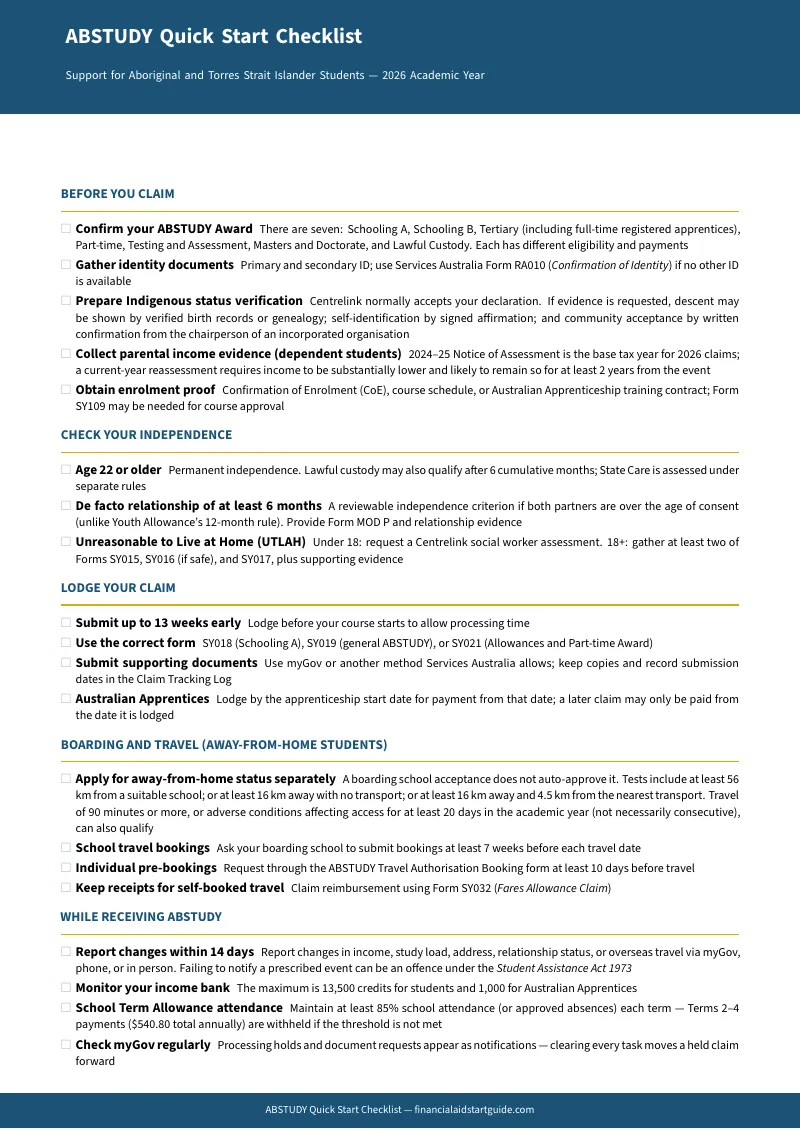
The free ABSTUDY Checklist gives you a summary of the ABSTUDY Awards, the key evidence needed for each, and the basic claim steps. It is a good starting point if you want to see what is involved before committing.
The full guide goes further: the Income and Means Test Calculator Worksheet, the Independence Assessment Guide, the Document Collation Checklist, the Boarding and Travel Planning Sheet, the Claim Tracking Log, and the Review and Appeal Preparation Guide. It is a one-time purchase — — with a full refund, no time limit.
Independent educational publication. Not affiliated with, endorsed by, or connected to Services Australia, Centrelink, the Department of Social Services, or any Australian Government agency, educational institution, or Aboriginal and Torres Strait Islander organisation. Free help is available from the ABSTUDY phone line (1800 132 317), university and TAFE Indigenous student support units, and pro bono legal services at Economic Justice Australia and Welfare Rights Centres.
Frequently Asked Questions
What if the rules change after I buy?
We update the guide when the rules change. Email us any time, even years later, and we'll send you the current edition free.