Your parents' income decides your Student Allowance — and the rules are harder than they look
If you're under 24, have no supported children, and are applying for a Student Allowance in New Zealand, StudyLink tests your parents' combined gross income against a set of thresholds that change every April. The parental-income reduction uses two rates: 30.30303% on the first band above the threshold and 27.93296% on income above that band — and the allowance drops to zero at the relevant cut-off.
The problem isn't finding the thresholds. They're on the StudyLink website. The problem is everything around them: how business income, trust distributions, and PIE returns count differently from wages. How the sibling deduction and separated-household deduction shift the effective cut-off. What happens when a parent loses a job or a contract mid-year. Which form to lodge, when, and with what evidence — and what to do if StudyLink says no.
Official pages explain each rule on its own page, in its own language, without showing you how the pieces fit together or what order to work through them. Free calculators give you a yes-or-no answer but can't tell you why, or what to change.
The Parental Income Navigator — every threshold, deduction, and form in one reference
The StudyLink Student Allowance Guide puts the entire parental income test into a single walkthrough: the current-year thresholds, the abatement formula, the deductions that adjust them for your family, the documents StudyLink needs, and the steps for when circumstances change or a decision goes wrong.
This isn't a summary of the StudyLink website. It's the process in the order you actually meet it — from checking whether you qualify, through preparing your parents' income evidence, to requesting a review if the numbers don't work out the way you expected.
What's inside the guide
- Current-year parental income thresholds — the abatement start, the living-at-home and living-away cut-offs, and how the 30.30303% and 27.93296% abatement rates calculate the reduction between them, with three worked examples showing different family incomes
- Complex income types explained — how StudyLink treats business drawings, trust distributions, PIE income, fringe benefits, and rental income under the Family Scheme Income definition, so parents know what goes on the form and what doesn't
- Sibling and separated-household deductions — the $7,000-per-sibling and $3,400 deductions that shift the effective threshold, with a calculation matrix for multi-student families
- The 25% income-drop reassessment — a step-by-step workflow for the Reassessment of Parents' Income form, including how to calculate whether the drop meets the 25% threshold, what "already realised" means, timing, and the documents that prove the change
- Your own earnings and your partner's income — the weekly personal income limit, the dollar-for-dollar reduction above it, the partner income cut-off, and how Student Loan living costs can top up a reduced allowance
- Accommodation Benefit — who qualifies, how much, and how it differs from the Accommodation Supplement that non-students apply for through Work and Income
- Document checklist matched to each form — what to upload through Connect for the initial application, the Parents' Form, and the reassessment, paired with the student identity documents StudyLink asks for
- The weeks limit — 200 weeks for students under 40, 120 weeks for students aged 40 or over at the start of study, and how to check your remaining entitlement
- Academic progress rules — the pass-more-than-half test, what happens if you fail it, and the circumstances-beyond-your-control exception
- Reviews and appeals — the Review of Decision process, the three-month deadline, the Student Allowance Appeal Authority, and what evidence to prepare
- Contacts and free help — StudyLink, your university's financial adviser, Citizens Advice Bureau, and Community Law Centres
Who this guide is for
- Parents completing the Parents' Form — if you're declaring household income that includes anything beyond simple PAYE wages, the guide explains which income types count and how to fill in each field
- School leavers applying for the first time — the process from first application through to your first weekly payment, in order
- Families whose income has dropped — redundancy, reduced business income, or loss of a contract: the guide walks you through the mid-year reassessment form and the evidence it needs
- Multi-student families — how to apply the sibling deduction correctly when two or more children are studying at the same time
- Students working part-time — how much you can earn before the allowance is reduced, and what happens when you go over
- Anyone whose application was declined or put on hold — the review process, the deadlines, and what to do next
Why not just read the StudyLink website?
You can. Every rule in this guide comes from public sources — StudyLink, Work and Income, and New Zealand legislation. Nothing here is proprietary.
The gap is structure. StudyLink's parental income rules are spread across a glossary entry, a downloadable PDF form, a separate rate table on the Work and Income MAP site, and a reassessment form with its own instructions. The accommodation benefit is on one page; the review process is in a different section entirely. Free calculators tell you whether you qualify but not why, and not what to change if you don't.
This guide puts the rules in the order you work through them, pairs every form with the documents it needs, includes worked examples for the abatement calculation, and covers what to do when a decision doesn't go your way — so you can prepare everything at home, at your own pace, without calling the helpline for each question.
What this guide does not do
This is a process guide, not a promise. It cannot guarantee a Student Allowance, predict a specific weekly amount, or change your family's assessed income. It has no affiliation with StudyLink, the Ministry of Social Development, Inland Revenue, or any tertiary institution. It does not provide financial or legal advice. If you disagree with a decision, the guide explains the review steps and points you to free advice services. Community Law Centres offer free initial legal help to eligible people; representation in court or tribunals is available only in a small number of eligible cases.
Printable tools you can use beside the forms
The guide comes with seven standalone PDFs designed to be printed and filled in while you work through the process: a parental income calculation worksheet, an abatement calculator for both living-at-home and living-away formulas, a reassessment evidence checklist for the 25% income-drop form, an application document tracker, an agency communication log, a key forms reference card, and a free help contacts sheet. Each one stands on its own — print what you need and keep it beside you while you fill in the forms.
The free checklist covers the basics — the full guide covers the hard parts
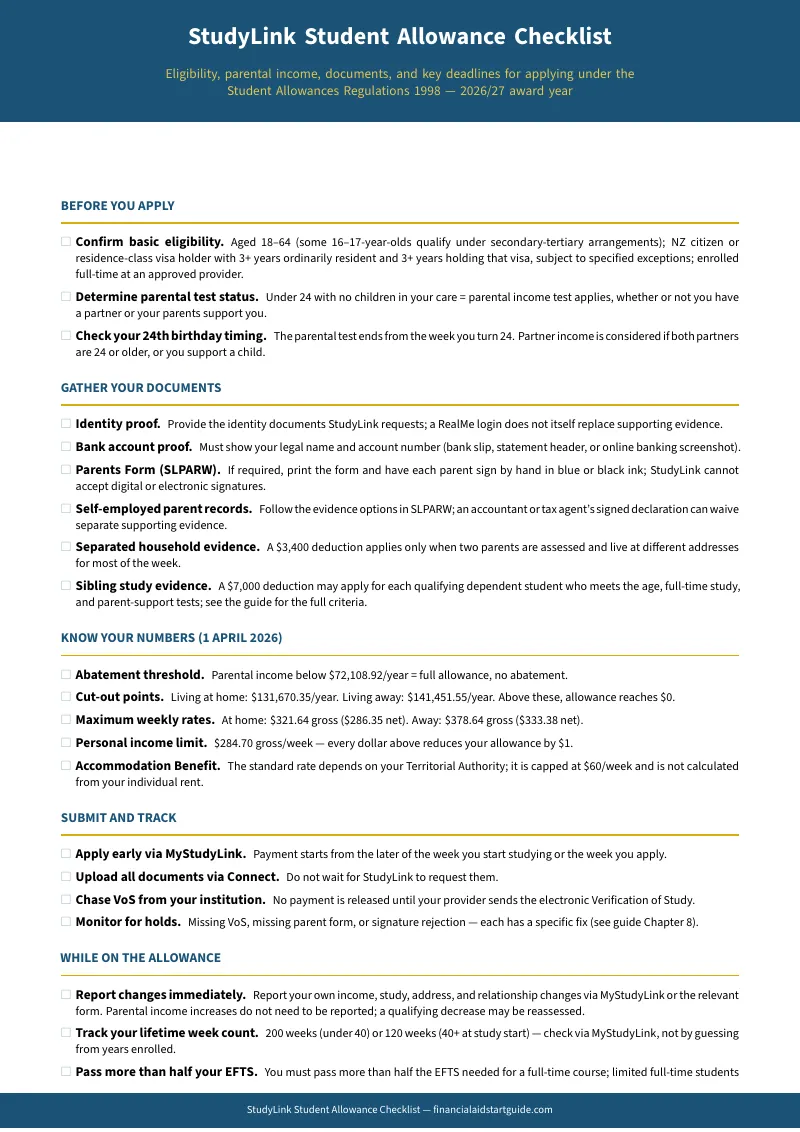
Download the free Student Allowance Checklist for a 25-item summary of the eligibility tests, current thresholds, and a document list. It's enough to check whether you're likely to qualify and to start gathering paperwork.
The full guide goes further: worked income examples, the reassessment workflow for income drops, the sibling deduction matrix, the payment-hold diagnostic, the step-by-step review process, and all seven printable tools. For families with straightforward PAYE incomes, the checklist may be all you need. For everyone else — business income, trust distributions, mid-year changes, or a declined application — the guide is where the answers are.
Full refund, no time limit. Questions: [email protected].
Frequently Asked Questions
What if the rules change after I buy?
We update the guide when the rules change. Email us any time, even years later, and we'll send you the current edition free.