Your OSAP Assessment Is Wrong — and the Fix Has a Deadline
Your parent lost their job in March. Your OSAP assessment still uses last year's income — the year they were earning full salary. The resulting funding gap means you are short on tuition, short on rent, and staring at a September deadline that the Ministry will not extend because you filed the wrong form.
Ontario has a review process for exactly this situation. There are forms for reduced income, for unusual expenses, for living allowance adjustments. There are separate pathways for students who cannot get parental information, for students whose parents refuse to cooperate, and for students whose funding was restricted after a bad term. But the forms are scattered across the OSAP portal, institution-specific PDFs, and policy pages that describe the rules without showing the steps.
Filing the wrong form wastes weeks. If the Ministry requests income verification, the 2026–27 form and required documents must be received within 12 months of your study period start. If the income cannot be verified, your Ontario Student Grant may be converted to a loan. An unverified estimate can add long-term loan debt.
The OSAP Review Route System
This guide is built around a single idea: every review situation maps to a specific form, a specific evidence set, and a specific institutional pathway. The OSAP Review Route System connects your circumstances to the exact steps — not general advice about "contacting your financial aid office," but the form title, the documents that satisfy the Ministry's verification standard, and the deadline that governs your submission.
The Review Route Decision Matrix
A structured decision tree that matches your situation — parental job loss, medical leave, retirement, step-parent non-support, estrangement, course failure — to the official review form and the office that processes it. Most students waste their first appointment at the financial aid office describing their problem and being redirected. The matrix gets you to the right form before you walk in.
The Auditor Evidence Checklist
Every lower estimated income review is subject to Ministry verification through CRA or other means. The guide breaks down exactly what "supporting documentation" means for each scenario: which employer letters need specific dates and dollar figures, what CRA income information the Ministry may use, what medical documentation must include to qualify, and how to organise an evidence package for verification before the 12-month submission deadline.
The Federal/Provincial Dependency Split Chart
If you graduated high school four years ago, you are independent for federal OSAP funding. If you graduated six years ago, you are independent for both federal and provincial. Between four and six years, you are split — independent for one, dependent for the other. The chart maps graduation dates to dependency status across both systems, including the 24-month full-time work exemption and the married or common-law override, so you know which portion of your funding depends on parental income and which does not.
The Appeal Tracking Log
Academic progress appeals and income reviews involve multiple submissions, acknowledgement codes, and institutional deadlines — including the rule that full-time review documents must be received at least 40 days before the end of the study period. The tracking log keeps every submission date, document list, and follow-up milestone in one place, so nothing falls through when you are managing classes, work, and a bureaucratic process simultaneously.
What's Inside the Guide
- The OSAP review architecture — how provincial reviews, institutional appeals, and federal reassessments interact, and which office has authority over which decision
- Lower estimated income reviews — the current form, line-by-line evidence requirements, the CRA verification process, and the grant-to-loan conversion risk if verification fails within 12 months
- Independent student status — the federal 4-year test, the provincial 6-year test, the 24-month full-time work exemption, extenuating parental circumstances, and what happens when parents refuse to provide information
- Academic progress restrictions — how probation escalates to restriction, the institutional appeal process, what documentation supports a review after restriction, and the 40-day submission deadline
- Overpayment and recovery — how over-awards happen, the repayment process, and the pathway to restoring funding eligibility
- 2026–27 policy changes — the provincial grant-to-loan ratio shift, the current pause on private postsecondary OSAP funding, and how these affect review calculations
- Disability-related reviews — the Bursary for Students with Disabilities, the 40% course load threshold for students with permanent or persistent disabilities, and documentation standards
- Institutional variation — how review forms, deadlines, and appeal processes differ between large urban universities, regional colleges, and private career institutions
- 5 printable worksheets — review route decision matrix, auditor evidence checklist, federal/provincial dependency split chart, appeal tracking log, and income projection worksheet
Who This Guide Is For
- Students and parents reporting an income drop — job loss, medical leave, retirement, or business closure that makes last year's tax return irrelevant to this year's reality
- Students navigating independence rules — between 4 and 6 years out of high school, or needing the 24-month work exemption, and unsure which funding components still require parental information
- Estranged students and students with uncooperative parents — who need to understand the extenuating parental circumstances process and what it can and cannot override
- Students on academic probation or restriction — who need a structured framework for the institutional appeal, including how to document medical, family, or personal circumstances
- Students with an overpayment notice — who need to understand the recovery timeline and the steps to restore funding eligibility
Why Not Just Use the Free Resources?
Every review form in this guide is publicly available through the OSAP portal. The rules are published on Ontario.ca. Your school's financial aid office can answer questions if you study in Ontario; the Ministry handles questions for students studying outside Ontario.
The problem is not access. The problem is that the review form tells you to provide "supporting documentation" without defining what the Ministry considers sufficient. The OSAP portal warns that unverified income may lead to grant-to-loan conversion; this guide connects that deadline to the evidence checklist for each income-change situation. Your institution publishes its own submission deadlines and internal codes without mapping them to the provincial rules. And when September hits, the financial aid office queue stretches into weeks — and every week you wait is a week closer to the verification deadline.
This guide does not replace any of those resources. It is the preparation layer: a single document that connects the forms to the evidence standards, maps your situation to the right pathway, and lays out the deadlines before you are in a queue trying to figure out which form you need.
Backed by a Full Refund, No Time Limit
If the guide does not help you navigate your OSAP review or appeal, email [email protected] for a full refund. No forms, no time limit, no questions.
Start With the Free Checklist
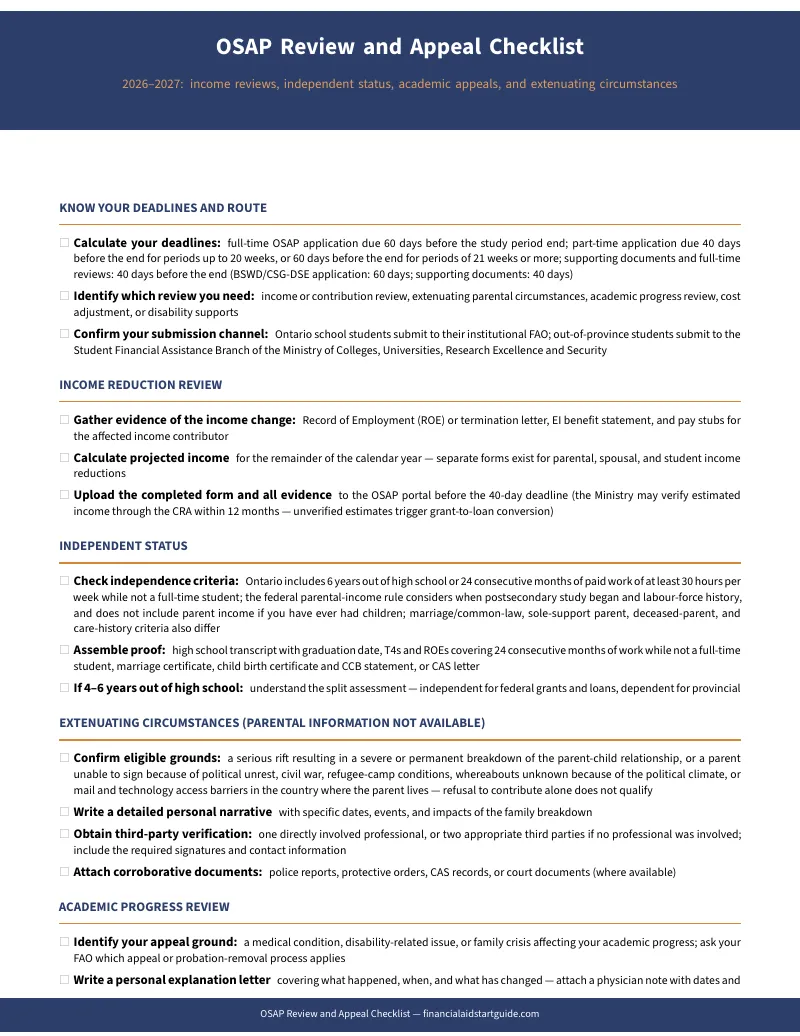
The free OSAP Review and Appeal Checklist covers the review forms, the evidence requirements, and the key deadlines in a quick-reference format. Download it now and use it as a starting point. If you want the full guide — with the decision matrix, the evidence audit checklists, the dependency split chart, and the academic appeal framework — it is available on this page.
Frequently Asked Questions
Is this an official government guide?
No. This is an independent educational publication. It is not affiliated with the Ministry of Colleges, Universities, Research Excellence and Security, OSAP, the NSLSC, or any postsecondary institution. Official forms and government resources are referenced throughout.
Will this guide guarantee I get more funding?
No. Your school's financial aid office handles review forms if you study in Ontario; the Ministry handles them if you study outside Ontario. A review can leave your funding unchanged or change the amount you receive. If parent income cannot be verified, an Ontario Student Grant may be converted to a loan. The guide helps you submit the right form with the right evidence; it cannot control the outcome.
Can this guide help if my parent refuses to provide income information?
The guide explains the extenuating parental circumstances process and the criteria under which OSAP may proceed without parental information. It also clearly states that arbitrary parental refusal — a parent who earns enough but chooses not to contribute — is not grounds for an exception under current policy. The guide covers the realistic alternatives for students in that situation, including institutional bursaries and the independence tests.
Does the guide cover the 2026–27 changes?
Yes. Every form reference, deadline, and policy rule in the guide reflects the 2026–27 academic year, including the provincial grant-to-loan ratio shift, the pause on private postsecondary OSAP funding, and the current income-verification deadline.
I need help with my initial OSAP application, not a review. Is this the right guide?
The OSAP application guide covers the full application from eligibility through disbursement. This guide picks up where that one leaves off — when an assessment needs correcting, an income change needs reporting, or a restriction needs appealing.
What is the refund policy?
Full refund, no time limit. Email [email protected] and we will process it.
Frequently Asked Questions
What if the rules change after I buy?
We update the guide when the rules change. Email us any time, even years later, and we'll send you the current edition free.