Ontario Changed OSAP — Your Application Shouldn't Be a Guessing Game
Provincial grants capped at 25 percent. The tuition freeze lifted. Federal grant eligibility also changed for most full-time students at private, for-profit schools. If you are applying for OSAP for the 2026–2027 year, the stakes of getting your application wrong just got higher — and the information you need is scattered across Ontario.ca, Canada.ca, the NSLSC, and your institution's financial aid office.
A missed tax line on a parent verification form creates a hold. A hold delays your disbursement. A delayed disbursement means you are covering tuition and rent out of pocket while the bureaucracy catches up. None of this is hypothetical — it is the single most common complaint on r/osap every September.
The OSAP Application Clarity System
This guide puts the entire OSAP application process in one place, in the order you will actually encounter it — from eligibility rules through disbursement and the hand-off to repayment. It is built around three tools that do what no government portal does: connect the steps, explain the formula, and tell you who to call when something stalls.
Tool 1: The Application and Verification Flow Matrix
A sequential task schedule mapping every step from OSAP Access Number creation to final disbursement. Each step shows exactly which documents are needed, which tax lines to check, and whether the task falls to the student or the parent. No more toggling between the OSAP portal, CRA records, and your institution's website trying to figure out what goes where.
Tool 2: The Integrated Award Breakdown
The 2026 changes affected the provincial portion of your OSAP assessment — not the federal portion. Most students do not know this, and most online summaries do not explain it. This guide breaks down how federal Canada Student Grants and federal loans combine with the new 25 percent provincial grant cap to form your total Notice of Assessment. Two worked examples show the formula in action so you can follow the arithmetic behind your own number.
Tool 3: The Hold Diagnostic Map
When your OSAP dashboard shows a hold, the portal does not tell you which office created it or what it needs. The guide maps each common dashboard status to the responsible body — Ministry of Colleges, Universities, Research Excellence and Security, the NSLSC, or your institution's financial aid office — and the specific documents or actions needed to clear it. You stop guessing and start with the right office.
What's Inside the Guide
- The 2026 changes explained — what the 25 percent provincial grant cap, removal of provincial grants for career colleges, and tuition freeze lift actually mean for your package, with a comparison table showing pre-2026 and post-2026 rules side by side
- Eligibility and residency — citizenship, the 12-month Ontario residency test, study load categories (full-time, part-time, disability stream, micro-credential), and approved institution requirements
- The need assessment formula — how OSAP calculates educational costs and resources, the federal and provincial assessment interaction, and where most applicants' expectations diverge from the actual number
- Dependency and independence — the federal 4-year rule versus the provincial 6-year rule, split status situations, the extenuating parental circumstances process, and married or common-law status
- Parent-student task coordination — which tax lines, forms, and signatures each household member is responsible for, so nothing slips through the gap between "I thought you did that" and a verification hold
- MSFAA and Confirmation of Enrolment — signing the Master Student Financial Assistance Agreement, confirming enrolment through your institution, and the timeline for each step
- Disbursement timing and holds — how the two-stage split disbursement works (tuition and other school fees to the institution, remaining funds to your bank), common hold types, and the diagnostic map
- Grant-to-loan conversion — how reassessment after a course drop or academic standing issue can convert grants to loans, and the conditions that trigger it
- Special circumstances reviews — income change reviews, living allowance adjustments, and when to use the formal review process (with a hand-off to the reviews and appeals guide for the full procedure)
- Repayment basics — the 0 percent federal interest rate, Ontario's prime-plus-one rate after the grace period, Ontario-paid interest through the payment trigger date, and the hand-off to the Canada student grants and loans guide for RAP and consolidation
- 7 printable worksheets — application flow matrix, parent-student task matrix, hold diagnostic map and worksheet, financial comparison worksheet, grant-vs-loan tracker, and agency communication log
Who This Guide Is For
- First-time OSAP applicants who want to get it right the first time instead of troubleshooting a hold in September
- Parents supplying income verification who need to know exactly which CRA lines, consent forms, and signature steps are required
- Students reapplying after the 2026 changes who want to understand what shifted in their assessment and why
- Adult learners and student parents navigating independence rules, dependant grants, and part-time versus full-time thresholds
- Anyone stuck on an OSAP hold who cannot figure out which office to contact or what document is missing
Why Not Just Use the Free Resources?
Every rule in this guide is publicly available — across the OSAP portal, Canada.ca, the NSLSC, your institution's registrar, and CRA tax references. The problem is not access. The problem is that these sources describe each rule on its own page, in its own terminology, without showing how the steps connect or what to do when something stalls.
The OSAP portal gives you a blank Parent Income Verification form — but not which CRA tax lines to enter or what "non-taxable income" means in this context. Canada.ca explains federal grant eligibility — but not how it combines with the provincial cap in your integrated assessment. Your financial aid office answers questions during business hours — but in September, wait times stretch into weeks, and they cannot fill out your forms for you.
This guide is not a replacement for those resources. It is the layer that connects them: a single sequential workflow with checklists, worked examples, and a diagnostic map, so you arrive at each step prepared instead of discovering what you missed after a hold appears.
Backed by a Full Refund, No Time Limit
If the guide does not help you navigate your OSAP application, email [email protected] for a full refund. No forms, no time limit, no questions.
Start With the Free Checklist
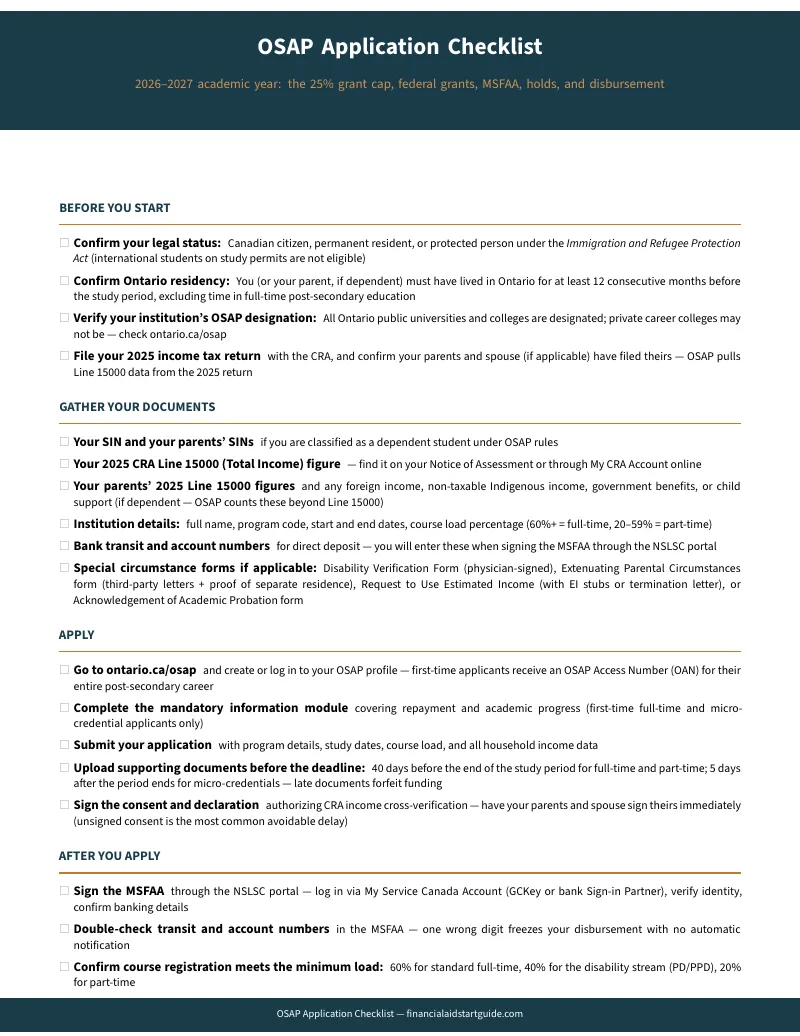
The free OSAP Application Checklist covers the key steps, deadlines, and documents in a two-page format. Download it now and use it alongside the OSAP portal. If you want the full guide — with the worked examples, the hold diagnostic map, and the parent-student task matrix — it is available on this page.
Frequently Asked Questions
Is this an official government guide?
No. This is an independent educational publication. It is not affiliated with the Ministry of Colleges, Universities, Research Excellence and Security, OSAP, the NSLSC, or any postsecondary institution. Official forms and government resources are referenced throughout the guide.
Does the guide apply to private career college students?
Yes. Chapter 1 explains the separate rules for private career college students under the 2026 changes, including the elimination of provincial grants and the federal restriction that makes most full-time students at private, for-profit schools ineligible for the Canada Student Grant for Full-Time Students, though some programs are exempt.
Can the guide tell me exactly how much OSAP I will get?
The guide explains the need assessment formula and includes two worked examples. Your actual award depends on your household income, educational costs, and other factors that only OSAP's system can compute. The guide shows you which inputs drive the number so you can understand your assessment when it arrives.
What if I am an independent student?
The guide covers both the federal 4-year independence test and the provincial 6-year test, including split-status situations and the extenuating parental circumstances process for students who are estranged from their parents.
I already applied and my funding is stuck on a hold. Will this help?
Yes. The hold diagnostic map in the guide matches common OSAP dashboard statuses to the office responsible for clearing them and the documents or actions required. It is designed for exactly this situation.
What is the refund policy?
Full refund, no time limit. Email [email protected] and we will process it.
Frequently Asked Questions
What if the rules change after I buy?
We update the guide when the rules change. Email us any time, even years later, and we'll send you the current edition free.