Claim Every Wisconsin State Grant You Qualify For — Without Missing a Hidden Nomination, Sector Cutoff, or Appeal Route
If you are trying to pay for college in Wisconsin, you have probably already discovered the frustrating truth: there is no single Wisconsin state financial aid portal.
Instead, your money is split across the federal FAFSA, the Higher Educational Aids Board (HEAB), four separate Wisconsin Grant sectors with their own annual funding caps, high school GLASS nominations, regional WEOP offices, campus-level tuition promises, and campus-specific residency offices. National sites tell you Wisconsin has "no fixed state deadline" — while private non-profit and technical college grant funds quietly run dry mid-year for late filers.
Families lose thousands of dollars in gift aid not because they were ineligible, but because nobody showed them how Wisconsin's pieces actually fit together: which awards come automatically from the FAFSA, which require a separate high school or WEOP nomination, how part-time credits count against the 10-semester cap, and which office has legal authority when an award is cut or an out-of-state tuition bill arrives.
Introducing the Wisconsin Three-Part Aid System
College Financial Aid in Wisconsin: State Grants, Deadlines and Appeals is a 50-page plain-language reference and planning system built specifically around Wisconsin's statutes and 2026–27 HEAB formulas. Instead of sending you down a rabbit hole of disconnected agency pages, it organizes everything into three working tools:
- The Wisconsin State Aid Source Map — every active HEAB grant, statutory remission, and campus tuition promise mapped by sector, eligibility rule, and lifetime limit.
- The Dual-Year Application & Renewal Calendar (2026–27 and 2027–28) — every FAFSA opening date, high school GLASS nomination window, September 30 enrollment claim deadline, and HEAB awarded-through cutoff in chronological order.
- The Lost-Award Routing Checklist — a step-by-step diagnostic that matches every aid problem (income drop, SAP suspension, residency dispute, verification hold, or lien hold) to the exact office with authority and the third-party proof they ask for.
What's Inside the Complete Guide
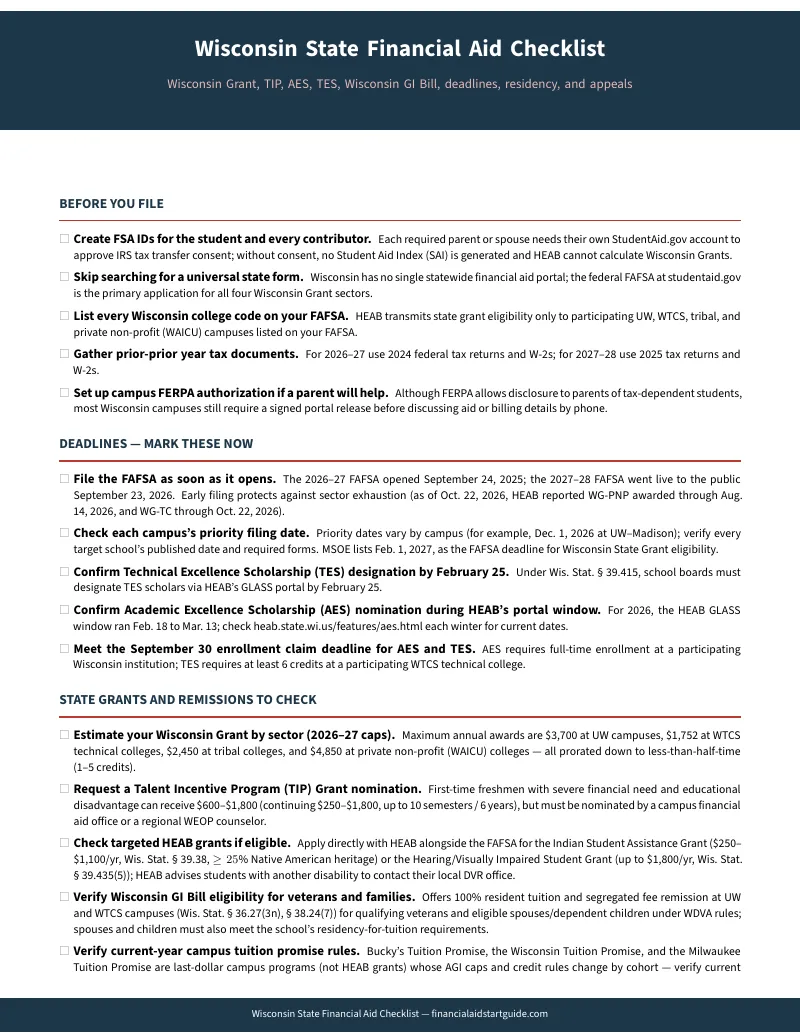
- All Four Wisconsin Grant Sectors & 2026–27 Formulas — because the maximum annual award changes sharply by sector ($3,700 at UW campuses, $1,752 at WTCS technical colleges, $2,450 at tribal colleges, and $4,850 at WAICU private non-profit colleges), and knowing how HEAB prorates awards down to 1–5 credits prevents you from leaving money on the table as a part-time or certificate student.
- Hidden Nomination & Merit Awards (TIP, AES, and TES) — because the Talent Incentive Program ($600–$1,800 initial freshman award, $250–$1,800 continuing) requires a campus aid office or regional WEOP counselor nomination for an initial award, while continuing awards require ongoing financial need, and high school Academic and Technical Excellence Scholarships require GLASS designation and September 30 enrollment claims.
- Targeted Grants, Veteran Remissions & Closed-Program Warnings — covers the Indian Student Assistance Grant ($250–$1,100), the Hearing/Visually Impaired Student Grant (up to $1,800), the Wisconsin GI Bill 100% resident tuition and fee remission for qualifying veterans and eligible family members, and what changed after the June 18, 2026 Wisconsin Supreme Court injunction on the Minority Undergraduate Retention Grant so you never waste time applying for an enjoined program.
- Campus Tuition Promises vs. Statutory State Grants — explains how last-dollar programs like Bucky's Tuition Promise, the Wisconsin Tuition Promise, and the Milwaukee Tuition Promise stack after federal Pell and HEAB grants, and what cohort rules to verify directly on each campus's aid site.
- Three Worked Stacking Examples Across Sectors — concrete side-by-side numbers for a UW System student (full-time vs. three-quarter time), a half-time WTCS adult returner, and a cross-sector offer comparison, so you can see true remaining Cost of Attendance before committing to loans.
- Wisconsin Residency & Tuition Classification — covers the 12-month bona fide domicile standard for UW campuses under Wis. Stat. § 36.27(2), which campus office to contact, and the separate WTCS residency process under Wis. Admin. Code ch. TCS 10.
- Renewal Clocks, 10-Semester FTE Caps & Administrative Holds — shows how part-time terms count fractionally toward the 10-semester Wisconsin Grant limit, how mid-year transfers must re-certify grants, and how to clear verification or Wis. Stat. § 49.854 child support lien holds.
- Appeals & Professional Judgment Playbook — structured checklists and documentation guides for Special Circumstances income-drop reviews (HEA Section 479A), Satisfactory Academic Progress (SAP) appeals and academic recovery plans, and campus-specific residency petitions.
- Six Printable Worksheets & Trackers — ready-to-print planning sheets for mapping state grants, tracking deadlines, comparing three college offers side by side, logging your 10-semester FTE cap, organizing an appeal file, and recording every call with HEAB, WEOP, or your campus aid office.
Who This Guide Is For
- Wisconsin high school seniors and parents comparing UW campuses, WTCS technical colleges, tribal colleges, and WAICU private colleges who want every grant and nomination accounted for before priority cutoffs hit.
- Technical college, part-time, and adult returning students who assume state grants are only for full-time 18-year-olds — and need the exact credit-load proration and independent student rules.
- Transfer and continuing students protecting multi-year aid against SAP drops, mid-year transfer gaps, or the 10-semester FTE lifetime limit.
- Families dealing with a recent income drop, aid suspension, or out-of-state tuition bill who want to walk into the right office with complete third-party documentation on the first try.
Why Not Just Piece It Together From Free Websites?
Every rule in this guide comes from public statutes and official pages — and we list every free official resource (HEAB, regional WEOP offices, College Goal Wisconsin, and your campus financial aid office) right inside the guide. You never have to buy a guide to apply for financial aid.
The problem with piecing it together yourself is fragmentation:
- StudentAid.gov covers federal Pell and loans, then tells you to ask your state for everything else.
- HEAB's website publishes statutory codes and board memos, but does not walk you through campus tuition promise stacking, campus-specific residency petitions, or SAP academic recovery plans.
- Generic national templates and forums still repeat outdated pre-2024 EFC rules, miss Wisconsin's four-sector grant formulas, and never mention GLASS nomination windows or the June 2026 court injunction.
This guide does the cross-referencing once, dates every rule and formula to the 2026–27 and 2027–28 aid years, and puts every step in the exact order you will meet it.
Independent, Transparent, and Risk-Free
Full refund, no time limit. If this guide does not help your family navigate Wisconsin state financial aid with clarity, email [email protected] with your order details for a full refund.
Independent educational publication: Financial Aid Start Guide is not affiliated with HEAB, the Universities of Wisconsin, WTCS, WAICU, the U.S. Department of Education / Federal Student Aid, or any college. This guide provides plain-language process navigation — not financial, legal, or admissions advice — never suggests misstating income, household, or residency, and cannot promise any award or amount.
Start Today — Free Checklist or Complete Guide
Not ready for the full guide? Grab the free two-page Wisconsin State Financial Aid Checklist on this page for the core grants, deadlines, and official free contacts.
Want the complete 50-page Wisconsin guide, worked stacking examples, appeal documentation checklists, and printable trackers? Get instant access for a one-time payment — backed by a full refund, no time limit.
Frequently Asked Questions
What if the rules change after I buy?
We update the guide when the rules change. Email us any time, even years later, and we'll send you the current edition free.