Navigate Washington's State Financial Aid System Without Missing Deadlines, Residency Rules, or Campus Grants
Washington funds one of the strongest public financial aid systems in the country. For the 2026–27 award year, a family of four earning up to $83,500 qualifies for a full Washington College Grant (WA Grant) — up to $13,203 at the University of Washington, $12,700 at Washington State University, or $5,095 at public community and technical colleges — and partial awards scale all the way to $139,500.
Yet students and parents lose thousands in real aid every year for purely administrative reasons. Families file both the FAFSA and the WASFA and risk financial-aid processing delays. Seniors assume the WA Grant's state entitlement means deadlines do not matter, then miss a campus priority date and lose first consideration for some limited institutional aid; State Work Study awards depend on available funds and determined financial need. Transfers and recent arrivals who take more than six credits in a term at another Washington college during the prior 12 months must provide evidence that their Washington residence was for non-college reasons. Returning adults who drop classes can receive a prorated WA Grant if enrollment falls below full-time, and should track SAP and lifetime QEU limits.
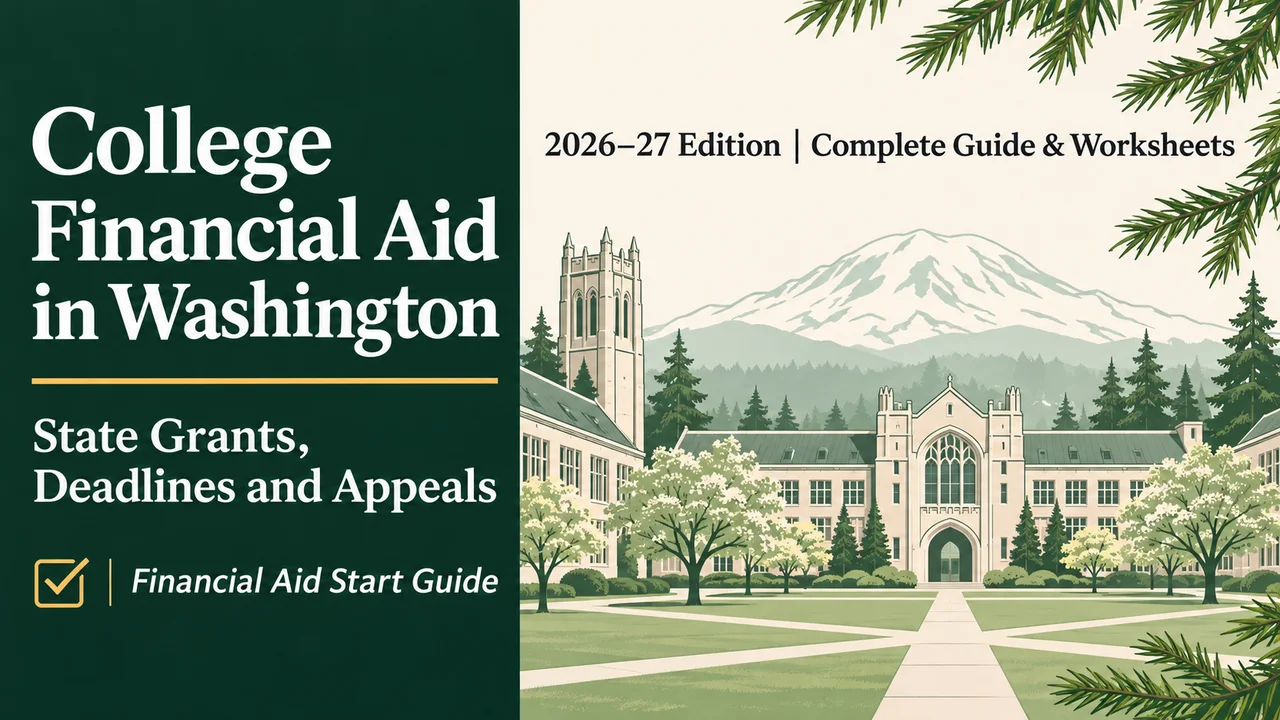
College Financial Aid in Washington: State Grants, Deadlines and Appeals gives you the Washington State Aid Workflow System — a 50-page, plain-language reference binder and worksheet kit that brings WSAC policy manuals, RCW residency statutes, FAFSA/WASFA portals, and campus appeal procedures into one ordered sequence.
What's Inside the Guide
- 2026–27 Washington MFI & Sector Award Tables — because federal Student Aid Index (SAI) formulas do not tell you your state grant amount. Look up your exact household Median Family Income bracket for both WA Grant (up to 100% MFI) and College Bound Scholarship (up to 65% MFI), and compare maximum awards across UW, WSU, regional universities, community and technical colleges, private institutions, and registered apprenticeships (WG-A).
- FAFSA vs. WASFA Decision Tree & Portal Guide — because filing both forms unnecessarily can delay your aid processing. Know which application you should file, how Washington privacy protections limit WASFA data sharing, how to prepare for the WASFA shift from Regent (2026–27) to Concourse (2027–28), and how to clear weekly holds in myUW, myWSU, and ctcLink.
- Campus Priority Deadline vs. State Entitlement Playbook — because while WA Grant is a statutory entitlement, some limited campus grants give first consideration to applicants by each school's priority date. State Work Study awards depend on available funds and determined financial need. Track each college's priority window alongside tuition-deferment steps if your file is still under review near payment due dates.
- SB 5194 Residency Affidavit & SB 5874 Military Residency Rules — because one misstep in your 12-month non-educational residence period can cost you in-state tuition and state grant access. Understand the six-credit limit for courses at another Washington college during the prior 12 months (excluding Running Start and College in the High School credits), standard student classification and domicile under WAC 250-18-020 and 250-18-030, financial independence under WAC 250-18-035, and military, tribal, and Oregon border-county exemptions.
- Workforce, Foster Youth & Targeted State Grants Directory — because WA Grant is not the only funding on the table. Screen for Passport to Careers (including SB 5963 maximum-WCG income eligibility for foster and unaccompanied homeless youth), SBCTC Opportunity Grant, Worker Retraining, BFET, Early Achievers, State Work Study, and local last-dollar programs like Seattle Promise.
- Three Worked Dollar Examples — follow step-by-step math for full-time vs. part-time WCG proration across MFI tiers, how a mid-year job loss shifts your WCG bracket through a Special Circumstances review, and how a half-time student tracks SAP completion pace and the WCG limit of 18 full-time quarters or 150% of program length, whichever is less.
- Campus Appeal & Escalation Routing Maps — because there is no central WSAC financial-aid appeal form. Know which campus office handles Special Circumstances (Professional Judgment) income drops, SAP suspensions and any Academic Plan your school requires, campus classifications under WAC 250-18-045, and court review of final classifications as contested cases under WAC 250-18-050 and chapter 34.05 RCW, plus which documents each school requests for its review.
- Nine Standalone Printable Worksheets & 2-Page Summary Checklist — print-ready tools covering application readiness, 2026–27 MFI estimation, campus priority dates, residency affidavit compliance, side-by-side aid offer comparison, Special Circumstances evidence packets, SAP appeal preparation, QEU renewal tracking, and a financial aid office communication log.
Who This Guide Is For
- Washington high school seniors and parents sorting out FAFSA, College Bound Scholarship rules, campus priority dates, and competing four-year and community college award offers.
- Community college, transfer, and adult returning students managing part-time credit proration, workforce grants via Start Next Quarter, SAP pace, lifetime QEU limits, or returning with prior federal loan defaults.
- Undocumented students and mixed-status families filing the WASFA and verifying eligibility under the Washington Higher Education Residency Affidavit.
- Former foster youth and unaccompanied homeless youth coordinating Passport to Careers, maximum-WCG rules, and campus designated liaisons.
Why Not Just Use Free Websites, Appeal Generators, or a Consultant?
Every Washington financial aid rule is public, and your campus financial aid office and the WSAC helpline (888-535-0747) are free to use — this guide points you to them at every hand-off. What free sources do not give you is a single, student-ready workflow:
- Official websites split the process across four silos: StudentAid.gov omits Washington grants and residency statutes; WSAC publishes state manuals without individual campus deadlines; and campus offices cannot build a personal filing binder for your family during peak registration.
- Automated AI appeal sites sell generic national letter templates that ignore Washington MFI tiers, College Bound matching, and RCW residency statutes — and campus committees decide appeals on documented evidence, not prose polish.
- Private financial aid consultants charge $500 to $3,500+ and focus mainly on high-net-worth private college planning rather than need-based Washington state grants.
- Lender-funded blogs summarize grants at a high level while steering readers toward private student loans.
Independent notice: Financial Aid Start Guide is an independent publisher. We are not affiliated with WSAC, the U.S. Department of Education, Federal Student Aid, any college, or any lender. This guide provides plain-language process navigation — not legal or financial advice — and cannot promise any award, amount, or appeal outcome.
Full Refund, No Time Limit
Every purchase is covered by a full refund, no time limit. If the guide does not save you time or make Washington's financial aid process clearer, email [email protected] and we will refund you in full.
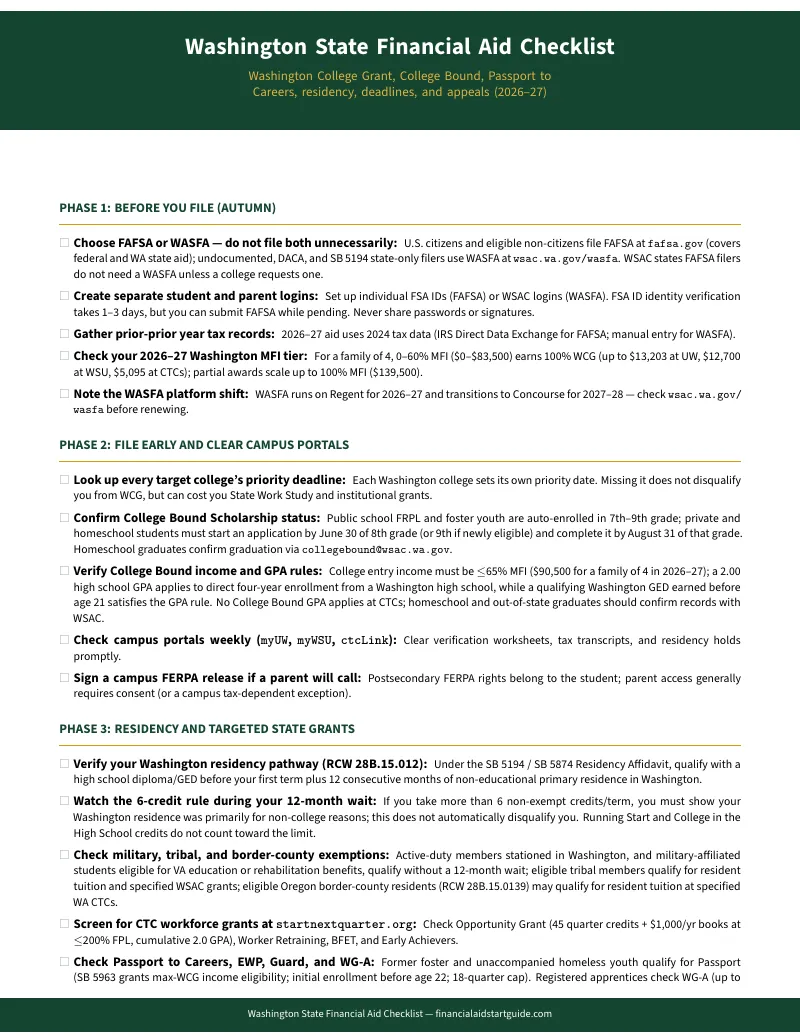
Ready to take control of your Washington financial aid? Start with the free 2-page Washington State Financial Aid Checklist to verify your application pathway and 2026–27 benchmarks tonight, or get the complete 50-page guide and nine standalone printable worksheets — one-time purchase with instant PDF download.
Frequently Asked Questions
What if the rules change after I buy?
We update the guide when the rules change. Email us any time, even years later, and we'll send you the current edition free.