You filed the FAFSA on time — then the state grant line was blank
The FAFSA went through. The confirmation email arrived. And then, when you checked your financial aid offer, the Virginia state grant line was estimated, reduced, or missing entirely. Nobody told you that filing the FAFSA is only half the process in Virginia. VTAG requires a separate paper or approved electronic application submitted directly to the private college's financial aid office. Submit by July 31 for Category 2 priority. Category 3 applications close September 14; later-category awards depend on funds remaining after higher-priority students are funded. Category 4 applications close December 1 and cover spring only. The Two-Year College Transfer Grant requires a separate application to the four-year institution's financial aid office. G3 checks eligibility through VCCS independently. The rules, application steps and responsible offices differ by programme — and none of them warns you about the others.
That gap between "FAFSA submitted" and "state grant actually in your account" is where Virginia families lose money every year. A private-college student who misses the July 31 VTAG Category 2 priority date may be considered in a later category if funds remain. A community college student with a household income below 400% of the federal poverty level never learns about G3 because nobody connected the FAFSA to the VCCS eligibility check. A transfer student completes an associate degree and enrols at a four-year university without submitting the CTG application, missing the Transfer Grant. The rules are all published — scattered across SCHEV policy pages, the Code of Virginia, campus financial aid sites and the VASA portal, each one written for administrators, not for the family sitting at the kitchen table.
The Virginia State Aid Routing System — major programmes, deadlines and appeal routes in one guide
This reference guide covers Virginia's major state aid programmes for college, written for students and the parents who fill in the forms with them. It maps the major programmes covered here — the Virginia Guaranteed Assistance Program, the Commonwealth Award, the Virginia Tuition Assistance Grant, G3, the Two-Year College Transfer Grant, VMSDEP, the Foster Care Tuition Grant, VTSLP and the Mary Marshall Nursing Scholarship — against their eligibility tests, applications, deadlines and renewal rules.
Where free tools explain one programme at a time and campus offices answer one question per phone call, the guide puts the full routing in front of you: which applications stack, which deadlines come first, which office actually decides your appeal, and what documentation to bring when you walk in.
What you get
- The state programme eligibility matrix — your enrolment type, institution category, need status and programme-specific criteria mapped against the state aid programmes covered in this guide so you know which ones to apply for and how they interact
- The master deadline calendar — FAFSA and VASA filing dates, the July 31 VTAG Category 2 priority date and later Category 3/4 deadlines, institutional priority dates, G3 programme deadlines and Transfer Grant application windows mapped against each other so nothing falls between them
- The domicile evidence organiser — the documentary evidence the institution needs to classify you as a Virginia domiciliary under Code § 23.1-502, the Tuition Equity route under § 23.1-505.1 for VASA-eligible students, and the three-tier institutional appeal process when a classification is denied
- The packaging order walkthrough — how Virginia institutions stack federal Pell, state grants, institutional aid and outside scholarships against cost of attendance, and what happens when an outside scholarship triggers a grant reduction you did not expect
- The renewal safeguard checklist — the GPA threshold, the credit-progression rule that requires advancement to the next class level within a year, and the programme-specific enrolment rules, with the tracking approach to prevent mid-year award loss
- The appeals taxonomy worksheet — the three distinct appeal routes (campus Professional Judgment for income changes, institutional aid appeal for packaging disputes, SCHEV appeal of VTAG domicile determinations), which office handles each one, what evidence to prepare and the deadlines that apply
- The VASA application roadmap — step-by-step instructions for students ineligible for FAFSA who apply for Virginia state aid through SCHEV's VASA portal, including the SAI calculation and data transmission to institutions
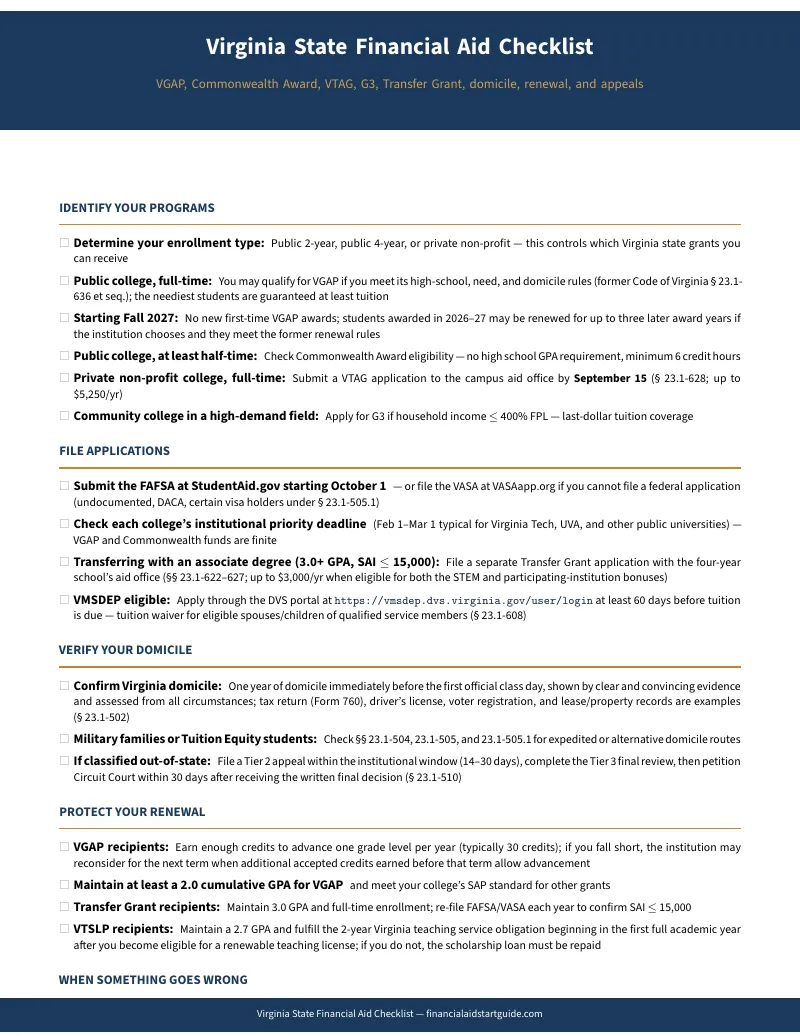
- A free quick-start checklist — the grants to check, the applications to file and the dates to watch, yours to download at no cost
Who this is for
- Virginia high-school seniors and their parents filing the FAFSA and state applications for the first time
- Private-college students who need to submit the VTAG application by July 31 for Category 2 priority and want to understand the later categories
- Community college students checking G3 eligibility, the six-credit minimum and the additional stipend for full-time students who qualify for a full Federal Pell Grant
- Transfer students who completed an associate degree and need to claim the Two-Year College Transfer Grant before the window closes
- Adult returners and part-time students checking whether G3 or the Commonwealth Award covers their enrolment pattern
- VASA-eligible students — DACA recipients, undocumented students and some nonimmigrant visa holders — navigating state aid through SCHEV without FAFSA access
- Families who relocated to Virginia and need to build a domicile case under Code § 23.1-502
- Military families determining VMSDEP Tier 1 or Tier 2 eligibility and how the tuition waiver fits into a financial aid package
Why not just search for it?
You can — every rule is public. The issue is where you end up. SCHEV explains eligibility for each programme on separate pages, but doesn't show you which ones stack, which deadlines come first or what happens when a grant is prorated because appropriations ran short. Campus pages describe their own packaging logic but can't tell you how it compares to the state's published formula. Reddit threads on r/FinancialAid and r/VirginiaTech describe real frustrations but routinely confuse VTAG (non-need-based, private colleges only) with VGAP (need-based, public colleges only), and claim that living in Virginia for a year automatically establishes domicile — which contradicts Code § 23.1-503's rule that residence primarily for educational purposes does not establish domicile.
Loan-comparison sites wrap accurate surface-level summaries around private-lending funnels. AI appeal generators produce generic letter templates that have never seen a Virginia domicile reclassification request or a VTAG Category 1–4 proration system.
This guide is independently published with no connection to SCHEV, any college or any lender. It has no loan marketing, no lead-generation motives and no ads — just the rules, the forms and the steps in order.
Full refund, no time limit
If the guide doesn't help, email [email protected] for a full refund, no time limit — no questions asked.
Download the free checklist to get the key dates and grant names now. When you're ready for the full programme-by-programme breakdown, the domicile evidence organiser, the packaging walkthrough and the appeal routing, the complete guide is here.
Frequently Asked Questions
What if the rules change after I buy?
We update the guide when the rules change. Email us any time, even years later, and we'll send you the current edition free.