You know Texas has state grants for college. You just can't find the full picture.
The TEXAS Grant, TEOG, TEG, TPEG, Hazlewood — each one has its own eligibility rules, enrolment minimums, renewal standards, and deadlines that don't match the federal calendar. And the information you need is scattered across THECB policy memos written for campus administrators, university catalog pages that describe a single programme in isolation, and forum threads from students who aren't sure whether what happened to them is normal.
Many Texas institutions use January 15 as a state priority date for limited funding. Applying before it gives priority consideration, but does not guarantee an award. Applying later does not automatically disqualify you; funds may already be committed.
The Texas State Aid Navigator: One Reference for Core Programmes, Key Deadlines, and Appeal Routes
This is a complete process-navigation guide to Texas state financial aid for college. It takes the rules from the Texas Higher Education Coordinating Board guidelines, the Texas Education Code, and campus-level policies, and puts them in one document — in the order a student and family actually encounter them.
What makes this different from free resources: official sources describe each rule on its own. The THECB memo tells a financial aid administrator how to calculate renewal eligibility. A university's aid page tells you the TEXAS Grant exists. But nobody puts the full sequence together — which programmes you qualify for at your institution type, whether you are eligible to file the FAFSA or may use TASFA for state-aid consideration, what the priority deadline actually means for limited funding, how to keep your awards year after year, and what to do when something goes wrong.
That's what the Texas State Aid Navigator does. It's the reference manual your campus financial aid office would hand you if they had time to sit down and walk through everything.
What's Inside
- Core Texas state grant programmes and selected additional programmes — TEXAS Grant (public four-year), TEOG (community college), TEG (private non-profit), TPEG (public campuses), and Hazlewood Act exemptions for veterans and dependents — with eligibility rules and enrolment minimums, plus grant maximums where applicable
- FAFSA vs. TASFA routing — a decision tree covering FAFSA eligibility and Texas residency requirements, and what to confirm with your institution if you've already submitted the wrong form
- Priority Deadline and Receipt Log — a printable tracker for the January 15 priority date used by many institutions and each institution's own deadline, with space for confirmation numbers and follow-up dates so you can track submissions and follow up about missing documents
- Residency rules decoded — the Core Residency Questions, the SB 1528 affidavit, the domicile pathway, and the current court-ordered limit on the high-school-graduation pathway for undocumented students
- Renewal Audit Worksheet — a calculation sheet that tracks your cumulative GPA and completed credit hours against the programme-specific renewal standards (institutional SAP after your first year, then 2.5 GPA and 24 completed hours in the most recent academic year at the end of the second academic year and in later years for the TEXAS Grant), so you can see where you stand before the institution evaluates you
- Hardship appeal framework — the statutory provisions that let an institution make exceptions, the types of evidence that support a request (medical statements, employer notices, caregiving documentation), and a preparation worksheet to organise your case before you contact the financial aid office
- Professional judgment section — how to ask your aid office to reconsider when your family's income has dropped since the tax year your aid was based on, with the documentation the office typically needs
- Transfer student rules — what happens to state grants when you move between Texas institutions, including the attempted-hour and time-limit calculations that carry across campuses
Who It's For
- High-school seniors and parents applying for state aid for the first time, trying to figure out which programmes exist at your target institutions and how to file by the priority deadline
- Community-college students navigating TEOG eligibility, the half-time enrolment rule, and the separate 75-attempted-hour and 75-funded-hour limits
- University students who lost a state grant after a difficult semester — you need to know whether a hardship appeal is possible and what evidence to bring
- TASFA filers who need to understand how the Texas application connects to state grant eligibility, residency documentation, and campus processing
- Adult and returning students re-entering the Texas system, unsure which programmes still apply and what deadlines have changed
Why Not Just Use Free Resources?
Free resources exist, and they're good at what they do. The THECB publishes the programme guidelines. StudentAid.gov handles the FAFSA. Your campus financial aid office answers questions during business hours.
Here's the gap: THECB memos are written for campus administrators managing institutional allocations — they describe funding formulas, reporting windows, and compliance requirements, not what a student should do when their grant disappears from the portal. The College Investor and SoFi both cover several Texas state grant programs, but their Texas pages also cover student loans and other options rather than putting campus deadlines, renewal rules, residency steps, and appeals into one sequence. And campus aid offices manage thousands of files during peak processing periods — they answer the question you walk in with, but they rarely have time to help you plan across multiple programmes and deadlines.
Generic appeal templates on Etsy and marketplace sites give you a Word document that works the same for every state. They don't know that the TEXAS Grant renewal rules are evaluated at the end of your second academic year and later, that TEOG has separate attempted-hour and funded-hour limits, or that a hardship exception for sub-half-time enrolment works differently than a GPA appeal.
This guide is Texas-specific, programme-by-programme, rule-by-rule. It's what happens when someone reads the THECB guidelines, the Texas Education Code, and the campus-level policies and writes them up for the family who has to act on them.
Full Refund, No Time Limit
If the guide doesn't help, email [email protected] for a full refund, no time limit, no questions.
Get Started
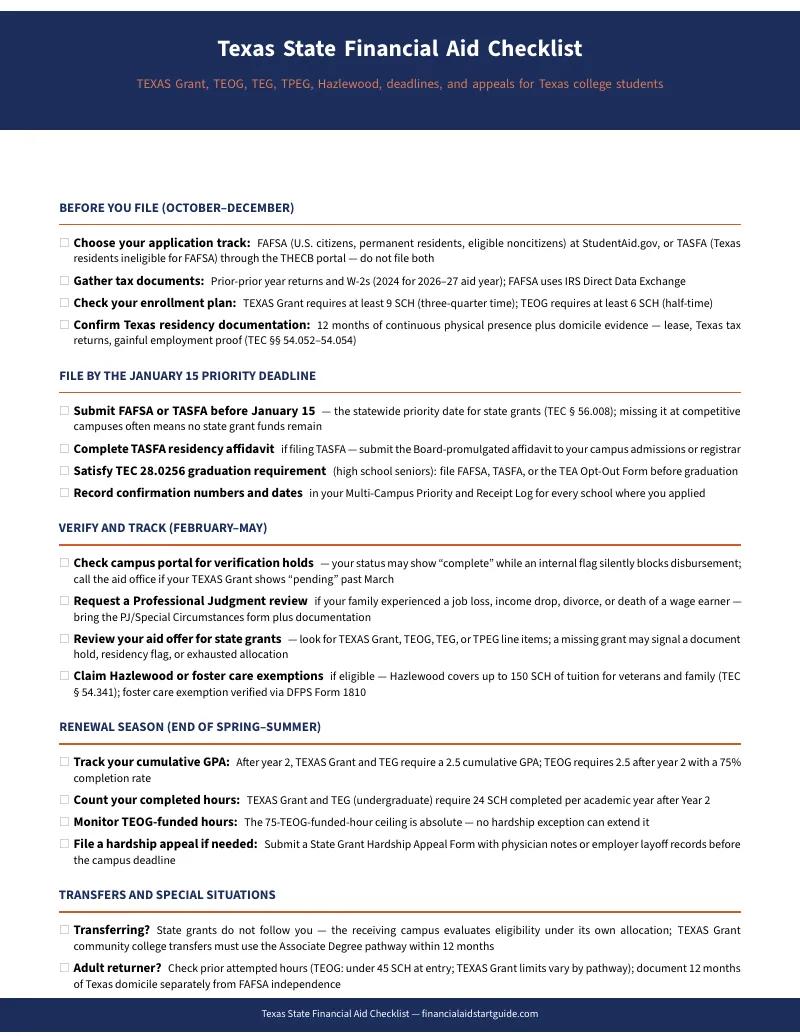
Download the free Texas State Financial Aid Checklist to see the programmes, deadlines, and key questions at a glance. When you're ready for the guide — rules for the core programmes it covers, the renewal worksheets, the appeal framework, and the deadline tracker — get the full toolkit for less than the cost of one hour in a campus parking garage.
Your download includes 7 PDFs: the full 46-page guide, the printable checklist, and five standalone worksheets you can print and fill in with a pen — the Aid Decision Routing Tree (FAFSA or TASFA), the Multi-Campus Priority and Receipt Log, the State Grant Renewal Audit Sheet, the Hardship Review Preparation Worksheet, and the Agency Communication Log.
The guide covers the 2026–2027 award year only. Every rule and figure is dated.
Frequently Asked Questions
What if the rules change after I buy?
We update the guide when the rules change. Email us any time, even years later, and we'll send you the current edition free.