You filed the FAFSA. Then Pennsylvania sent you to a portal you've never seen before.
Some first-time applicants without an existing GrantUs account receive an activation link after PHEAA processes the FAFSA and they pass initial eligibility checks — but the link expired in five days and nobody told you it was coming. Your college's award letter lists a PA State Grant, but the money is "estimated" and it's October and nothing has arrived. You earned a 3.2 GPA and assumed the grant was safe — then your school marked a State Grant term ineligible because you completed 21 credits instead of the 24 required across two full-time award terms. And somewhere in all this, you learned that May 1 applies to renewals and first-time applicants in degree or college-transferable programs at a 2-year college or other college/university (excluding community colleges and designated PA open-admission institutions), while August 1 applies to first-time applicants at community colleges, designated PA open-admission institutions, business/trade/technical schools, hospital schools of nursing, and nontransferable two-year programs; RTSS is first-come-first-served with a campus nomination you didn't know about, and Grow PA has a post-graduation work requirement nobody mentioned until after you accepted the award.
The information exists. But it's scattered across PHEAA policy pages written for campus administrators, institutional FAQ pages that describe one programme in isolation, and Reddit threads from students trying to figure out whether their experience is normal.
The Pennsylvania State Aid Navigator: One Reference for Every Programme, Deadline, and Appeal Route
This is a complete process-navigation guide to Pennsylvania state financial aid for college. It takes the rules from PHEAA's published policies, the Pennsylvania statutes, and campus-level procedures, and puts them in one document — in the order a student and family actually encounter them.
What makes this different from free resources: official sources describe each rule on its own. PHEAA's FAQ explains the domicile requirement. A college's aid page tells you the PA State Grant exists. But nobody puts the full sequence together — how FAFSA processing can lead to a GrantUs activation notice, which Action Items to complete and in what order, why your grant disappeared after add/drop, how the State Grant credit-progress rule differs from your campus GPA standard, and what to do when PHEAA says no.
That's what the Pennsylvania State Aid Navigator does. It's the reference your campus financial aid office would hand you if they had time to sit down and walk through every programme and deadline in order.
What's Inside
- Every state grant and scholarship programme explained — PA State Grant (up to $6,000/year full-time in-state), Ready to Succeed Scholarship (RTSS), Grow PA, PA-TIP for short-term credentials, Chafee and FosterEd for foster youth, PATH matching grants, PEGP, and the Blind or Deaf Beneficiary Grant — with eligibility rules, award limits, and application routes for each
- GrantUs Portal Workflow — when an activation email arrives after FAFSA processing, what to do when the link expires, which assigned Action Items to complete (State Grant Form, High School Form), how to tell whether you need GrantUs or PHEAA Account Access for your specific programme, and what each status message means
- Deadline Tracker — a printable tracking sheet for May 1 (renewals and first-time applicants to degree or transferable programs at a 2-year private college or other college or university), August 1 (specified first-time applicants), RTSS first-come-first-served timing, and PA-TIP filing windows, with space for confirmation numbers and follow-up dates
- Domicile Documentation Organiser — the 12-month residency standard, the school-attendance exclusion that trips up out-of-state students, acceptable evidence (tax returns, leases, W-2s, voter registration), and how to respond to a PHEAA domicile review or denial through the GrantUs appeals process
- Credit-Progress Audit Sheet — a calculation worksheet that tracks your credits against the State Grant progress rule (12 successfully completed credits for each full-time award term, 6 for each half-time term), explains why passing your courses with a strong GPA is not enough on its own, walks through the summer catch-up strategy at a community college, and identifies the point at which you need a formal appeal
- Appeal Preparation Worksheet — which office handles which appeal (domicile, income, credit progress, missed deadline), what evidence each one requires, and a step-by-step preparation framework so you walk in with organised documents instead of a scattered explanation
- Disbursement timing decoded — how PHEAA sends PA State Grant funds to your school and your school credits your account after certifying eligibility, what "anticipated aid" credits mean for your tuition bill, LADS (Last Award Different School) reviews for transfer students, and when to escalate directly to PHEAA
- Aid stacking and anti-fraud rules — how state grants interact with federal Pell, institutional aid, and outside scholarships, and the reporting requirements that keep your application clean
Who It's For
- High-school seniors and parents filing the FAFSA and landing on the GrantUs portal for the first time, trying to figure out which state programmes exist and how to meet each deadline
- Community-college students navigating the May 1 renewal deadline or the August 1 deadline for first-time applicants, PA-TIP eligibility for short-term credential programmes in energy, health, manufacturing, and agriculture, and the RTSS campus nomination process
- University students who lost the PA State Grant after a credit shortfall — you need to understand whether summer catch-up, a progress appeal, or both are available and how to prepare the paperwork
- Transfer students whose grant is frozen in a LADS review — the guide explains what triggers the review, what your campus needs from you, and the typical resolution timeline
- Adult and returning students trying to determine whether PA-TIP applies, or checking Grow PA eligibility (students who have already earned a bachelor's degree are not eligible for the Grant)
Why Not Just Use Free Resources?
Free resources exist, and they're good at what they do. PHEAA publishes its FAQ and programme pages. StudentAid.gov handles the FAFSA. Your campus financial aid office answers questions during business hours.
Here's the gap: PHEAA's policy pages are written for campus administrators managing institutional allocations. They explain the state domicile regulation in legal language and assume you already know which portal to use. College financial aid pages describe one programme at a time — the PA State Grant page doesn't mention RTSS, and the RTSS page doesn't mention that it's first-come-first-served based on your FAFSA filing date. And Reddit threads from students at Penn State, Temple, and Pitt are genuinely helpful — but a student who says "usually it gets distributed between October and November" is telling you their experience, not explaining the administrative process that determines whether your specific grant will arrive.
Generic appeal templates on marketplace sites give you a letter framework that works the same for every state. They don't know that PHEAA's credit-progress rule requires 12 successfully completed credits for each full-time award term or 6 for each half-time term (not a GPA standard), that repeated courses previously counted toward State Grant progress cannot be counted again, or that a federal SAP appeal at your campus does not automatically restore your state grant.
This guide is Pennsylvania-specific, programme-by-programme, rule-by-rule. It's what happens when someone reads PHEAA's published policies, the Pennsylvania statutes, and the campus-level procedures and writes them up for the family who has to act on them.
Full Refund, No Time Limit
If the guide doesn't help, email [email protected] for a full refund, no time limit, no questions.
Get Started
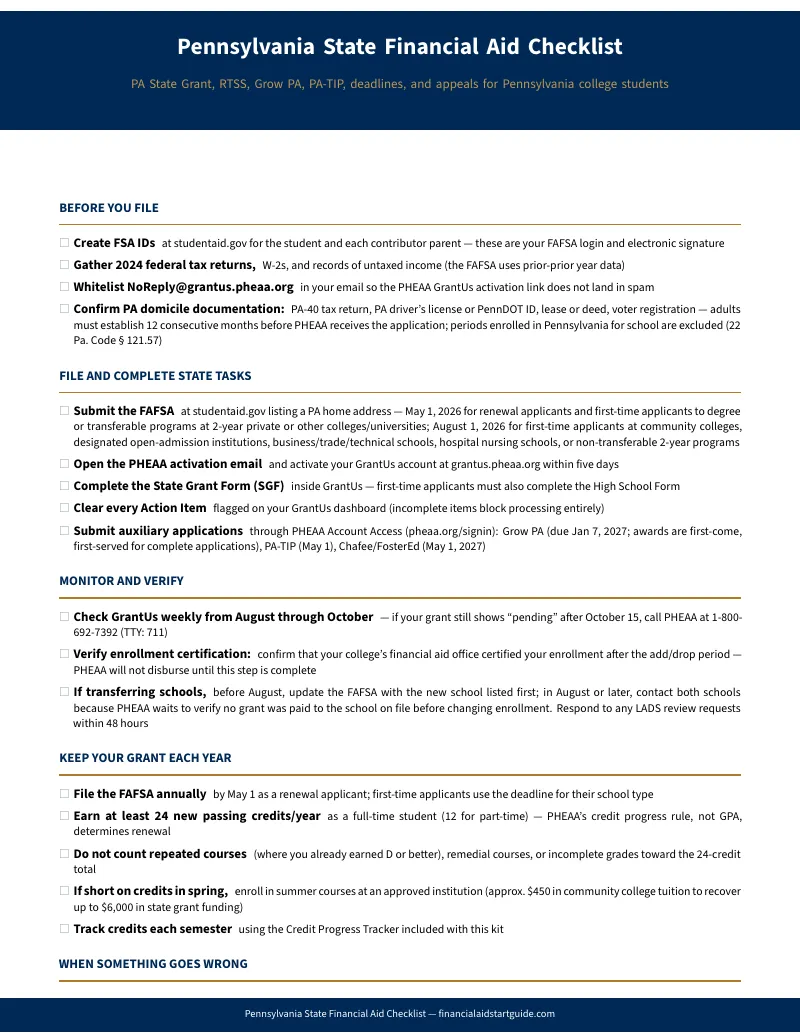
Download the free Pennsylvania State Financial Aid Checklist to see the programmes, deadlines, and key questions at a glance. When you're ready for the full guide — every programme's eligibility rules, the GrantUs portal walkthrough, the renewal worksheets, the appeal framework, and the deadline tracker — get the complete toolkit for less than the cost of one campus parking pass.
Your download includes the full guide, the printable checklist, and six standalone worksheets you can print and fill in with a pen — the Deadline Tracker, the Credit-Progress Audit Sheet, the Domicile Documentation Organiser, the Appeal Preparation Worksheet, the Aid Stacking Calculator, and the Agency Communication Log.
The guide covers the 2026–2027 award year only. Every rule and figure is dated.
Frequently Asked Questions
What if the rules change after I buy?
We update the guide when the rules change. Email us any time, even years later, and we'll send you the current edition free.