Your OCOG award letter looked right — until the summer audit pulled it
You filed the FAFSA on time. Your Student Aid Index came in under the limit. The estimated award letter showed thousands in Ohio College Opportunity Grant money. Then, weeks before move-in, the campus ran its audit and the grant disappeared — because your household income crossed a second threshold nobody told you about.
That is the dual-threshold trap, and it catches Ohio families every year. But it is only one of a dozen ways state financial aid slips through the cracks in Ohio: a Governor's Merit Scholarship permanently lost because the student didn't click "accept" in a portal by May 15, a Guard member hit with late fees because the unit approval took longer than the add/drop deadline, a relocated family denied in-state tuition because they couldn't prove 12 months of Ohio residency without financial support from non-Ohio residents.
The rules are all public. They are also scattered across ODHE guidance memos, campus registrar pages, separate application portals and administrative codes that read like contracts. Piecing them together during a deadline is where the mistakes happen.
The Ohio State Aid Navigator — every programme, deadline and appeal route in one guide
This is a complete reference guide to Ohio's state grants and scholarships for college, written for students and the parents who fill in the forms with them. It covers every major state programme — OCOG, Governor's Merit, Choose Ohio First, War Orphans, National Guard, the Ohio Work Ready Grant, Hidden Heroes, Second Chance, NEALP and Forever Buckeyes — with the eligibility tests, the applications, the exact deadlines and the renewal rules for each one.
Where free tools list one programme at a time and campus offices answer one question at a time, the guide puts the full picture in front of you: which applications stack, which deadlines come first, and which office actually decides your appeal.
What you get
- The OCOG dual-eligibility matrix — the SAI cap, the household income cap, the campus-tier award amounts and the community college exception that makes standard OCOG zero at most two-year campuses, so you know exactly where you stand before the audit does
- The Governor's Merit lifecycle — from high school nomination through portal acceptance, the 3.0 GPA and 20-credit-hour renewal thresholds, and the campus-level appeal process when those thresholds slip
- The programme-by-programme deadline calendar — FAFSA receipt dates, GMS portal deadlines, War Orphans application windows, Guard unit approval buffers and campus add/drop dates mapped against each other so nothing falls between them
- The OAC 3333-1-10 residency checklist — the four main routes to in-state tuition (C-1 dependent, C-2 independent, C-3 employment-based, C-4 for veterans), plus selected other military and nonmilitary routes, evidence to organize for each and the C-3 documents and 12-month trigger specified in the rule
- The appeal routing worksheet — where to start for common issues (campus financial aid for GMS renewals and Special Circumstances, the registrar for residency, and ODHE for limited program-specific matters) so you don't waste weeks sending paperwork to the wrong desk
- Stacking and part-time schedules — how awards combine, how prorated amounts work at half-time and quarter-time enrolment, and the lifetime semester caps that apply to each programme
- Six printable worksheets — a fillable deadline tracker, an OCOG eligibility self-assessment, a residency evidence checklist for the main OAC routes, a GMS renewal tracker, an appeal routing worksheet and an agency communication log, all as separate PDFs you can print and bring to the office
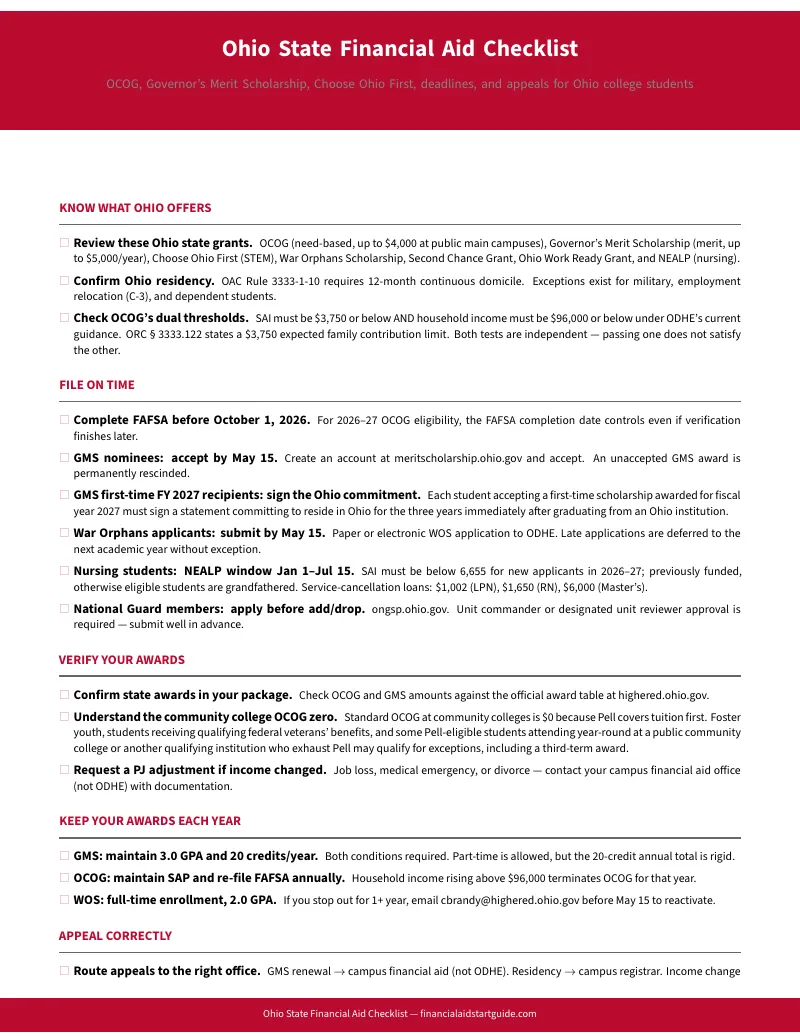
- A free two-page checklist — the grants to check, the applications to file and the dates to watch, yours to download at no cost
Who this is for
- Ohio high-school seniors and their parents filing the FAFSA and state applications for the first time
- Community college students who saw OCOG come back at zero and want to know what else is available
- Transfer students moving from a two-year to a four-year campus and trying to keep or unlock state awards
- Adult returners navigating part-time enrolment and workforce grants
- Families who relocated to Ohio and need to build a residency reclassification dossier
- National Guard members and veterans' dependents who qualify for programmes most students never hear about
Why not just search for it?
You can — every rule is public. The issue is where you end up. Scholarship aggregator sites list OCOG but confuse the federal FAFSA deadline with Ohio's October 1 state receipt deadline. Campus pages explain their own residency process but can't tell you how it compares to the statewide OAC 3333-1-10 standard. Reddit threads describe real OCOG revocations but confuse federal Professional Judgment with the state's statutory income cap. And loan-portal blogs wrap accurate surface-level summaries around private-lending funnels.
The guide is independently published with no connection to ODHE, any college or any lender. It has no loan marketing, no lead-generation motives and no ads — just the rules, the forms and the steps in order.
Full refund, no time limit
If the guide doesn't help, email [email protected] for a full refund, no time limit — no questions.
Download the free checklist to get the key dates and grant names now. When you're ready for the full programme-by-programme breakdown, the residency dossier and the appeal routing, the complete guide is here.
Frequently Asked Questions
What if the rules change after I buy?
We update the guide when the rules change. Email us any time, even years later, and we'll send you the current edition free.