You filed the FAFSA. Now what about North Carolina's own grants?
You completed the FAFSA, and maybe you even finished the Residency Determination Service interview. But now you're staring at a grant offer that seems lower than it should be — or you're not sure whether you've applied for everything North Carolina actually offers. The Next NC Scholarship, the NC Need-Based Scholarship, Forgivable Education Loans for Service, the Teaching Fellows Program — each one has its own eligibility rules, its own deadlines, and its own agency handling it. No single official page puts them all together.
Meanwhile, the priority dates are ticking. For 2027–28, miss the June 1, 2027 Next NC priority date for UNC System and community college students and limited funding may already be gone. File your RDS interview late and your in-state classification won't be ready when the campus packages your award. And if your aid gets reduced after a hard semester, the appeal process is buried across three different offices.
The North Carolina Aid Navigation System
This guide is a step-by-step routing map through North Carolina's state financial aid system — the major grant programs, their application steps and deadlines, and the main appeal pathways organized in the order you'll actually need them.
Instead of bouncing between StudentAid.gov, ncresidency.org, cfnc.org, ncseaa.edu, and your campus portal trying to piece the process together, you get a single document that connects FAFSA filing to RDS residency to state grant eligibility to campus disbursement. When something goes wrong — a residency mismatch, a missing grant, a SAP problem — the guide tells you exactly which office to contact, what evidence to bring, and how the appeal works.
What's Inside
- Major North Carolina state grants and scholarships mapped — Next NC Scholarship (minimum combined federal-and-state aid of $3,000 at community colleges and $5,000 at UNC System institutions for eligible full-time students from households with AGI at or below $80,000 and SAI at or below $7,500), NC Need-Based Scholarship for private colleges, Forgivable Education Loans for Service, Teaching Fellows, veterans' and military-family scholarships, NC Reach, and the Early High School Graduate Scholarship. Each program's eligibility, award calculation, and application requirements in one place.
- The RDS residency walkthrough — how the Residency Determination Service works, what documentation supports your case, what to do when your Residency Certification Number doesn't sync with your campus portal, and how to file a reconsideration or formal appeal if you're classified as out-of-state.
- A deadline calendar — key federal and state priority dates, with campus-specific examples, organized chronologically so you can see when to file and how priority dates differ from hard cutoffs.
- Part-time and adult learner coverage — Next NC eligibility and partial awards from 6 credit hours, the 6-credit minimum for the NC Need-Based Scholarship, and SAP rules for returning students.
- The appeal toolkit — RDS reconsideration steps, SAP appeal procedures, special circumstances (professional judgment) requests for income changes, and the escalation path from campus financial aid office to formal appeals. Each pathway explains the evidence standards and what the reviewing office actually evaluates.
- Renewal and multi-year tracking — credit-hour thresholds, GPA requirements, annual FAFSA refiling dates, and what triggers a loss of state aid so you can stay ahead of renewal requirements instead of scrambling after the fact.
- Federal coordination explained — how the Student Aid Index works with state grant calculations, how Pell stacking determines your Next NC award, and why meeting federal eligibility doesn't automatically mean you'll receive state aid.
Who This Is For
- High school seniors and their parents navigating North Carolina state aid for the first time alongside the FAFSA
- Community college students — including part-time and adult learners — who want to know exactly what state funding they can access
- Transfer students who need to understand how state aid follows them between NC institutions
- Any NC college student who lost state aid after a rough semester and needs to know how to appeal
- Families who received an award letter that seems incomplete and want to verify whether all state grants were included
Why the Free Resources Aren't Enough
Every fact in this guide comes from public sources — NCSEAA policy documents, the RDS portal, CFNC program pages, and federal regulations. That's the point. The information is public. But it's scattered across five different agency websites, each explaining its own piece without connecting to the others.
CFNC explains Next NC eligibility but doesn't walk you through what to do when your RDS classification comes back wrong. The RDS portal explains the appeal process but doesn't tell you how a residency problem affects your state grants. Your campus financial aid office packages the award but can't explain why the state portion is lower than expected if the issue is at the NCSEAA level. Each agency handles its piece — nobody maps the full route.
Generic national financial aid guides are worse. They typically reference the old Expected Family Contribution instead of the current Student Aid Index, skip the RDS requirement entirely, and offer appeal templates designed for federal aid that don't apply to North Carolina's state-level processes.
Your Purchase Is Protected
If the guide doesn't help you navigate North Carolina's state financial aid system, email [email protected] for a full refund, no time limit. The guide is a one-time purchase — no subscriptions, no recurring charges, no upsells at checkout.
Free help is always available. Your campus financial aid office, College Foundation of North Carolina (cfnc.org), and Federal Student Aid (studentaid.gov) provide direct assistance at no cost. This guide is an independent organizational tool — it is not affiliated with any state agency, college, or lender.
Get Started Now
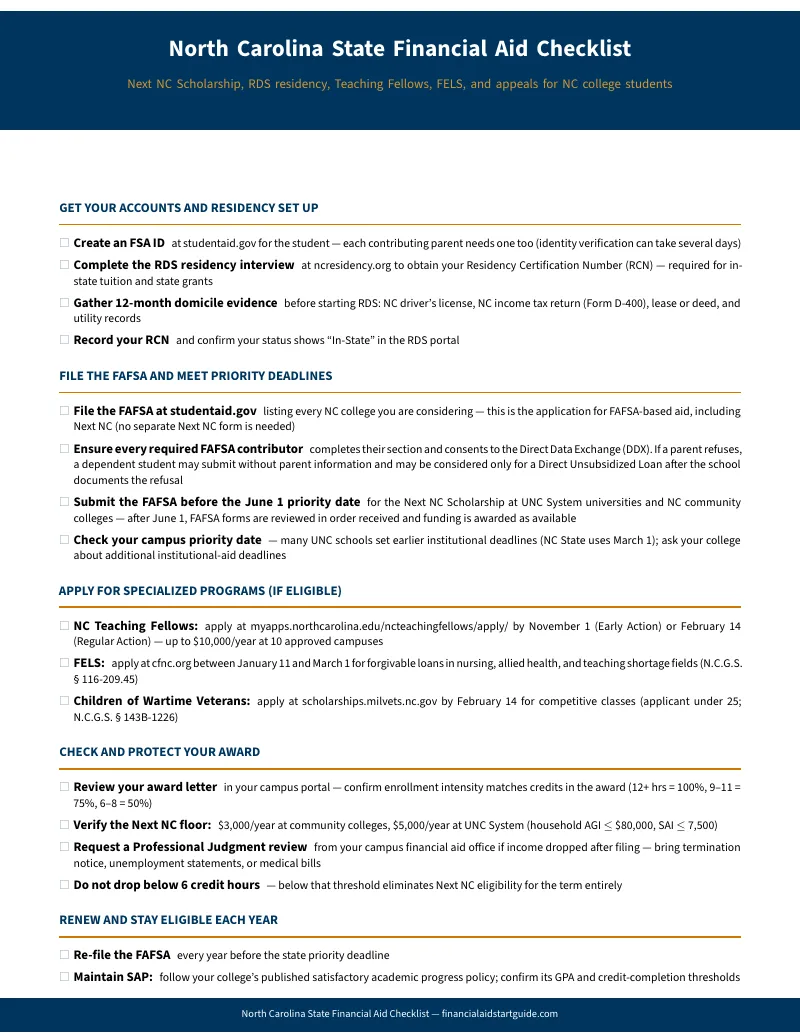
Download the free North Carolina State Financial Aid Checklist to see the grants, deadlines, and renewal rules at a glance. When you're ready for the full walkthrough — the major programs, key appeal pathways, and the steps from FAFSA filing to disbursement — get the guide for and start working through North Carolina's state aid system with a clear map in front of you.
Frequently Asked Questions
What if the rules change after I buy?
We update the guide when the rules change. Email us any time, even years later, and we'll send you the current edition free.