Navigate Minnesota College Aid, Hit Every State Cutoff, and Prepare Campus Appeals Without Guessing
In Minnesota, filing the FAFSA is only half the job. Between the Minnesota State Grant, the North Star Promise, targeted campus grants, and ten separate state residency pathways, families are left piecing together rules across StudentAid.gov, MNAid, Minnesota Office of Higher Education (OHE) manuals, and their college financial aid offices: MNAid handles applications such as the Minnesota Dream Act and Postsecondary Child Care Grant and shows OHE program usage, while colleges handle school-specific holds and documentation.
One missed detail can quietly shrink an aid offer by thousands of dollars. Families miss the rolling 30-day State Grant term deadline because they assume the June federal FAFSA deadline protects them. In a standard-term undergraduate program where the school defines 12 credits as full-time for Pell, students may enroll in 12 credits as full-time, only to discover the Minnesota State Grant benchmarks full-time at 15 credits and prorates its budget while keeping the full-time Pell subtraction intact. Others qualify for the North Star Promise, assume it covers textbooks or housing, or lose expected dollars when an outside scholarship offsets a last-dollar award. And when household income drops or a Satisfactory Academic Progress (SAP) hold hits, students routinely send appeals to the wrong agency instead of the campus office that holds actual decision authority.
The Minnesota Aid Sequence: One Chronological Playbook From Filing to Appeal
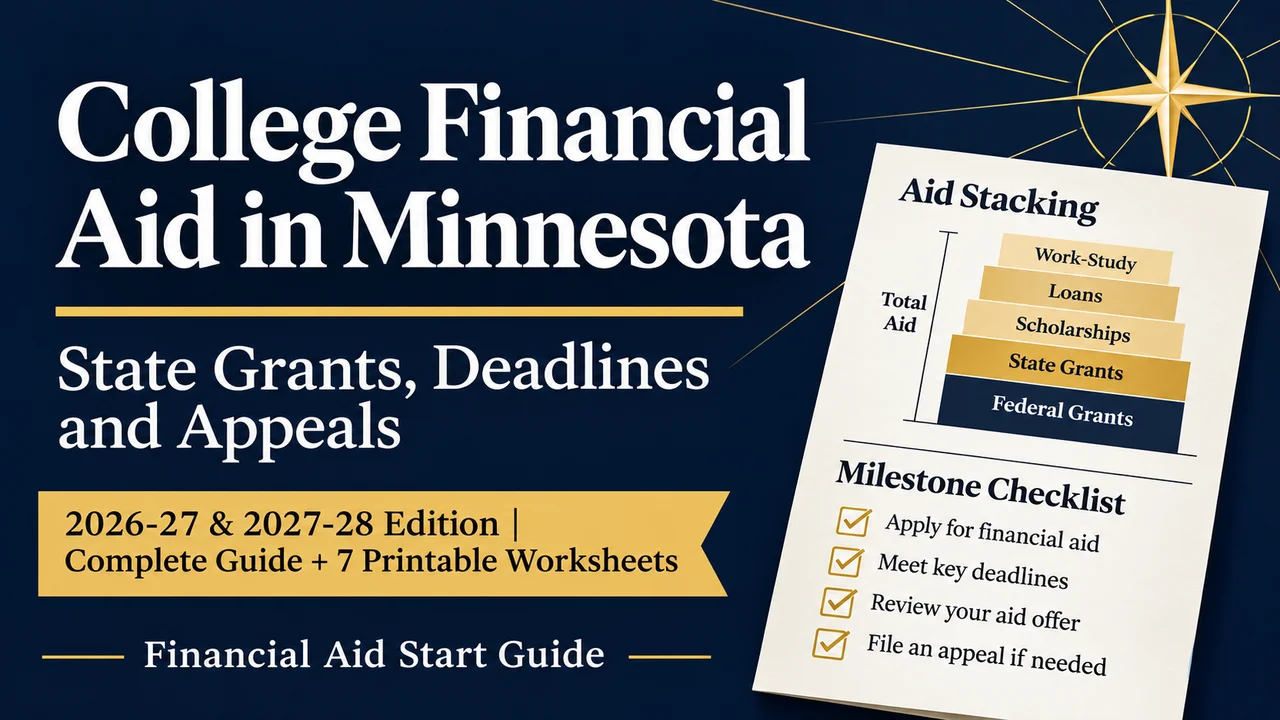
College Financial Aid in Minnesota: State Grants, Deadlines and Appeals organizes every active Minnesota state grant rule, statutory deadline, residency pathway, credit-proration calculation, and appeal route into one plain-language sequence—built from current 2026–27 and 2027–28 Minnesota statutes and OHE manuals.
Instead of jumping between dozens of agency PDFs and campus web pages, you follow The Minnesota Aid Sequence: screen every program you qualify for, pick the right core application, lock in every campus and state cutoff, verify your residency pathway, audit your award letter for proration and last-dollar offsets, and route any appeal to the exact office that can act on it.
What's Inside the Complete Guide & Printable Kit
- Complete 12-Chapter Process Guide (51 Pages) — Plain-language coverage of how OHE and campus aid offices divide authority, why your college sector (Minnesota State, UMN, Tribal, or private non-profit) changes which grants you can receive, and which older pilot programs have expired so you never waste time chasing closed funds.
- Minnesota State Grant Formula & FY2027 Rationing Breakdown — Because knowing the 15-credit benchmark, part-time proration math, 120-credit lifetime cap, extra-term medical/caregiving/military protections, and FY2027 rationing (54.5% assigned student responsibility) lets you audit a reduced offer instead of being blindsided in August.
- North Star Promise Last-Dollar & $80,000 AGI Playbook — Clarifies exactly whose income counts toward the strict $80,000 family AGI cap, how last-dollar calculations interact with Pell and outside scholarships (including what non-tuition aid is excluded from reducing NSP), why NSP+ is zero for 2026–27, and which surcharges and living costs you must budget for separately.
- Targeted Minnesota State Grants Matrix — Side-by-side rules for the first-dollar American Indian Scholars Program, Postsecondary Child Care Grant (up to $6,500 per eligible child for the nine-month academic year, with an OHE-approved infant-care increase), Fostering Independence Grant, ID Grant for CTP programs, Workforce Development Scholarships, and the Minnesota GI Bill.
- Application & Statutory Deadline Calendar — Clear routing between the FAFSA and the Minnesota Alternative State Financial Aid Application (Minnesota Dream Act), the annual North Star Promise cutoff (February 1, 2027 for 2027–28), campus-set Child Care Grant dates, and how Minnesota's 30-day State Grant deadline is counted under Minn. Stat. § 645.15.
- Three Worked Dollar Examples — Line-by-line math showing 15 credits vs. 12 credits on a Minnesota State Grant, how an outside scholarship displaces last-dollar North Star Promise dollars, and how dropping from 15 credits to 9 credits before your campus's award adjustment end date creates an unexpected bill.
- All Ten Statutory Residency Pathways & Reciprocity Rules — Explains how state aid residency (Minn. Stat. § 136A.101, Subd. 8) differs from in-state tuition and why students receiving North Dakota or Wisconsin reciprocity at a Minnesota college cannot receive a State Grant while those benefits continue; Minnesota residents may cancel reciprocity to receive state aid.
- Campus Appeals & Escalation Routing — Matches every dispute to the right deciding office: campus Professional Judgment (Special Circumstances) for job loss or income drops, campus SAP suspension appeals with an Academic Recovery Plan, and OHE Commissioner escalation for Postsecondary Child Care Grant denials.
- Seven Standalone Printable Worksheets + Quick-Reference Checklist — Program Eligibility Matcher, Master Deadline Tracker, Credit Load & Aid Proration Worksheet, Residency & Domicile Evidence Worksheet, Aid Offer & Net Cost Comparison Worksheet, Special Circumstances & SAP Appeal Preparation Worksheet, Financial Aid Communication Log, and the 2-page Minnesota State Financial Aid Checklist.
Who This Guide Is For
- Minnesota high school seniors and parents comparing offers across Minnesota State, UMN, Tribal, and private colleges who want to see how federal and state grants actually stack before signing a tuition bill.
- Returning adult students and part-time learners who need clear rules on credit proration (1 to 15 credits), the prior bachelor's degree bar, transferring between Minnesota colleges, and protecting aid during a reduced course load.
- Independent, estranged, and Minnesota Dream Act students who need to document one of Minnesota's statutory residency pathways, file the Alternative State Application, or prepare a documented Professional Judgment request after a drop in household income.
When free help is enough: If your household has straightforward W-2 income, you are attending full-time at 15+ credits, and you are already working one-on-one with a high school college counselor or your campus financial aid office, official free resources may be all you need.
Why Families Choose This Over Scattered Websites and Generic Templates
- Official government sites are free and authoritative, but fragmented: StudentAid.gov and ohe.mn.gov publish federal and state requirements, while colleges handle school-specific documentation and adjustment dates—leaving you to connect federal SAI rules, Minnesota State Grant proration, and last-dollar NSP offsets on your own.
- Generic appeal templates and AI letter generators miss Minnesota law: National templates focus on generic federal rules, frequently still reference outdated EFC terminology instead of the current Student Aid Index (SAI), and omit Minnesota's $80,000 NSP cap, 30-day State Grant cutoff, statutory residency pathways, and campus-vs-OHE routing.
- Lender-backed financial aid blogs exist to sell student loans: Editorial summaries on loan-comparison sites give high-level overviews without worked proration math, printable audit worksheets, or step-by-step appeal preparation.
Honest Boundaries & Full Refund Guarantee
Independent publisher: Financial Aid Start Guide is an independent educational publisher. We are not affiliated with, endorsed by, or speaking for the Minnesota Office of Higher Education (OHE), the U.S. Department of Education / Federal Student Aid, Minnesota State, the University of Minnesota, any college, or any lender. Applying for financial aid and filing appeals are always free through official offices (StudentAid.gov, ohe.mn.gov, and your college financial aid office).
No guarantees and no shortcuts: No guide can guarantee any grant award, dollar amount, or appeal outcome—eligibility is governed strictly by federal and Minnesota statutes, available appropriations, and campus financial aid administrator discretion. This guide never suggests misstating income, household size, residency, or dependency status, and it does not write custom appeal letters for you.
Full refund, no time limit: If you buy the guide and decide it is not helpful for your situation, email [email protected] for a full refund, no time limit.
Get Started Today
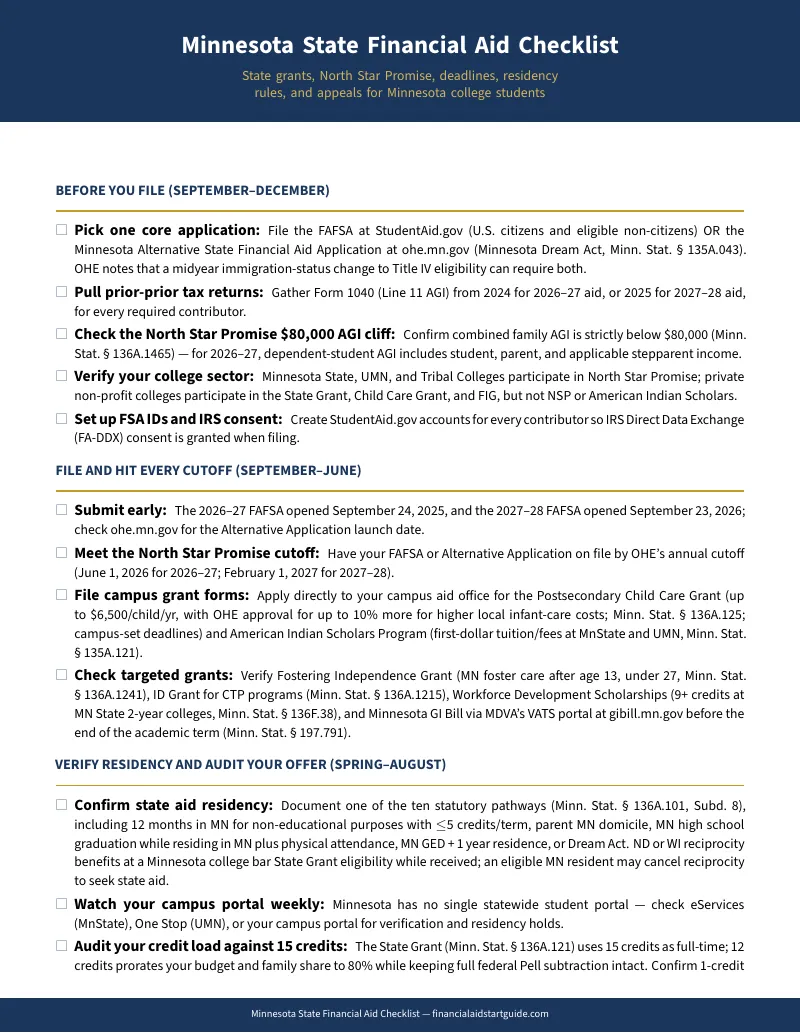
Start with the free 2-page Minnesota State Financial Aid Checklist to verify your core application and cutoffs tonight, or download the complete 51-page guide and all seven printable worksheets for instant PDF access.
Frequently Asked Questions
What if the rules change after I buy?
We update the guide when the rules change. Email us any time, even years later, and we'll send you the current edition free.