You filed the FAFSA on time — then ScholarTrack said your state aid was gone
The FAFSA went in before April 15. The preliminary award letter showed thousands in Frank O'Bannon money. Then, somewhere between summer and the first tuition bill, the grant dropped to a lower tier because your student earned 27 rather than 30 credit hours in the award year, and nobody explained that the state counts credit hours differently from the campus.
That is the 30-credit completion trap, and it catches Indiana families every year. But it is only one of a dozen ways state financial aid slips through the cracks in Indiana: a 21st Century Scholar who could not receive the scholarship without completing the required Scholar Success Program activities in high school, a ScholarTrack account that won't link to the FAFSA because the ZIP code doesn't match, a returning adult who never learned that Indiana has separate grants for part-time certificate and degree students, or a family that missed the appeal deadline because they didn't know CHE runs a formal hearing process with its own evidence rules.
The rules are all public. They are also scattered across CHE policy manuals, ScholarTrack help pages, campus financial aid offices and statutory codes that read like contracts. Piecing them together during a deadline crunch is where the mistakes happen.
The Indiana State Aid Navigator — every programme, deadline and appeal route in one guide
This is a complete reference guide to Indiana's state grants and scholarships for college, written for students and the parents who fill in the forms with them. It covers every major state programme — the Frank O'Bannon Grant (HEA and FOC), 21st Century Scholars, the Adult Student Grant, the Workforce Ready Grant, the Next Generation Hoosier Educators Scholarship, the CVO tuition and fee exemption programs and the National Guard Tuition Supplement Grant — with the eligibility tests, the applications, the exact deadlines and the renewal rules for each one.
Where free tools list one programme at a time and campus offices answer one question at a time, the guide puts the full picture in front of you: which applications stack, which deadlines come first, how the Credit Bank works and which office actually decides your appeal.
What you get
- The Frank O'Bannon award tiers explained — the need-band calculations, the difference between the Higher Education Award at public colleges and the Freedom of Choice Award at private colleges, and the on-time vs full-time credit thresholds that determine whether you get the maximum award, a reduced amount or nothing
- The 21st Century Scholars lifecycle — from automatic enrolment and Scholar Success Program requirements in middle and high school through the college credit completion rules and renewal, with the pledge requirements and what happens when a student falls short
- The 30-credit rule and Credit Bank system — how Indiana counts completed credits each academic year, what happens to Frank O'Bannon at 30, between 24 and 29 and below 24, the separate 30-credit 21st Century renewal requirement, how summer courses and banked excess credits can protect your award, and the worked examples that make it concrete
- ScholarTrack step by step — creating the account, linking the FAFSA, checking for the ZIP code and SSN mismatches that silently block your state aid, and checking state aid award status in ScholarTrack
- The CHE appeal framework — the grounds the Commission accepts (medical, bereavement, residency, military, disability), the evidence checklist for each type, the 21-day window to submit requested information, the 30-day deadline for a second appeal to the Executive Appeals Committee and the administrative review under IC 4-21.5-3-7
- Adult and workforce pathways — the Adult Student Grant for part-time degree students, the Workforce Ready Grant for high-value certificate programmes, and how they stack with federal aid for returning students who don't know these exist
- Teaching scholarships, CVO waivers and Guard fee remissions — the programmes with their own applications and deadlines outside ScholarTrack, including the Next Generation Hoosier Educators Scholarship service requirement and the veteran residency rules for the tuition waiver
- Six printable worksheets — a credit completion tracker for the 30-credit rule, an appeal preparation worksheet with CHE's evidence requirements, an aid stacking worksheet, a priority deadline and FAFSA log, a residency documentation organizer and an agency communication log
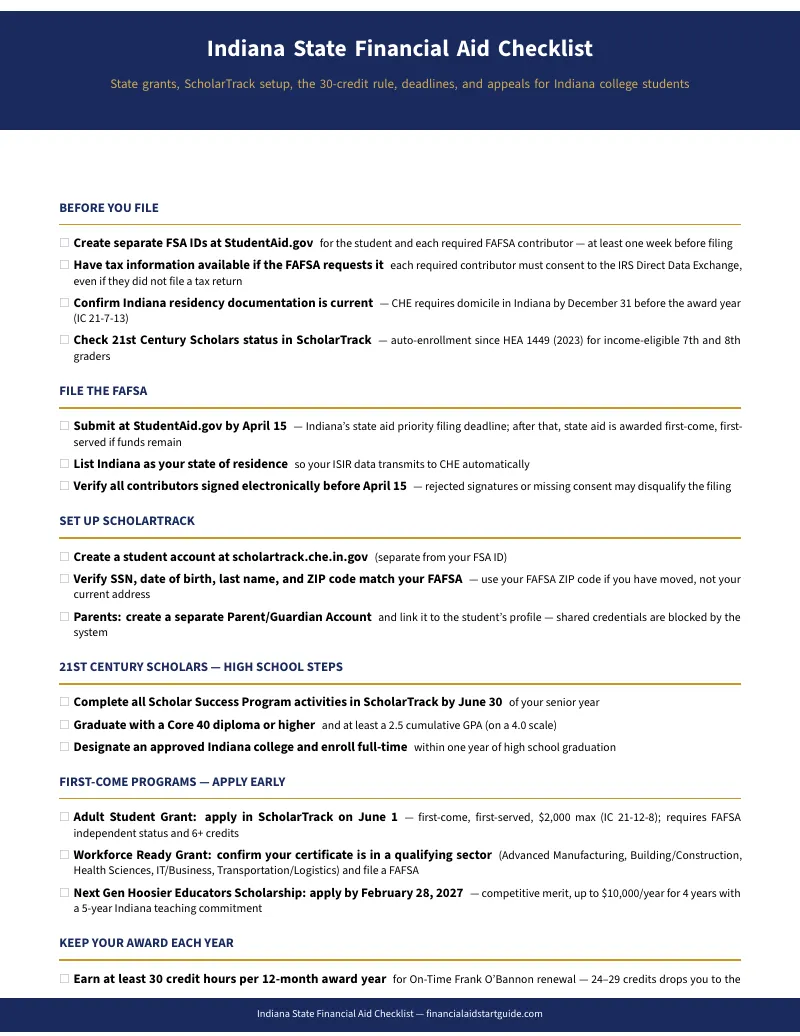
- A free two-page checklist — the grants to check, the applications to file and the deadlines to watch, yours to download at no cost
Who this is for
- Indiana high-school seniors and their parents applying for state aid alongside the FAFSA for the first time
- 21st Century Scholars who fell short of the 30-credit renewal requirement in their last award year
- Community college and Ivy Tech students juggling the Adult Student Grant, Workforce Ready Grant and federal aid
- Transfer students trying to keep existing state awards or establish eligibility at a new campus
- Returning adult students who didn't know Indiana has grant programmes for part-time enrolment
- Families who received a CHE denial notice and need to file an appeal before the deadline passes
Why not just search for it?
You can — every rule is public. The issue is where you end up. Scholarship aggregator sites list the Frank O'Bannon Grant but confuse the federal FAFSA deadline with Indiana's April 15 state priority deadline. Campus financial aid pages explain their own institutional rules but can't tell you how they differ from CHE's statutory credit completion requirements. Reddit threads describe real grant reductions but confuse campus Satisfactory Academic Progress with the state's 30-credit rule. And loan-portal blogs wrap accurate surface-level summaries around private-lending funnels.
The guide is independently published with no connection to the Indiana Commission for Higher Education, Federal Student Aid, ScholarTrack, any college or any lender. It has no loan marketing, no lead-generation motives and no ads — just the rules, the forms and the steps in order.
Full refund, no time limit
If the guide doesn't help, email [email protected] for a full refund, no time limit — no questions.
Download the free checklist to get the key dates and grant names now. When you're ready for the full programme-by-programme breakdown, the planning worksheets and the appeal framework, the complete guide is here.
Frequently Asked Questions
What if the rules change after I buy?
We update the guide when the rules change. Email us any time, even years later, and we'll send you the current edition free.