Illinois Has Its Own Grant System. The Rules Are Buried in Administrative Code and Campus Portals.
You filed the FAFSA. You might think that covers state aid too. It doesn't — not fully. Illinois runs its own grant ecosystem through ISAC, with its own income formula, its own credit hour limits, and a MAP suspense date ISAC may announce when applications are projected to exceed available funding. MAP awards shown on a college financial aid notice are estimates; applications received after a suspense date are placed on a waiting list and will not receive MAP funds unless additional funding becomes available.
And the rules are not in one place. The MAP formula is described in one ISAC page. The 135 MAP Paid Credit Hour maximum and its one-term extension are buried in the administrative code. AIM HIGH matching rules are different at every campus. The Alternative Application for RISE Act students lives on a separate portal entirely. Campus financial aid offices answer questions one at a time, usually after something has already gone wrong.
The State Aid Navigation System — Every Program, Credit Rule and Deadline in One Manual
This guide assembles the full picture that ISAC's scattered pages don't give you. It covers every major Illinois state grant and scholarship, the applications and deadlines in the order you'll meet them, the income formula and credit hour caps that determine your eligibility, what it takes to keep each award year after year, and exactly how to appeal when something falls through.
It is not a summary. It is not a blog post with five bullet points about MAP. It is a structured reference you work through once, keep on hand, and come back to every term when renewal deadlines or credit hour checkpoints arrive.
What You Get
- Complete program coverage — MAP Grant, AIM HIGH campus matching, Teachers of Illinois Scholarship Program (TISP, formerly MTI), Special Education Teacher Tuition Waiver (SETTW), Golden Apple Scholars, Illinois Veteran Grant (IVG), Illinois National Guard (ING) Grant, public safety dependents grant, and the RISE Act Alternative Application, each with eligibility rules, award mechanics, and renewal conditions
- The MAP Grant formula explained — how ISAC calculates your award from your Student Aid Index and tuition costs, the suspense date system and what "estimated" status actually means, and part-time proration for 3 to 14 credit hours (15 or more receives the maximum term award)
- Credit hour limits that can end your funding — how the 135 MAP Paid Credit Hour maximum and its one-term extension work, with a tracking worksheet to monitor your balance across transfers and institutions
- AIM HIGH campus matching across all 12 public universities — side-by-side comparison of income ceilings, GPA renewal thresholds, and what each campus actually calls the program (Illinois Commitment at UIUC, UIC Aspire, Saluki Commitment at SIUC, and more)
- The FAFSA and the Alternative Application — when to file each one, how the RISE Act opens state aid to students who cannot file a federal FAFSA, and how to document Illinois residency without parental tax returns
- The high school graduation requirement — what Public Act 101-180 means for seniors, how the non-participation form works, and what families give up by opting out of filing
- Appeals and escalation — how to request an institutional income adjustment (professional judgment), prepare an appeal for a lost MAP or AIM HIGH award, and where to escalate when a campus decision seems wrong
- The stacking hierarchy — how state grants, federal Pell, AIM HIGH, institutional aid, and educator scholarships layer together so you know which dollars come first and what gap remains
Who This Is For
- High-school seniors and their parents filing for Illinois state aid alongside the FAFSA for the first time — the guide walks you through both systems so nothing slips through
- Students approaching the 135 MAP Paid Credit Hour maximum who need to plan remaining funding and a transfer
- Students at any of the 12 public universities who lost AIM HIGH or MAP eligibility and need to understand the appeal process before meeting with a financial aid officer
- Adult and returning students navigating part-time MAP proration and re-entry after a gap in enrollment
- RISE Act applicants who cannot file the FAFSA and need the Alternative Application for Illinois Financial Aid, with residency documentation and privacy protections explained
- Future teachers exploring TISP (formerly MTI), SETTW, and Golden Apple scholarships alongside state grants — including the service obligations that come with them
Why Not Just Read ISAC's Website?
You can, and you should — this guide links to the official pages throughout. But ISAC explains each program on its own page. The MAP credit hour rules are in the administrative code, written for lawyers. AIM HIGH rules are different at every campus, and each campus uses its own name for the program. If your situation crosses programs — you're stacking MAP with AIM HIGH and a veteran benefit, or you're a transfer student trying to figure out how MAP Paid Credit Hours from community college and university terms count toward the 135-hour maximum — the connections are left for you to piece together.
The guide does that assembly work. It puts the rules in the order you'll encounter them, explains how programs interact, and gives you the worksheets and tracking tools to stay on top of renewals. It is not a replacement for ISAC or your campus financial aid office — it's the preparation that makes those conversations more productive.
What This Guide Does Not Do
It does not write appeal letters for you. It does not guarantee any award, any amount, or any appeal outcome — those decisions belong to ISAC and your campus. It is published by an independent educational publisher with no affiliation with any government agency, college, or lender. All state aid applications are completely free, and your campus financial aid office, ISAC's helpline, and ISACorps workshops provide free support.
Full Refund, No Time Limit
If the guide doesn't help, email [email protected] for a full refund, no time limit, no questions.
Get Started
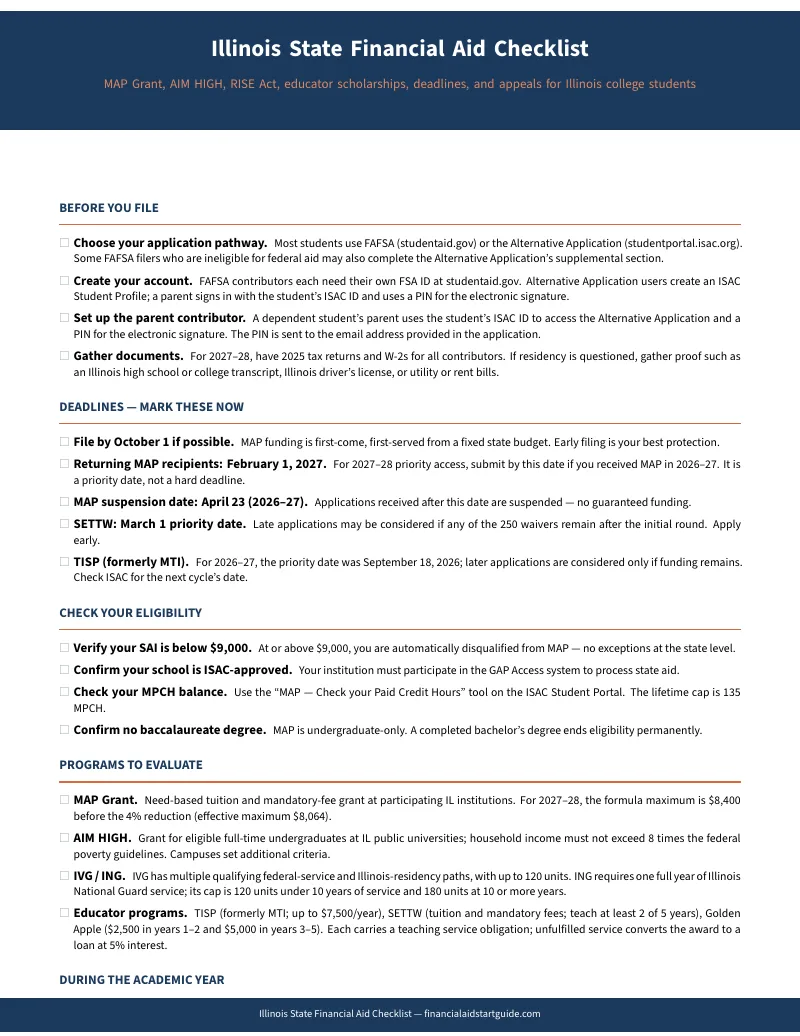
Download the free Illinois State Financial Aid Checklist — it covers the key programs, deadlines, and renewal rules at a glance. When you're ready for the full system — every program explained, every rule dated, every appeal route mapped — get the complete guide for and work through it at your own pace.
Frequently Asked Questions
What if the rules change after I buy?
We update the guide when the rules change. Email us any time, even years later, and we'll send you the current edition free.