You filed the FAFSA. Georgia has its own grants, its own application, and its own deadlines.
Most families treat the FAFSA as the whole process. In Georgia, it is one part. Georgia offers a separate set of state grant and scholarship programs — HOPE Scholarship, Zell Miller Scholarship, HOPE Grant, HOPE Career Grant, the Tuition Equalization Grant, the REACH Georgia Scholarship, the DREAMS Scholarship, and others — with program-specific application options (including the GSFAPP on GAfutures), residency rules, and credit-hour checkpoints that can affect some awards mid-degree.
Your college's financial aid page says "complete the FAFSA." It probably does not explain that a FAFSA alone does not activate every state program — some require a separate GSFAPP filing on GAfutures, and that GSFAPP remains valid for 120 consecutive months after approval. The FAFSA must be renewed every year. For HOPE and Zell Miller Scholarships, GSFC checks the calculated HOPE GPA at 30, 60, and 90 attempted semester hours (45, 90, and 135 quarter hours) and at the end of every Spring term. Some first-tier students who received HOPE funds while enrolled below full-time in each of their first three terms also have a Three-Term Checkpoint. "Attempted hours" includes degree-credit courses with a W on the transcript and degree credit from other institutions, but excludes audits and credit-by-exam hours. The guide also explains the difference between a campus SAP appeal and a GSFC or GSFA Administrative Review, which is available if you believe a state program rule was incorrectly applied; submit a written request within 45 calendar days of receiving notice of denial.
That is where families get stuck — not because the information does not exist, but because it is scattered across GSFC and GSFA regulations, GAfutures portal pages, USG catalogs, TCSG policies, and campus-specific priority dates, and nobody has put the full sequence in one place.
The Georgia State Aid Navigation System
This is not a list of grants with bullet-point summaries. The Georgia State Aid Navigation System is a structured, step-by-step workflow for the Georgia state financial aid programmes, deadlines, forms, and appeal routes — organised in the order you actually encounter them.
The guide covers the full process: from choosing the right application track (FAFSA, GSFAPP, or both), through the residency rules that determine your eligibility, through the merit and need-based programmes, through the credit-hour checkpoints that can suspend your award, through the stacking order that determines how state and federal aid interact, and through the appeal routes available when something goes wrong.
What the guide covers
- Application path selector — FAFSA, GSFAPP, or both — a decision flowchart mapping which forms you need based on your institution type (USG, TCSG, or private), the programmes you are applying for, and whether you need federal aid alongside state grants
- Campus priority deadlines — Georgia programs have state deadlines, and each institution may also set priority dates for each term. The guide explains how those dates relate and how priority dates can affect access to limited-pool institutional aid
- HOPE and Zell Miller Scholarships — full coverage of both merit scholarships for degree-seeking students at eligible public and private institutions, including the GPA thresholds (3.00 for HOPE, 3.30 for Zell Miller), the credit-hour checkpoints, and the 127-semester/190-quarter attempted-hour and combined paid-hour limits
- HOPE Grant and HOPE Career Grant — the grant programmes for certificate and diploma students at eligible Georgia public institutions, with the HOPE Grant cap of 63 semester or 95 quarter paid hours, eligible high-demand programme lists, and how paid hours are counted differently from attempted hours
- Additional and specialised programmes — Tuition Equalization Grant (TEG) for private college students, REACH Georgia Scholarship, DREAMS Scholarship for Pell-eligible USG and TCSG undergraduates, Georgia College Completion Grant (GCCG) for students close to finishing, and the foster care and public service memorial programmes
- Residency rules explained — the difference between USG tuition residency (12-month domicile) and state aid residency (12 or 24 months depending on whether you met residency requirements at high-school graduation), with a checklist of the documents that establish domicile
- Credit-hour checkpoint tracker — a printable worksheet for tracking attempted hours, paid hours, and calculated HOPE GPA against the 30/60/90 semester-hour (45/90/135 quarter-hour), end-of-Spring, and applicable Three-Term checkpoints, including how withdrawals, transfer credits, and repeat courses count
- Aid stacking order — how federal Pell, state HOPE/Zell Miller, institutional grants, and other programmes layer together, and why the packaging order determines what you actually receive
- Renewal and lifetime limits — what it takes to keep each award year after year, how enrolment intensity consumes your eligibility, the 7-year and 10-year time limits, and what happens when you change institutions
- Appeals and administrative reviews — campus SAP appeals for federal aid, GSFC or GSFA Administrative Reviews (written request within 45 calendar days of receiving notice of denial) when a state program rule was incorrectly applied, and HOPE/Zell exception requests for specific qualifying circumstances
Who this guide is for
- A high-school senior or parent filing for Georgia state grants for the first time, who needs the full picture — not just "complete the FAFSA," but every step from application selection through award notification
- A USG student whose HOPE or Zell Miller award is approaching a credit-hour checkpoint, and who needs to understand exactly what counts toward the 127-semester/190-quarter-hour limits before they run out
- A TCSG student or adult returning to a technical college, navigating the HOPE Grant, HOPE Career Grant, and the HOPE Grant's 63-semester/95-quarter paid-hour cap
- A transfer student or recent Georgia resident who needs to distinguish the 12-month USG tuition-residency rule from the 12- or 24-month state-aid residency rules and document the requirement that applies
- Any Georgia student whose state aid was denied, suspended, or placed on hold — and who needs to know whether to file a campus SAP appeal, a GSFC or GSFA Administrative Review, or both, and how quickly
Why free resources leave gaps
Every programme rule and deadline in this guide is publicly available. GSFC publishes programme regulations, GAfutures hosts the applications, and campus catalogues list priority dates. The information is free — and it is spread across dozens of sources that do not talk to each other.
GAfutures tells you HOPE requires a 3.0 GPA but does not walk you through what happens at each checkpoint if your GPA dips below it and then recovers. GSFC's regulation PDFs define the 45-day Administrative Review window but do not explain how it differs from a campus SAP appeal or what evidence to organise. Campus financial aid pages list their own priority dates but not how those dates compare to other institutions in the system. National financial sites like SoFi and Sallie Mae give high-level HOPE overviews and then route you toward private loan products.
The guide puts the full Georgia-specific sequence in one place — applications, deadlines, checkpoints, residency, renewals, and appeals — so you work through it in order instead of piecing it together from scattered sources.
Satisfaction guarantee
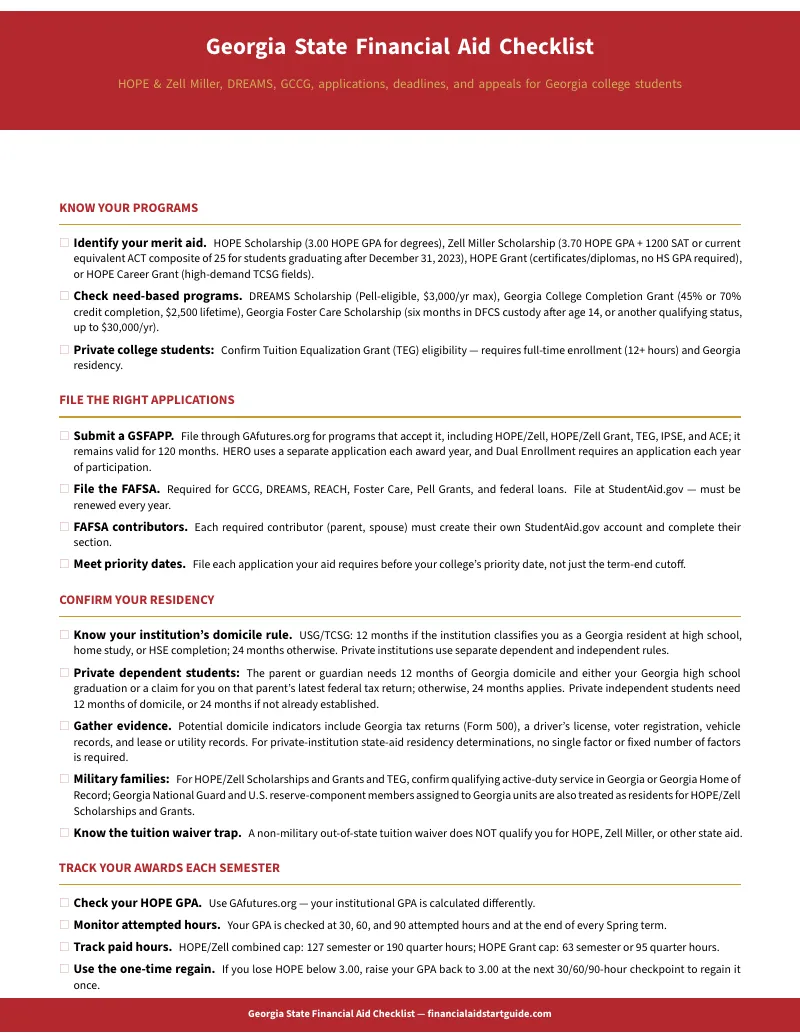
If the guide is not what you expected, email [email protected] for a full refund, no time limit. The free Georgia State Financial Aid Checklist is always available at no cost — download the three-page checklist from the top of this page to see the key programmes, deadlines, and renewal rules before deciding whether the full guide is right for you.
Get started
Download the free checklist to see the key Georgia state aid programmes and deadlines at a glance. When you are ready for the full step-by-step process — applications, residency documentation, checkpoint tracking, and appeal routes — the complete guide is available for .
Frequently Asked Questions
What if the rules change after I buy?
We update the guide when the rules change. Email us any time, even years later, and we'll send you the current edition free.