Your Campus GPA Is Not the Number That Decides Your Scholarship
You check your GPA on the campus portal — DegreeWorks, PAWS, OwlExpress — and it says 3.05. Safe, you think. Then a few weeks into the next semester, your financial aid package drops by thousands of dollars. No warning email. No grace period. Just a billing statement that no longer includes HOPE.
The number you were watching was your institutional GPA. The number GSFC uses to decide your scholarship is a completely different calculation — the postsecondary HOPE GPA — that includes transfer credits your campus ignores, strips out grade replacement your registrar applied, and adds a STEM course weighting your portal has never heard of. Students lose scholarships every year because these two numbers look similar but are not the same.
And for high school seniors, the trap starts even earlier. Your weighted GPA — the one that includes honors bumps from your district — is not your HOPE GPA either. GSFC strips every local weighting, converts to a flat 4.0 scale, and adds 0.5 points only for AP, IB, and dual enrolment courses. An incoming freshman who thinks a 3.4 weighted GPA guarantees HOPE eligibility may discover their calculated HOPE GPA is below 3.00 before their first college class begins.
The HOPE Checkpoint Audit System
This guide puts the entire HOPE and Zell Miller lifecycle into a single self-audit workspace — from the high school qualifying calculation through every postsecondary checkpoint to the administrative review process when something goes wrong.
It covers all four Georgia merit programs — HOPE Scholarship, Zell Miller Scholarship, HOPE Grant, and Zell Miller Grant — because the differences between them determine what GPA threshold you need, how your checkpoints are scheduled, and what happens when you fall below the line. Students who do not know which program they are on make decisions based on the wrong rules.
This is not a summary of what the scholarships are. You can get that from the GSFC homepage in five minutes. This is the operational manual for navigating them — the high school unweighting calculation, the STEM grade boost that your campus portal excludes, the attempted-vs-paid hour distinction that catches students who withdraw from courses, the single-regain limitation that means a second loss is permanent, and the worksheets that let you project your standing before grades post instead of discovering the damage after.
What's Inside the Guide
- High school HOPE GPA conversion worksheet — step-by-step unweighting of local district grades to the GSFC 4.0 scale, with AP/IB/dual enrolment adjustments and the class-of-2027 Advanced Fine Arts inclusion, so you can calculate your real qualifying GPA before transcripts ship
- Postsecondary STEM boost calculator — apply the statutory +0.5 quality point boost for B, C, and D grades in approved STEM courses that your campus portal never shows, and see your true GAfutures HOPE GPA alongside your institutional number
- Attempted hour checkpoint tracker — log every credit hour attempted (including Ws and transfer credits) against the 30, 60, and 90 hour thresholds and the 127 lifetime cap, so you know exactly when each checkpoint will trigger and how close you are to the ceiling
- Four-program comparison tables — side-by-side GPA gates, checkpoint schedules, award amounts, and hour limits for HOPE Scholarship, Zell Miller Scholarship, HOPE Grant, and Zell Miller Grant across public, private, and technical college enrolment
- Single-regain rule walkthrough — exactly how the one-time regain works, which checkpoints can trigger it, and why a second loss means permanent forfeiture — with a planning worksheet for students who have already used their regain and cannot afford to slip again
- Transfer credit reconciliation guide — how out-of-state and multi-institution credits are counted in GSFC's attempted hours even when your receiving school excludes them from your institutional GPA, and how dual enrolment hours taken after Fall 2011 are treated differently
- Expiration window calculator — the 7-year limit for first payments from Summer 2011 through Spring 2019, the 10-year limit for first payments from Summer 2019 onward, and no time limit for earlier first payments; calculate the window from whichever occurred first: high school graduation, HSE test, or home study completion
- Administrative review evidence checklist — what to assemble for a GSFC Administrative Review request (the 45-day deadline, the submission email, the required documentation) and the separate Board of Commissioners Exception Request for eligible withdrawals due to serious illness, injury, temporary care of an immediate family member, death, or active-duty military service
- GAfutures portal reconciliation walkthrough — how to compare your "My College HOPE Profile" data against your campus registrar records to identify transcript mismatches, processing lags, and missing STEM course classifications before they cost you a checkpoint
Who This Guide Is For
- High school seniors and their parents who need to verify that the HOPE GPA GSFC calculates from the final transcript will actually meet the 3.00 (HOPE) or 3.70 (Zell Miller) threshold — before tuition bills arrive with no state aid attached
- College students approaching a checkpoint at 30, 60, or 90 attempted hours or the end-of-spring evaluation, who want to project whether their postsecondary HOPE GPA — including STEM boosts and transfer credits — will clear the threshold before grades are final
- Students who lost HOPE and used their one regain, who now have zero margin for a GPA dip and need to track every remaining credit hour against both the checkpoint schedule and the 127-hour lifetime cap
- Transfer students moving between Georgia institutions or arriving from out of state, who need to understand how prior credits will be folded into GSFC's attempted hour count and postsecondary GPA — even when the receiving school's institutional GPA does not include them
- Adult returning students re-entering college after a gap who need to verify the applicable eligibility limit — 7 years for first payments from Summer 2011 through Spring 2019, 10 years for first payments from Summer 2019 onward, or no time limit for earlier first payments — and how prior attempted hours affect their remaining balance
- TCSG certificate and diploma students tracking the HOPE Grant's 2.00 GPA at 30 and 60 paid hours or the Zell Miller Grant's 3.50 every-term requirement, with different hour caps and no expiration window
Why Free Resources Leave Gaps
Every rule in this guide is public record. The GSFC regulations, the GAfutures portal, and your campus financial aid office are free. This guide does not contain secret information, and you should absolutely use those free resources — they are the authoritative source.
The problem is that free resources answer questions you already know how to ask. GSFC's regulations span hundreds of pages across four programs. GAfutures shows you historical data after grades post — it does not let you project what will happen at your next checkpoint. Your campus financial aid advisor handles a massive caseload and usually steps in after an adverse determination, not before. And the Reddit threads that show up in search results give you one student's experience at one university, with advice that may be outdated or wrong for your award type.
This guide bridges those gaps with calculation worksheets you fill in yourself. You enter your grades, your STEM courses, your attempted hours, and the worksheets show you your real HOPE GPA at your next checkpoint — before the system calculates it for you. That is the difference between finding out you lost your scholarship and preventing the loss before it happens.
Satisfaction Guarantee
If the guide does not help you navigate the HOPE and Zell Miller system more confidently, email [email protected] for a full refund, no time limit. No forms, no justification needed.
Get Started
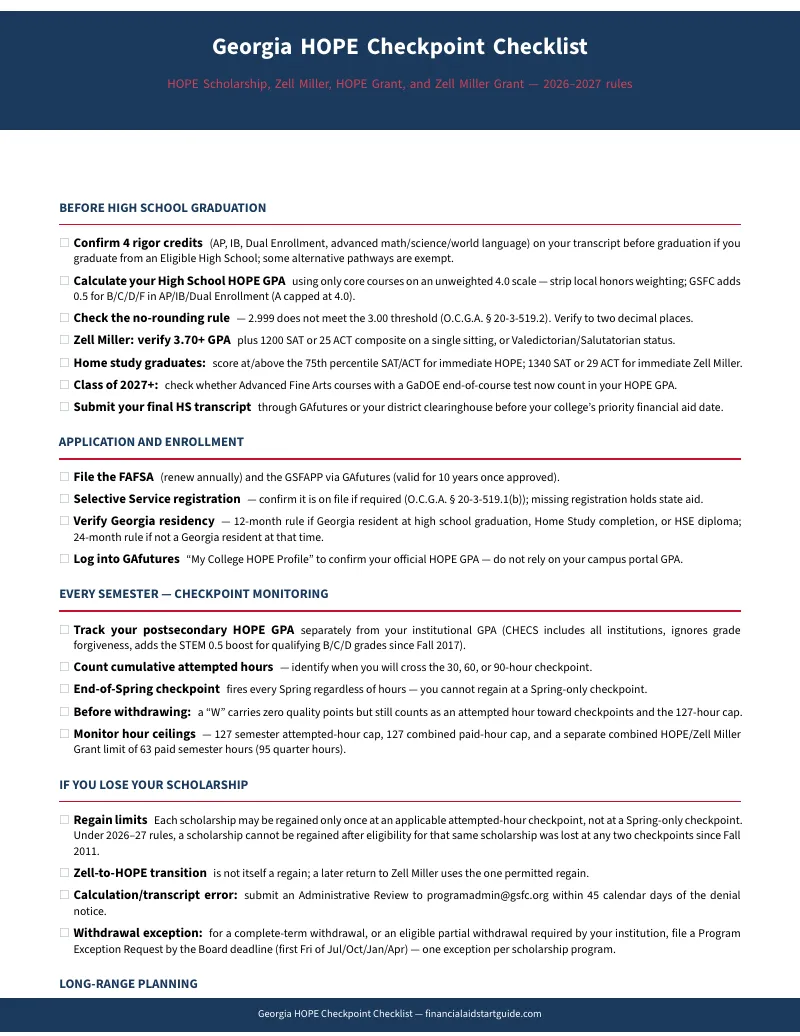
Download the free Georgia HOPE Checkpoint Checklist for a two-page reference of the requirements, checkpoints, and regain rules across all four programs. When you are ready for the full audit system — GPA calculators, hour trackers, STEM boost worksheets, and evidence checklists — get the complete guide for .
Frequently Asked Questions
What if the rules change after I buy?
We update the guide when the rules change. Email us any time, even years later, and we'll send you the current edition free.