Florida has its own financial aid system — and the FAFSA alone does not cover it
You filed the FAFSA. You expected your student's aid package to include Florida's state grants. But the package arrived and the state money was missing — or the grant showed up one semester and vanished the next.
Here is what happened: Florida runs a separate state aid pipeline alongside federal student aid. The FAFSA handles Pell Grants and federal loans, and is used for need-based state grants like FSAG. State programmes like FSAG, the EASE grant for private college students, and the Benacquisto Scholarship for National Merit Scholars each have their own eligibility rules, application requirements, and renewal criteria. Some awards, including Bright Futures, CSDDV, and Rosewood, require a separate Florida Financial Aid Application (FFAA) on the OSFA portal. For FSAG, each participating college sets its FAFSA deadline and awards funds from its campus allocation.
The rules are scattered across OSFA fact sheets, statutory chapters, and individual college policy pages. No single official source pulls them together into one walkthrough. That is exactly what the Florida State Aid Navigator does.
What the Florida State Aid Navigator covers
Major state grants and scholarships in one place. The guide breaks down FSAG (all four sector-specific variants — public, private, career, and postsecondary), the EASE grant, the Benacquisto Scholarship, the Children and Spouses of Deceased or Disabled Veterans scholarship, the First Generation Matching Grant, the Rosewood Family Scholarship, the Open Door Grant, and statutory fee exemptions and fee waivers — with the eligibility criteria, award ranges, and credit-hour requirements for each.
The application pipeline — step by step. The FAFSA calculates your Student Aid Index and is used for federal aid and need-based state grants like FSAG. Some state awards, including Bright Futures, CSDDV, and Rosewood, require the separate FFAA on the OSFA portal. The guide explains which application each covered program requires, when to file, and how to check that the relevant records are on file with your college.
Priority deadlines that matter more than the posted deadline. Each participating college sets FSAG application procedures and deadlines and awards funds from its campus allocation. Filing by the federal FAFSA deadline does not guarantee funding if your college's allocation is already committed. The guide explains how to identify each institution's real priority filing date and why missing it can affect FSAG consideration.
Florida residency for tuition purposes — the full statutory walkthrough. A Florida driver's licence alone does not prove residency under Florida Statute § 1009.21. The guide walks through the 12-month domicile requirement, Tier 1 and Tier 2 documentation categories, the Homestead Exemption as conclusive proof, the divorced-parent exception, and the reclassification petition process for students initially assessed as out-of-state — including what evidence to present to the campus residency committee.
A renewal tracking framework that prevents grant loss. The covered programmes have their own annual renewal criteria: GPA floors, credit-hour completion thresholds, programme credit limits (EASE's 110% cap, Benacquisto's semester limit). The guide organises these into a term-by-term tracker so you can catch a shortfall before the spring evaluation — not after the grant disappears from your portal.
Appeals and reinstatement when an award is lost. If a state grant is suspended, reduced, or refused, the guide covers the institutional appeal process, what evidence to assemble, how probation and restoration periods work for programmes like EASE, and the SAP appeal path that runs alongside state grant reviews.
Guidance for different types of Florida students. Separate sections cover adult and part-time students, transfer students updating their OSFA institution code, career-certificate students in clock-hour programmes, independent and estranged filers, and students enrolled across multiple Florida institutions through transient agreements.
Who this guide is for
- A high-school senior or their parent filing the FAFSA and, if required for their programs, the FFAA for the first time, trying to understand which state grants they may qualify for before the priority deadlines close
- A college student who just lost FSAG or EASE after a GPA drop, a course withdrawal, or a credit-hour shortfall — and needs to know whether an appeal or reinstatement is possible
- A family dealing with a residency reclassification, assessed as out-of-state despite living in Florida, who needs to build a documentation file under § 1009.21
- An adult learner or community college student returning part-time, unsure which state grants cover part-time or career-certificate enrolment
- A transfer student moving between Florida institutions who needs to update their OSFA profile without losing current awards
Why the free resources are not enough
Every rule in this guide is public record. OSFA publishes fact sheets. College financial aid offices provide free help. The Florida College Access Network runs FAFSA completion campaigns. You should use all of those — and the guide tells you exactly where to find them.
The problem is not that the information is hidden. The problem is that it is fragmented. OSFA distributes rules across dozens of separate PDF fact sheets written in regulatory language. Each college sets its own priority deadlines and appeal procedures. The residency statute runs to multiple pages of statutory text with no plain-language checklist. And the big financial content sites — the ones that rank for state grant queries — publish high-level summaries that exist to redirect you toward private student loan products, not to help you navigate the state system.
The Florida State Aid Navigator consolidates those scattered sources into a single walkthrough with plain-language explanations, documentation checklists, a renewal tracker, and appeal preparation steps — replacing hours of cross-referencing with one organised read.
What you are not getting
This is an independent educational guide. It is not affiliated with the Florida Department of Education, OSFA, any Florida college, or the U.S. Department of Education. It does not submit applications, write appeal letters, or provide legal representation. All aid decisions remain at the sole discretion of the state agency or institutional financial aid office. No product can guarantee an award, a renewal, or an appeal outcome.
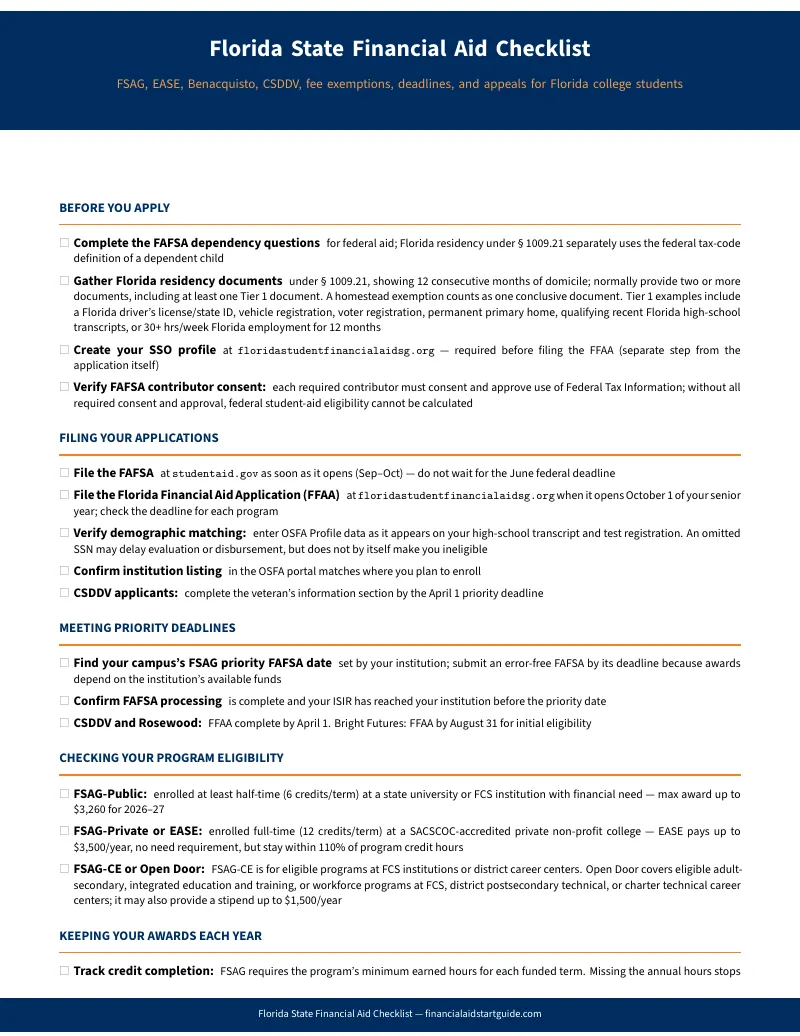
If spending on this guide would create a hardship, go directly to your college's financial aid office — they help with the same process for free. The free two-page checklist below covers the basic programme list, applications, and deadlines at no cost.
Full refund, no time limit
If the guide does not help, email [email protected] for a full refund. There is no time limit on refund requests.
Get started
Download the free Florida State Financial Aid Checklist for a two-page overview of the programmes, applications, and deadlines. When you are ready for the full walkthrough — residency documentation, renewal tracking, appeal preparation, and programme-by-programme guidance — get the complete Florida State Aid Navigator for .
Frequently Asked Questions
What if the rules change after I buy?
We update the guide when the rules change. Email us any time, even years later, and we'll send you the current edition free.