You Shouldn't Need a Law Degree to Keep a Scholarship You Already Earned
You earned the GPA, logged the service hours, and hit the test score cutoff. The FFAA went in on time. Bright Futures was supposed to be the reward — tuition covered, path clear, one less thing to worry about.
Then the rules started piling up. Annual credit hour minimums that nobody explained. A GPA calculation that doesn't match the number on your transcript. A course withdrawal that can trigger a repayment bill; a verifiable illness or documented emergency may qualify for an exception. A "Not Funded" status on the OSFA portal that means nothing — or everything — depending on whether your Social Security Number matches across three different systems.
The official handbook is three separate PDFs spread across the FDOE website. Your campus financial aid page explains its own procedures but doesn't tell you which problems are campus-level and which go back to OSFA. Reddit threads give you fragments — one student's story at one university — and half the advice is outdated or wrong for your award type.
The Bright Futures Compliance System
This guide puts the entire Bright Futures lifecycle in one place: qualifying during high school, applying through the FFAA, keeping the award term by term, understanding exactly what happens when something goes wrong, and knowing every available path to get it back.
It covers all four awards — Florida Academic Scholars, Florida Medallion Scholars, Gold Seal Vocational, and Gold Seal CAPE — because families who only know about one award leave money on the table, and students who don't understand the differences between them make decisions that close doors unnecessarily.
This is not a summary of what the scholarship is. You can get that from OSFA's homepage. This is the operational manual for navigating it — the repayment condition for renewal, how course hours affect annual earned-hour requirements, the distinction between state-level restoration and institutional hardship appeals, the transfer steps that prevent funding gaps, and the worksheets that let you track your standing semester by semester instead of finding out you've lost eligibility after the fact.
What's Inside the Guide
- Four-award qualification tables — side-by-side requirements for FAS, FMS, GSV, and GSC with the 2026–27 and 2027–28 test score thresholds, so you can see exactly where you stand and which awards are within reach
- OSFA GPA calculation walkthrough — how OSFA recalculates your GPA from 16 core credits with its own weighting rules, why your transcript number is almost certainly different, and how to check the real number before the FFAA deadline
- FFAA filing roadmap — the October 1 to August 31 window, the December 31 midyear graduate deadline, the demographic matching required for test-score reporting, and what to check if your scores or identifying information don't match your transcript
- Renewal compliance tracker — the annual GPA and earned credit hour thresholds by award level, how part-time enrolment and summer terms factor in, and what changes at each spring evaluation
- Course repayment decision tree — the repayment requirement, how repayment returns hours to your remaining funding balance, and how the course affects annual earned-hour renewal requirements
- GPA restoration vs. credit loss diagnostic — the one-time statutory GPA restoration that OSFA administers, who qualifies, when it applies, and why credit-hour shortfalls are not eligible for GPA restoration
- Hardship and medical appeal preparation — evidence checklists, structural outlines for institutional appeals, documentation requirements for medical withdrawals, and the difference between what OSFA handles and what your institution decides
- Transfer and transient student routing — how to update your institution code so funding follows you, the FloridaShines transient course application, and summer funding rules for students splitting time between institutions
- Semester tracking worksheets — printable logs for service hours, earned credit hours, GPA calculations, and deadline tracking across your entire award period
Who This Guide Is For
- High school juniors and seniors targeting FAS, FMS, or a Gold Seal award — and the parents helping them log service hours, verify test score submission, and file the FFAA correctly
- College students who lost or are about to lose Bright Futures after a hard semester, a medical withdrawal, or a course drop, and need to understand whether restoration, repayment, or a campus appeal is the right move
- Transfer students moving from a Florida College System institution to a state university (or the reverse) who need to keep funding uninterrupted through the transition
- First-generation college families who don't have someone who's already navigated the FFAA, the OSFA portal, and the renewal cycle to explain what the official language actually means in practice
Why Free Resources Aren't Enough
Every rule governing Bright Futures is public. The OSFA handbook chapters, the statute text, your campus financial aid office — all of it is free. This guide does not contain secret information.
What it does is solve the problem that free resources create: the rules are scattered across three OSFA handbook chapters, dozens of campus-specific pages, and statute sections that reference each other in circles. When your student's scholarship is suspended, you don't have weeks to piece together how GPA restoration differs from credit-hour restoration, whether an illness or emergency appeal goes to your institution for review and recommendation to OSFA, and how repayment affects the funding balance separately from earned hours.
The guide organises the scattered rules into one walkable path, with decision trees that tell you which section applies to your situation, worksheets that track the numbers the system actually evaluates, and preparation outlines for the conversations you'll have with your campus financial aid office. You can still call OSFA and your campus office for free — and you should. This guide makes sure you walk in knowing the right questions to ask.
Satisfaction Guarantee
If the guide doesn't help you navigate Bright Futures more confidently, email [email protected] for a full refund, no time limit. No forms, no hoops.
Get Started
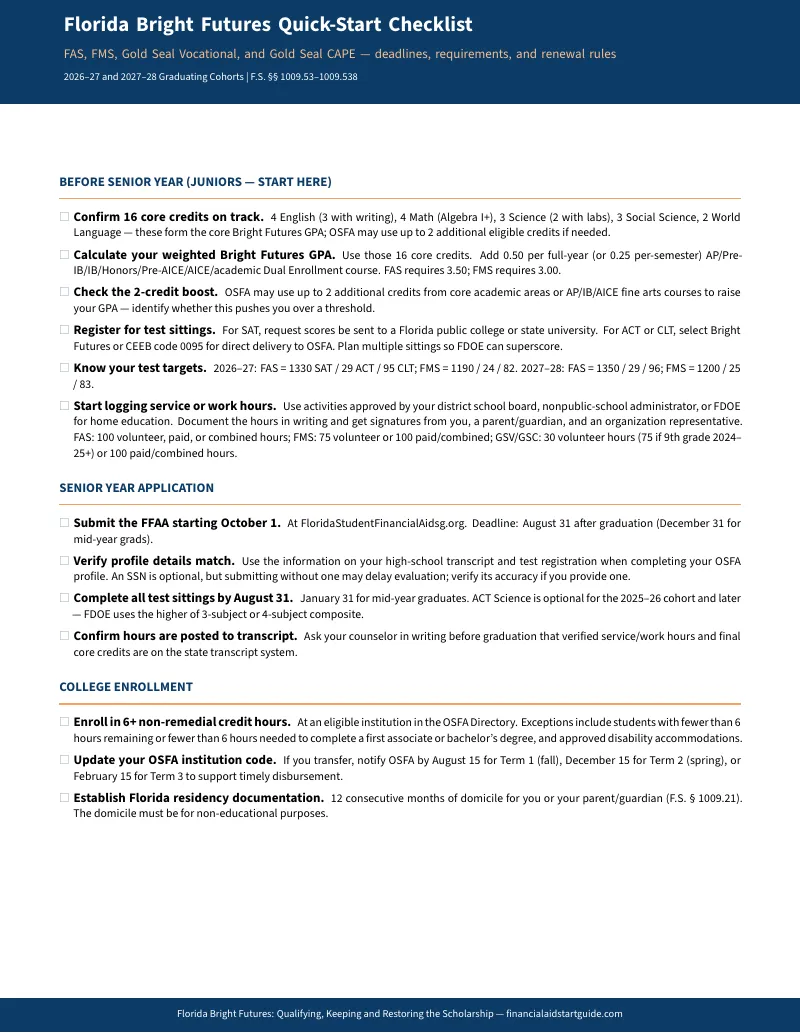
Download the free Florida Bright Futures Checklist for a two-page reference of the requirements, deadlines, and renewal rules. When you're ready for the full compliance system — GPA walkthroughs, repayment decision trees, appeal preparation, and semester tracking worksheets — get the complete guide for .
Frequently Asked Questions
What if the rules change after I buy?
We update the guide when the rules change. Email us any time, even years later, and we'll send you the current edition free.