You filed the FAFSA. California has a second layer — and its own deadlines.
Most families treat the FAFSA as the finish line. In California, it is the starting gate. The state runs its own grant programs through the California Student Aid Commission — including Cal Grant A, Cal Grant B, Cal Grant C, the Middle Class Scholarship 2.0, the California College Promise Grant, and the Chafee Grant for foster youth — with program-specific eligibility rules, income and asset ceilings, and filing deadlines.
Your school's financial aid page says "apply by March 2." It may not explain that a FAFSA or CADAA submission alone does not send your GPA to CSAC — your GPA must also be sent, either by school upload or paper Form G-4, with routing depending on your school and completed units. Community college students have a September 2 deadline for competitive Cal Grant awards; eligible students may also apply to the separate Expanded Entitlement Program for Cal Grant A or B by September 2. And the WebGrants 4 Students portal can show a hold, a form requirement, or a status you have never seen before.
That is where families get stuck — not because the information does not exist, but because it is scattered across CSAC, campus portals, Education Code sections, and budget trailer bills, and nobody has put the full sequence in one place.
The California State Aid Navigation System
This is not a list of grants with bullet-point summaries. The California State Aid Navigation System is a structured, step-by-step workflow for the California state financial aid programs, deadlines, forms, and appeal routes covered in the guide — organized in the order you actually encounter them.
The guide covers the full 14-chapter process: from choosing the right application track (FAFSA or California Dream Act Application), through the separate GPA verification step, through the eligibility and renewal rules for the grant programs it covers, through the stacking order that determines how state, federal, and institutional aid interact, and through the appeal routes available when something goes wrong.
What the guide covers
- Filing track selector — FAFSA or CADAA — the guide explains the two application tracks and the filing steps for each
- GPA verification routing — a separate step from FAFSA or CADAA submission. The guide explains who must submit your GPA (high school vs. college, depending on your completed units), by which deadline, and what to do if the submission fails or your school does not participate in electronic upload
- WebGrants 4 Students account audit — the guide walks through checking FAFSA or CADAA receipt, GPA matching, award status, school choice, and outstanding holds
- Cal Grant A, B, and C covered — Cal Grant A (tuition at four-year institutions), Cal Grant B (access grant with a living allowance for the highest-need students), and Cal Grant C (vocational and technical programs), with income ceilings, asset limits, age cutoffs, and entitlement vs. competitive distinctions
- Middle Class Scholarship 2.0 explained — why MCS awards change mid-semester, how the "last-dollar" formula interacts with Pell Grants and institutional grants, and what to do when your campus portal shows a surprise balance
- Community college programs — California College Promise Grant fee waiver, Student Success Completion Grant, and the September 2 competitive Cal Grant deadline. Eligible CCC students may also apply to the separate Expanded Entitlement Program for Cal Grant A or B by September 2; that program's rules are not covered in this guide
- Supplementary programs — Chafee Grant for foster youth, Students with Dependents supplement, Foster Youth Access supplement, CalKIDS, and the Golden State Teacher Grant
- Residency and AB 540 — the difference between admission residency and financial aid residency, the AB 540 nonresident tuition exemption, and the appeals process when your classification is wrong
- Aid stacking order — how federal Pell, state Cal Grants, institutional grants, MCS 2.0, and fee waivers layer together, and why the packaging order determines what you actually receive
- Renewal, SAP, and lifetime limits — what it takes to keep each award year after year, how enrollment intensity consumes your eligibility, and the Satisfactory Academic Progress rules that can suspend your aid
- Appeals and Professional Judgment — CSAC late filing appeals, campus-level special circumstances reviews under HEA Section 479A, residency reclassification disputes, and SAP suspension appeals
Who this guide is for
- A high school senior or parent filing for California state grants for the first time, who needs the full picture — not just the March 2 deadline, but every step from application through award notification
- A community college student navigating the CCPG fee waiver, the September 2 competitive deadline, and the transfer entitlement rules for moving to a UC or CSU
- An adult returning student whose eligibility depends on updated age limits and unit thresholds that changed in recent budget cycles
- A family in a mixed-status household choosing between the FAFSA and the California Dream Act Application
- Any California student whose WebGrants portal shows a hold, a form requirement, or a status they do not understand — and who needs to act before a deadline expires
Why the free checklist is not enough
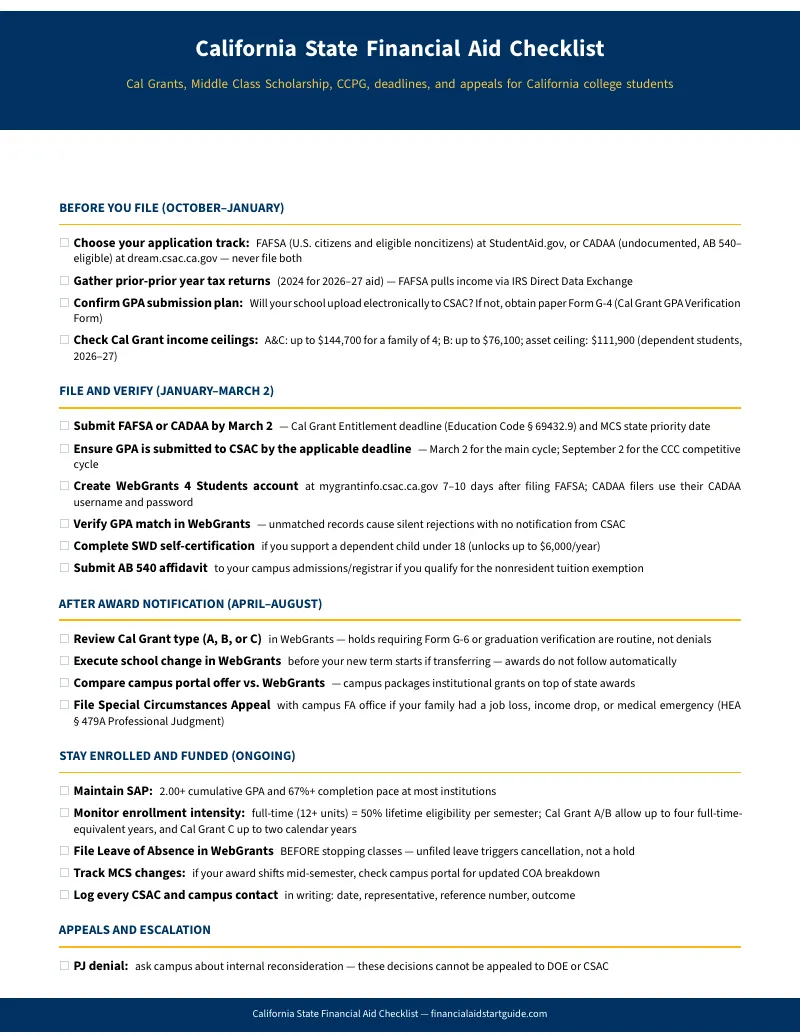
The free checklist gives you the core deadlines, the filing track decision, and the essential verification reminders. It covers what to do — file by March 2, confirm your GPA submission, check WebGrants.
What it cannot do is explain the GPA routing rules (high school vs. college, depending on your completed units), walk you through the grant programs' income ceilings and asset limits, show you how to audit application and GPA records and review outstanding WebGrants holds, or map the appeal routes when a state award is lost, reduced, or refused. It does not cover how the Middle Class Scholarship recalculates mid-semester, or how to stack state grants with federal and institutional aid so nothing falls through the gaps.
AI appeal-letter generators produce narrative text for institutional reviews — but California state grants are governed by statutory eligibility rules at CSAC, not campus narrative appeals. Generic financial aid templates use outdated terminology from before the FAFSA Simplification Act and do not address California-specific forms, portals, or deadlines. Private financial aid consultants charge hundreds of dollars per session for general planning — not a focused, California-specific toolkit priced at .
The California State Aid Navigation System fills the gap between the free one-page checklist and a paid consultant: a structured, affordable guide to the California state programs, deadlines, and appeal routes covered in the book for .
What this guide is not
This is an independent educational resource. It is not affiliated with, endorsed by, or connected to the California Student Aid Commission, the U.S. Department of Education, Federal Student Aid, any UC, CSU, or community college campus, or any state agency. It does not write appeals, provide financial or legal advice, or represent your family to any institution. State financial aid eligibility is determined by California Education Code provisions and institutional policies, and no product can guarantee a specific award, dollar amount, or processing timeline.
If you cannot afford this guide without cutting a basic household expense, go directly to your college's financial aid office or attend a free Cash for College workshop. They provide free help with the same programs. The guide includes direct links to CSAC, WebGrants, StudentAid.gov, and campus financial aid offices throughout the text.
Satisfaction guarantee
Full refund, no time limit. If the guide does not help you navigate California's state financial aid process, email [email protected] for a complete refund — no questions, no expiry.
Download the free California State Financial Aid Checklist to see the core deadlines and filing steps. When you are ready for the full system — the grant programs mapped, deadlines tracked, and appeal routes explained in the guide — the complete guide is here.
Frequently Asked Questions
What if the rules change after I buy?
We update the guide when the rules change. Email us any time, even years later, and we'll send you the current edition free.