The CADAA Is Not the Hard Part — Keeping Every Portal in Sync Is
You filled in the California Dream Act Application. You hit submit before March 2. Then your college portal still shows out-of-state tuition. WebGrants says "GPA Never Submitted." Your parent cannot complete the electronic signature with you and needs the separate consent link. And the CSAC helpline puts you on hold for two hours during peak season.
None of those problems mean you did something wrong. They mean the California state aid system runs across three separate offices — CSAC, your campus Financial Aid office, and Admissions & Records — and none of them automatically talk to each other. A completed CADAA does not clear your tuition hold. A submitted GPA does not mean CSAC matched it. A correct application does not mean your parent's electronic signature went through.
The Multi-Portal Filing System for AB 540 State Aid
The California Dream Act Application Guide is a step-by-step filing system built around the specific points where the CADAA process breaks down. It covers the full cycle — eligibility verification through AB 540/SB 68/SB 1141, the CADAA filing itself, parent signatures, GPA verification and force-match requests, and the Cal Grants, Middle Class Scholarship, California College Promise Grant, Student Success Completion Grant, and Chafee grants — organized so you handle each portal's requirements in the right order, before a missed step costs you an award.
This is not a summary of what Cal Grants exist. It is an operational guide to making sure your CADAA, your AB 540 affidavit, your GPA verification, and your campus records are all connected — because when one piece is out of sync, the others stall silently.
What's Inside
- AB 540 / SB 68 / SB 1141 eligibility audit — a self-assessment for each qualifying path, including how to count adult school and community college hours toward the three-year attendance requirement, and how to confirm your Admissions & Records office received the affidavit included with your CADAA
- CADAA filing walkthrough — the application screen by screen, with the income and household questions that trip up families where a parent does not file taxes or does not have an SSN, and the filing-track selector so you do not accidentally submit a FAFSA instead
- Parent signature resolution — the 2026–27 CADAA signature section and the separate consent link when the selected parent cannot sign with the student, covering the most common reason applications sit unprocessed for weeks
- WebGrants GPA verification and force-match protocol — how to check whether your school transmitted your GPA, what to do when WebGrants shows "GPA Never Submitted," and how to request a manual CSAC force match before the priority deadline passes
- California grant comparison tables — Cal Grant A (tuition at UC/CSU), Cal Grant B (access costs plus tuition after year one), Cal Grant C (career technical education), the Middle Class Scholarship, the California College Promise Grant, the Student Success Completion Grant, and Chafee grants for current and former foster youth — with the income and GPA thresholds, the entitlement-versus-competitive distinction, and which grants stack
- Transfer Entitlement certification — the WebGrants certification eligible community college transfer students must complete after a preliminary award to claim the award
- Appeal routes and deadlines — Form G-18 for Cal Grant denial or loss, the late GPA verification appeal, the September 2 Community College Expanded Entitlement deadline, and what evidence CSAC requires for each
- Privacy protections — what information the CADAA collects, CSAC's stated commitment not to share it with federal immigration authorities, and the guide's caution about federal subpoena powers
- Renewal and transfer rules — what it takes to keep each award year to year, how transferring between campuses affects your grants, and the satisfactory academic progress standards that can suspend them
Who This Is For
- High school seniors and their parents filing the CADAA for the first time alongside college applications
- Community college students applying for Cal Grants or transferring to a UC or CSU and needing to keep their state aid
- Adult students returning to education who qualify under SB 68 or SB 1141's expanded attendance rules
- Independent or estranged students navigating the CADAA without parental financial information
- Families where a parent does not have a Social Security Number and the electronic signature process has stalled
- Anyone whose WebGrants portal shows a hold, a missing GPA, or a denied award and who needs to understand the appeal route
Why Not Just Use the CSAC Website and Your Campus Aid Office?
You should. CSAC's portal, the campus Dream Resource Center, Cash for College workshops, and organizations like Immigrants Rising are free and staffed by people who can act on your file. This guide does not replace any of them.
What the guide does is put the scattered requirements from CSAC, Admissions & Records, and your Financial Aid office into one sequence. Official sources explain each rule on its own page. The guide shows you which steps depend on which, what to verify at each portal before moving on, and what to do when a GPA doesn't match, a signature stalls, or an award disappears — because the gap between "the rules exist online" and "all three offices agree your file is complete" is where most applicants lose time and money.
Generic financial aid planners on Etsy track deadlines but do not know what a CSAC force match is. AI appeal generators write federal letters but have never seen Form G-18. Private consultants who do know the California system charge hundreds of dollars. The guide sits between: it covers the California-specific portal mechanics at a fraction of that cost.
What You Get
- The full guide — 47 pages covering eligibility, filing, every grant program, appeals, privacy, and renewal
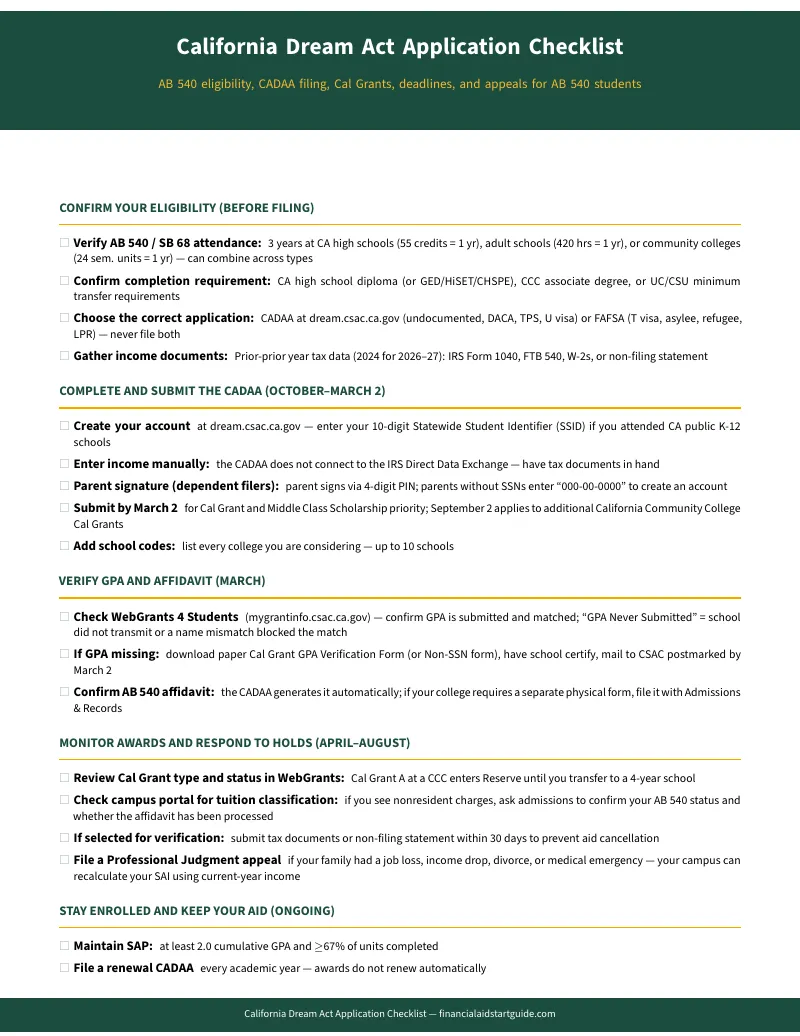
- The filing checklist — a two-page checklist of AB 540 eligibility, documents, and deadlines you can print and work through
- 5 printable tools — an AB 540 eligibility audit worksheet, a CADAA filing tracker, a WebGrants monitoring log, a portal notice decision tree, and an agency communication log you can print and use across all three offices
Full refund, no time limit. If the guide does not help, email [email protected] and you will get a complete refund — no questions, no expiry.
Start with the free checklist
Download the California Dream Act Application Checklist at no cost — it covers the key eligibility criteria, the documents you need, and the deadlines. If you want the full step-by-step system with every grant program, appeal route, and portal walkthrough, the complete guide is available on this page.
Frequently Asked Questions
What if the rules change after I buy?
We update the guide when the rules change. Email us any time, even years later, and we'll send you the current edition free.