SAAS Funding Is Not Complicated — the Instructions Are
SAAS pays your tuition directly and offers bursaries and loans for living costs. The rules are public. But when you sit down to actually apply, a different picture emerges: the portal asks for household income figures your parents are not sure how to calculate, the bursary and loan bands are split across multiple SAAS pages with no worked examples, the evidence list changes depending on whether your household is employed or self-employed, and the deadline everyone quotes is the June guarantee date — not the 31 March closing date that matters if you apply late.
Parents stall on the income section because they are unsure whether to include a step-parent's earnings, whether rental income counts as unearned, or what happens when the household income dropped after the tax year SAAS is using. Students stall because they do not know whether their previous study has eaten into the "+1 year" funding cushion. And nobody explains, in one place, how the Young Students' Bursary and the Independent Students' Bursary actually differ in assessment — or how to request a Current Year Income Assessment when the family's circumstances change mid-year.
The SAAS Funding Navigation System
This guide puts SAAS's scattered rules into the sequence a household actually follows — from checking whether previous study affects eligibility, through calculating the income band and gathering evidence, to challenging a decision that looks wrong. It is not a form-filling service and cannot predict what SAAS will award. What it does is turn the fragmented official pages into structured worksheets, printable checklists and worked examples so you can submit a correct, complete application without guessing.
What's Inside
- Tuition and Cross-Border Rules — SAAS pays tuition fees as a grant for Scottish students in Scotland (currently £1,820 per year). If you study in England, Wales or Northern Ireland, a Tuition Fee Loan covers up to £9,790 instead. The guide explains which funding applies to your course and what a cross-border move means for your package.
- Bursary and Loan Band Breakdown — The Young Students' Bursary (up to £2,000) and Independent Students' Bursary (up to £1,000) are non-repayable grants that taper across household income bands. The guide maps every band with the corresponding loan amount and total package, so you know what to expect before the award letter arrives.
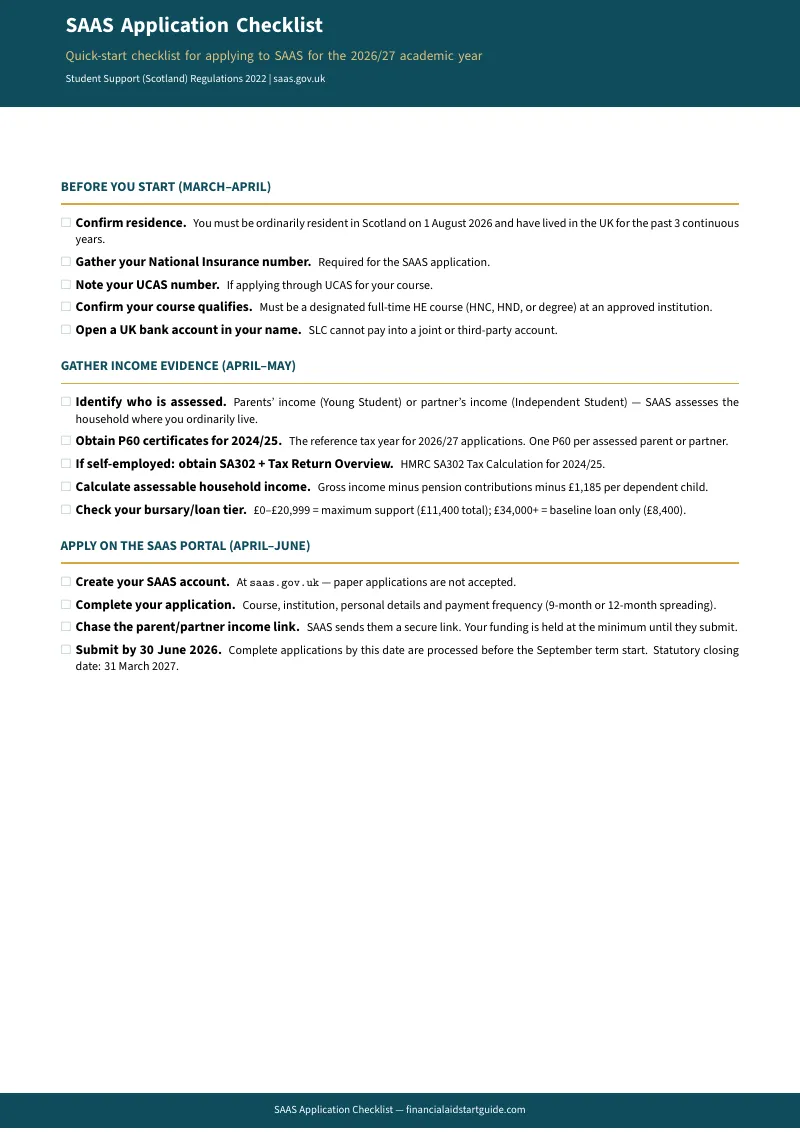
- Household Income Evidence Checklist — A printable checklist organised by household type: employed (P60), self-employed (SA302 or accountant's letter), divorced or separated (which parent is assessed), step-parent and cohabiting partner rules, and what to do when a parent refuses to share their income.
- Current Year Income Assessment Worksheet — When household income drops significantly — through redundancy, illness, reduced hours or separation — SAAS can reassess using estimated current-year figures. The worksheet walks through the calculation, lists the supporting documents and explains how the year-end reconciliation works.
- Previous Study and the +1 Rule — SAAS funds your course length plus one additional year. Prior higher education study counts against that allowance. The guide maps how switching courses, repeating a year or holding a prior qualification affects your remaining entitlement, and what counts as compelling personal reasons for extra funding.
- Young vs Independent Student Classification — Whether you are classified as a young or independent student changes whose income is assessed and which bursary you can receive. The guide sets out the criteria — age, marriage, self-support, care experience — and explains what to do if you believe you have been classified incorrectly.
- Care-Experienced and Estranged Routes — Care-experienced students can receive a £9,000 non-repayable bursary with a £2,400 optional loan. Estranged students need third-party evidence of permanent family breakdown. The guide covers the documentary requirements for each route and signposts specialist charities (Who Cares? Scotland, Stand Alone) for additional support.
- Plan 4 Repayment Explained — Scottish student loans are repaid under Plan 4: 9% of income above £33,795, deducted automatically through PAYE. The guide explains the threshold, voluntary overpayments, what happens when you work overseas, and the circumstances under which the balance is written off.
- Appeals and the SPSO Complaints Route — If a SAAS funding decision looks wrong, the guide explains how to appeal it separately from making a service complaint, and how to refer an unresolved complaint to the Scottish Public Services Ombudsman (SPSO) after SAAS's complaints procedure is complete.
Who This Is For
- Scottish school leavers applying to SAAS for the first time who need to understand bursary and loan bands, what evidence to upload and when to apply so the money arrives at the start of term
- Parents and step-parents gathering P60s and income evidence for a son, daughter or partner's application, unsure how household income is calculated or whether their earnings are included
- Adult learners aged 25 and over entering higher education as independent students, needing clarity on how their own and a partner's income is assessed
- Families whose income has dropped since the relevant tax year and who need to request a Current Year Income Assessment before the shortfall compounds
- Students with prior higher education study who need to check whether the +1 year rule still covers their new course
- Care-experienced or estranged students navigating the specialist evidence and bursary routes
Why Not Just Use the Free Information?
SAAS.gov.uk publishes every rule, every threshold and every form at no charge. The SAAS helpline (0300 555 0505) answers questions about individual applications. Your university's money advice team offers free appointments. Citizens Advice Scotland helps with benefit interactions and debt. These should always be your first port of call for personalised guidance.
The gap is structural. SAAS publishes bursary and loan amounts on one page, income evidence requirements on another, and the Current Year Income Assessment on a third — with no worked examples connecting them. Forum advice is contradictory (some threads still cite English rules or pre-2022 regulations). And no free resource combines the income band calculation, the evidence checklist, the previous study mapping and the appeals process into a single sequence you can follow from start to finish.
The SAAS Funding Navigation System is the preparation step that free resources skip: one structured document that puts the rules, the arithmetic and the evidence into the order you need them.
What This Guide Does Not Do
This guide does not submit forms, contact SAAS or provide legal advice. It is not affiliated with SAAS, the Scottish Government, the Student Loans Company, any university or any lender. It cannot guarantee any bursary, loan amount or decision. Entitlement depends solely on your verified household income and circumstances as assessed by SAAS.
The customer contact is [email protected]. The refund policy is a full refund, no time limit.
Frequently Asked Questions
What if the rules change after I buy?
We update the guide when the rules change. Email us any time, even years later, and we'll send you the current edition free.