The NI Student Finance Roadmap: Every Form, Threshold and Deadline in One Place
You are staring at a stack of forms — PN1, PFF2, maybe a CYI or a DSA1 — and each one points you to a different PDF booklet on a different website. The Student Finance NI portal splits its guidance across dozens of documents. The nidirect income tables show you the thresholds but not the deductions. The university funding page explains the hold on your account but not how to clear it. And somewhere in the background, English student finance announcements keep appearing in your search results, making you wonder whether Plan 5 or the Lifelong Learning Entitlement applies to you. It does not.
The Student Finance NI Roadmap pulls every rule, form, threshold and deadline into a single guide that follows the actual order of the process — from working out whether you qualify, through submitting the right evidence, to challenging a decision that looks wrong.
What's Inside the Guide
- Cross-border jurisdiction clarity — NI students studying in England, Scotland or Wales face different fee caps but stay on Plan 1 repayment terms. The guide maps the exact tuition fee loan limits and maintenance loan rates for every study location, so you know your numbers before you apply.
- Household income worked example — official form notes list what counts as income, but they do not walk you through the deductions. The guide includes a step-by-step breakdown of how eligible private pension contributions and additional voluntary contributions paid outside a workplace scheme, and sibling dependant allowances, reduce assessable household income, with a worked example that shows the arithmetic. Print the Household Income Deduction Calculator to run your own figures before form PFF2.
- Evidence checklists for every applicant type — standard full-time students, current year income claimants, estranged and care-experienced students, disabled students applying for DSA, and student parents each face different evidence requirements. Print the Application Evidence Checklist (22 items) and tick each document as you gather it.
- Payment hold troubleshooting — if your maintenance payment has not arrived at term start, print the Payment Hold Troubleshooter and work through five checks in order: declaration form status, your NINO details if you have one, attendance confirmation, whether your entitlement letter matches, and bank details.
- Complaints and appeals — the guide distinguishes how to challenge an entitlement decision from how to complain about service, including the Education Authority's two-stage complaint procedure and route to the Northern Ireland Public Services Ombudsman. Draft the letter on the Appeal Structure Template.
- Extra grants most applicants overlook — the Special Support Grant, Childcare Grant, Parents' Learning Allowance and Adult Dependants' Grant each have their own eligibility rules and evidence requirements. The guide covers who qualifies for each one and how claiming one can affect another.
Who This Guide Is For
This guide is for NI-domiciled students and the parents or partners completing the income forms alongside them. It is especially useful if you are applying for the first time, studying outside Northern Ireland, navigating an income drop, gathering evidence as an independent or estranged student, or trying to understand a decision that does not match what you expected.
It is not for students domiciled in England, Scotland or Wales — each of those nations has its own funding body and different rules. If you are not sure which funding body covers you, the guide's opening chapter explains the domicile test.
Why Not Just Use the Official Websites?
Every statutory rule in this guide is published somewhere on nidirect.gov.uk, studentfinanceni.co.uk, or the Education Authority's site. The information is there. What is not there is a single document that puts it in order.
To understand how household income is assessed, you need the PN1 notes for the application rules, the PFF2 form notes for the income categories, the nidirect income tables for the thresholds, and the separate dependants' grants booklet if you have children. That is four documents across two websites for one question. The guide consolidates the answer into one chapter with one worked example.
If you are an estranged student, the SFNI form notes define the criteria for independent status — the guide lists examples of third-party evidence from a social worker, local Jobs and Benefits Office, advice worker, personal tutor, teacher or doctor, and explains what a parent's refusal to provide income information does and does not mean for independent status.
Satisfaction Guarantee
The guide comes with a full refund, no time limit. If it is not what you need, email [email protected] and you will receive a complete refund.
Free Checklist
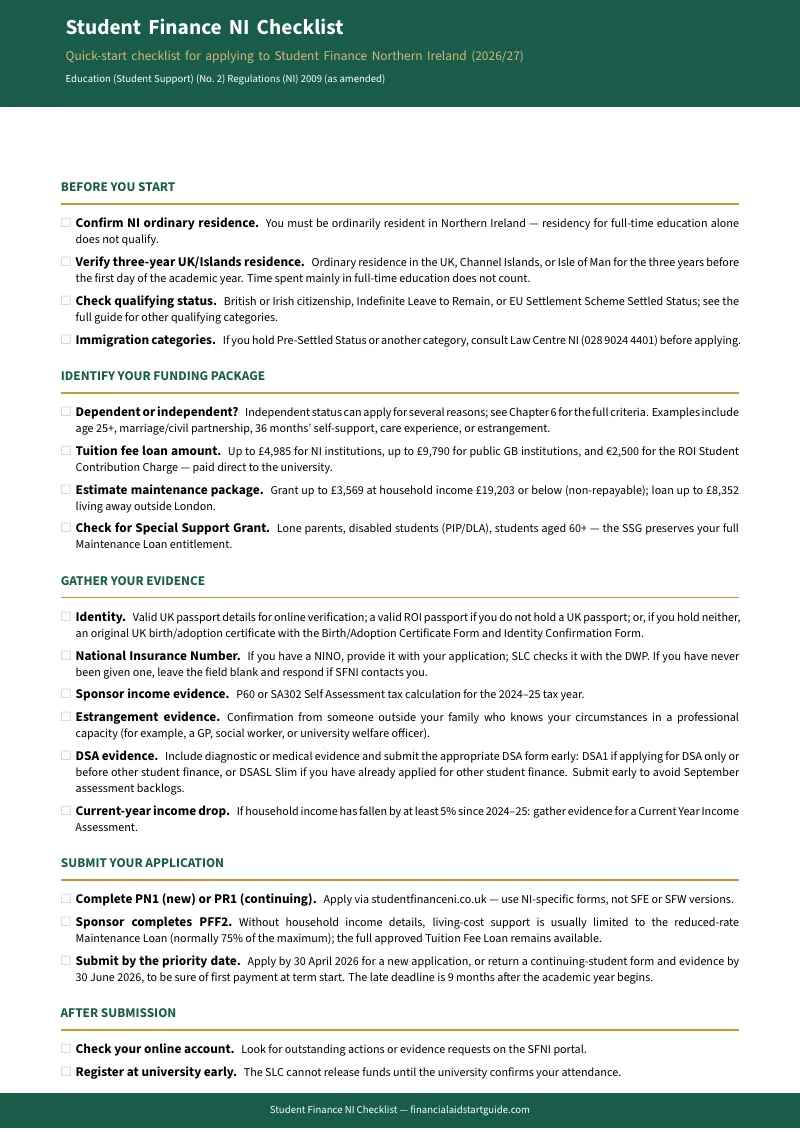
Not ready for the full guide? Download the free Student Finance NI Checklist — a two-page summary of the application steps, key evidence items, deadlines and extra grants. It covers what to do. The full guide covers how, with worked examples, deduction calculations, evidence preparation for every applicant type, and the complete review and appeal process.
The guide costs less than a single hour of a private education consultant's time — and unlike a consultant, you can refer back to it at every stage of the process.
Frequently Asked Questions
What if the rules change after I buy?
We update the guide when the rules change. Email us any time, even years later, and we'll send you the current edition free.