The SFE Application Coordination System
You're staring at a Student Finance England portal that wants household income from a tax year that ended eighteen months ago, a parent or partner declaration you can't quite explain to the person who needs to fill it in, and a deadline that — if you apply close to the start of your course or after it starts — can mean starting university on the minimum loan while everyone else's money has already landed.
The official guidance is scattered across GOV.UK pages, PDF form notes, and processing-time updates that change weekly. By the time you've found the right document, you're not sure whether it answers the question you started with.
Why the usual approach falls apart
Free tools handle the simple case — a single-earner PAYE household where both accounts link on the first try. The moment your situation involves a step-parent, self-employment income, a recent income drop, or a sponsor whose online declaration never seems to arrive, the official pages leave you piecing rules together from five different PDFs with no clear order.
Budget trackers on Etsy assume you've already received your loan. AI appeal generators cite outdated thresholds and mix up English rules with Scottish ones. Neither helps you get the right amount assessed in the first place.
What makes this different
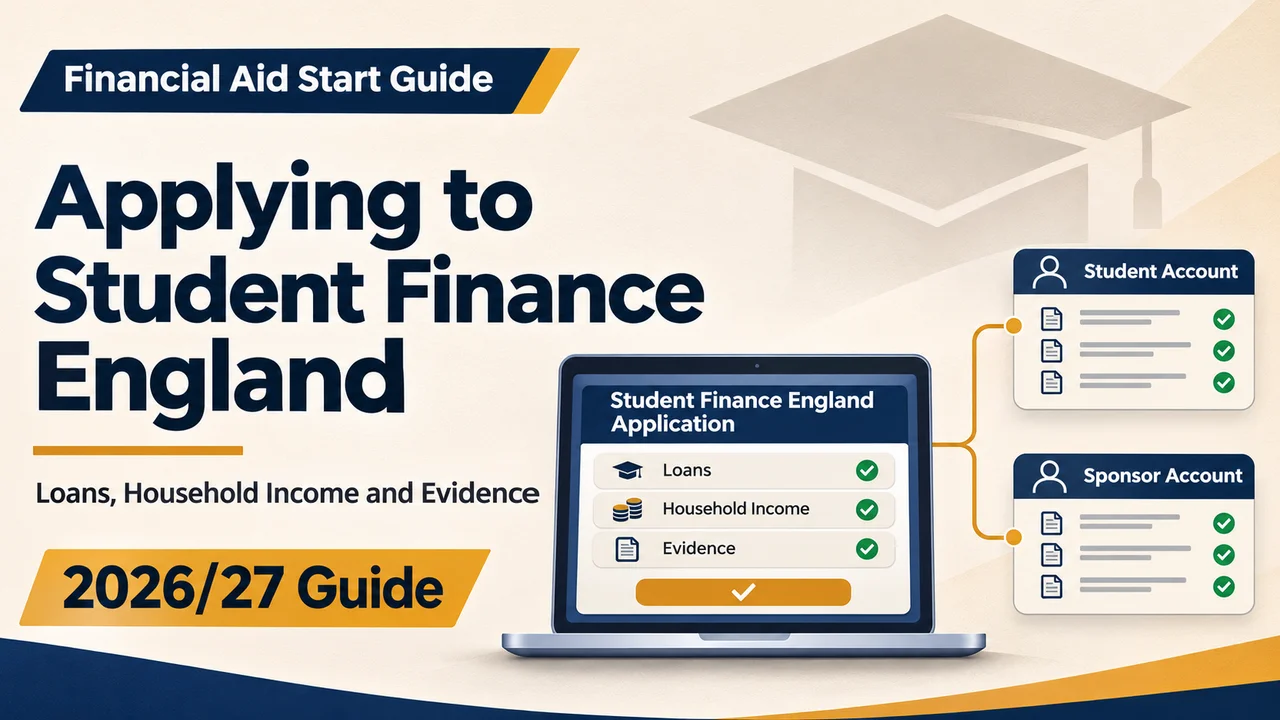
The SFE Application Coordination System puts the entire process — student application, sponsor declaration, evidence, deadlines, reassessment — into a single sequence. Every step tells you who does what, which form or screen to use, and what SFE is checking at that stage.
What's inside
- The Tuition Fee and Maintenance Loan Breakdown — which loans to apply for, the 2026/27 maintenance loan bands by living situation, and how the income taper works so you know what to expect before SFE confirms it
- The Household Income and Sponsor Declaration Walkthrough — who counts as a financial sponsor, what the prior-prior tax year means in practice, and step-by-step instructions for the online declaration and paper PFF2 form
- The Evidence Matching Grid — what to have ready for PAYE, self-assessment, partnership and other income, and when SFE asks for evidence for the 2024/25 assessment
- The Account Linkage Protocol — how to connect student and sponsor accounts using Customer Reference Numbers, and what to do when the digital link fails
- The Provisional Award Decoder — why SFE issues a minimum loan while sponsor evidence is pending, how to tell a provisional notice from a final decision, and the steps to trigger reassessment
- The Current Year Income Reassessment Roadmap — the three-step process for families whose income has fallen by 15% or more, including when a baseline PFF2 is needed because 2024/25 income details have not already been provided
- The Deadline and Processing Timeline — target dates for new and returning students, the realistic processing window, and what to do if your application is still pending as term approaches
- The Decision Challenge Protocol — how to request a review when the assessed amount looks wrong, who can help, and when to escalate to the Independent Assessor or the Public Service Ombudsman
Plus six standalone planning tools — a fillable application timeline planner, household income calculation worksheet, evidence tracking log, sponsor account setup checklist, maintenance loan taper calculator and SFE communication log — designed to be printed and used alongside the application process.
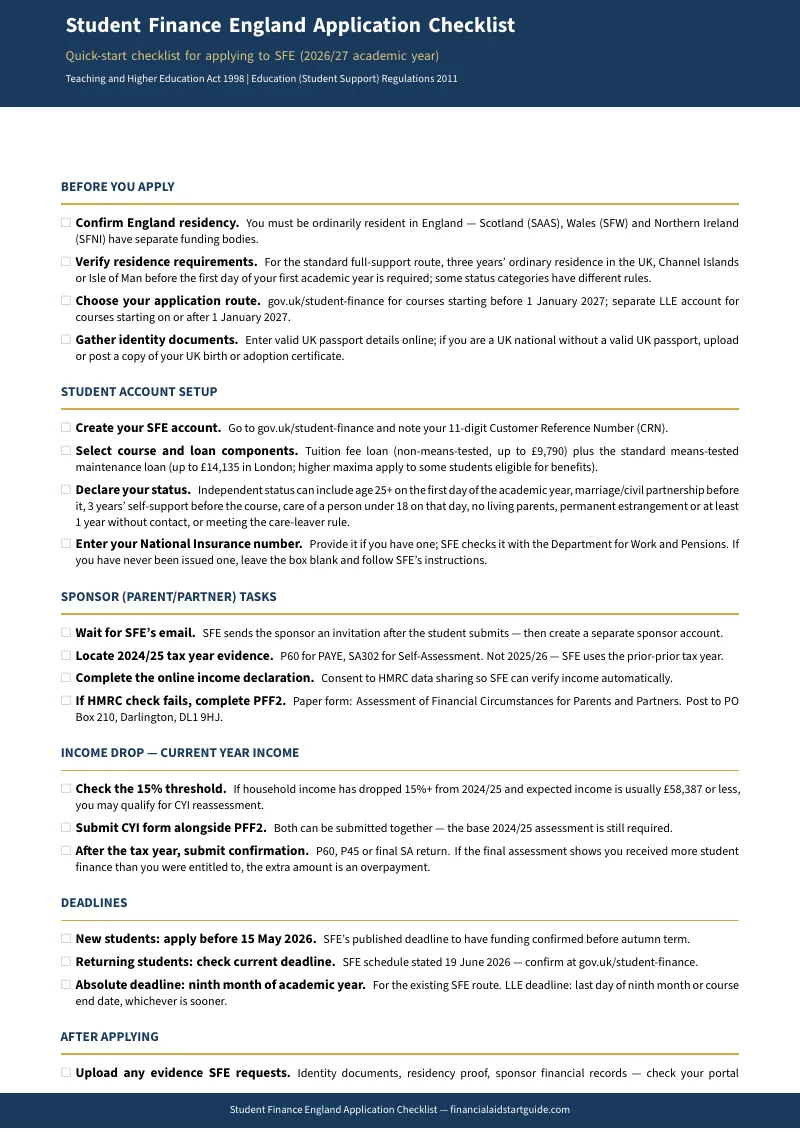
And the free checklist — a two-page rundown of every step, form and deadline — which you can download right now without buying anything.
Who this is for
- Students in England applying to SFE for the first time or returning for another year
- Parents or partners completing the financial declaration — especially if household income includes self-employment, rental income, or multiple earners
- Families whose income has dropped since the base tax year and who need a Current Year Income reassessment
- Anyone who received a provisional minimum loan and is not sure whether that's the final answer
Who this is not for
- Students in Scotland (SAAS), Wales (Student Finance Wales) or Northern Ireland (SFNI) — each has separate rules, forms and thresholds
- Postgraduate students applying for Master's or Doctoral loans, which follow a different single-allocation framework
- Anyone looking for legal representation, guaranteed funding outcomes, or help misrepresenting income or household circumstances
Why not just use the free stuff?
You should start with it. GOV.UK, your university's student money advice team, and SFE's own helpline are all free, and the guide says so on every relevant page. The gap is coordination: official sources describe each rule in isolation, and none of them walks you through what to do when the sponsor account won't link, the wrong tax year's figures have been submitted, or the portal shows a minimum loan two weeks before term. The guide covers those scenarios in the order you'll meet them.
No-risk purchase
Full refund, no time limit — email [email protected]. The guide costs a fraction of the professional advisory fees some families pay, and less than one evening's university accommodation. If it doesn't help, you get your money back.
Get the guide and the free checklist for , or download just the checklist below — no payment needed.
Frequently Asked Questions
What if the rules change after I buy?
We update the guide when the rules change. Email us any time, even years later, and we'll send you the current edition free.