Your University Said Yes. Student Finance Said No.
The exam board approved your repeat year. Or the admissions team accepted your transfer. Or you picked yourself up after dropping out and got an offer for a fresh start. The university is ready. But Student Finance England ran your prior study through a formula you have never seen, and the portal now shows a Maintenance Loan — with zero Tuition Fee Loan beside it.
A £9,790 invoice is heading for your household. You do not know whether the plus-one year has already been consumed, whether your partial first attempt counts as a full year of previous study, or whether the "compelling personal reasons" route everyone mentions on Reddit is a real mechanism or wishful thinking. GOV.UK gives the formula and a short example, but it does not calculate your full study history for you. Your university money adviser has a six-week wait.
The Previous Study Navigation Kit
This toolkit breaks Student Finance England's previous study rules into the sequence a student and parent actually need to follow. It starts with the standard entitlement formula for previous study, works through repeating, transferring and starting again, explains the compelling personal reasons process for recovering lost funding, and ends with the Lifelong Learning Entitlement transition from January 2027.
It does not fill in your forms, write your CPR letter, or predict what SFE will decide. What it does is put the regulatory rules, the calculation steps, the evidence requirements and the appeal stages into one document — so you spend your preparation time building an accurate submission, not decoding contradictory forum advice.
What's Inside
- The Plus-One Entitlement Formula Explained — under the previous-study rules, SFE normally calculates Tuition Fee Loan years as (Course Length + 1) − Previous Study. The guide explains what counts toward your previous study total, including partial years and self-funded enrolments, with three worked examples covering a single repeat, a transfer after two years, and a dropout restarting from scratch.
- The Backwards Allocation Rule — when your entitlement is short, SFE applies available Tuition Fee Loan years from the final year backwards under Regulation 19(6), leaving the earliest years unfunded. The guide maps this out year by year so you can see exactly which terms carry a fee gap and plan accordingly.
- Repeating a Year — Attendance vs Assessment-Only — an attendance-based repeat and an assessment-only repeat have different implications for SFE funding, council tax exemption and maintenance loan eligibility. The guide explains both, including what happens when the repeat consumes your plus-one year.
- Compelling Personal Reasons Evidence System — CPR is the discretionary mechanism that asks SFE to disregard a disrupted year from your previous study count. The guide covers what qualifies, how to structure a cover letter with your Customer Reference Number, what supporting evidence GOV.UK says to include, and where to send the application. It does not promise that CPR will succeed — SFE decides each case individually.
- Course Transfer Workflow — transferring between universities or programmes requires coordinating your institution's registry, your online SFE account and sometimes Form CO1. The guide maps the steps, including how Recognition of Prior Learning can shorten your course and change your entitlement calculation.
- Withdrawal, Suspension and Overpayment Rules — the guide explains the three liability points that determine how much tuition fee your university can charge after you leave, what happens to maintenance loan overpayments, the 60-day illness rule for suspensions, and how to apply for hardship support during a break.
- ELQ Exceptions for Second Degrees — if you already hold an honours degree, the Equivalent or Lower Qualification block normally prevents further Tuition Fee Loan funding. The guide covers the statutory exceptions for healthcare, veterinary science and certain STEM courses, with a worked example for graduate-entry medicine.
- Maintenance Loan, Income Assessment and Supplementary Grants — Maintenance Loans run on separate rules from Tuition Fee Loans. The guide explains 2026/27 rates by living situation, the household income taper, current year income assessments, and supplementary grants that are not affected by previous study rules.
- The LLE Transition — for eligible courses starting on or after 1 January 2027, the Lifelong Learning Entitlement replaces the traditional system with a single flexible funding account. The guide explains how previous study deductions are calculated under the LLE and confirms that years approved under compelling personal reasons are excluded from LLE deductions.
- Worksheets and Planning Tools — six printable one-page PDFs: Attendance-History Audit Worksheet, Plus-One Entitlement Calculator, Backwards Allocation Map, CPR Evidence Checklist, Course Transfer Workflow Checklist, and Suspension Planning Checklist.
Who This Is For
- Students in England repeating a year after academic failure, illness, bereavement or personal crisis — and unsure whether SFE will fund the repeat
- Students transferring to a different course or university and needing to understand how the move affects their remaining funded years
- Students who dropped out of a previous course and are starting again, wanting to know how many funded years remain
- Parents receiving an unexpected tuition fee invoice because SFE denied the Tuition Fee Loan while still approving the Maintenance Loan
- Adult returners with complex study histories across multiple institutions who need to work out their entitlement before committing to a new course
- Students considering a compelling personal reasons application and needing to understand the evidence requirements and process
Why Not Just Use the Free Information?
You should. The SFE helpline (0300 100 0607), your university money advice team, GOV.UK and Citizens Advice are all free. Save the Student and MoneySavingExpert explain the maintenance loan system clearly. The guide references all of them.
The gap is in what happens between reading the GOV.UK summary and submitting a correct application. The entitlement formula is one paragraph on GOV.UK, but the detail — what counts as a previous study year, how partial attendance is treated, how the backwards allocation rule removes funding from early years, whether an assessment-only repeat still counts — sits across practitioner manuals, statutory instruments and university guidance pages. Forum threads give worked calculations that sometimes use outdated figures or confuse English rules with Scottish ones.
The Previous Study Navigation Kit puts the formula, the evidence requirements, the form pairings, the worked examples and the appeal stages into one structured document. It is the preparation step that scattered free resources leave to you.
What This Guide Does Not Do
It does not fill in your forms or submit anything on your behalf. SFE requires applicants to complete and sign their own declarations.
It does not guarantee any increase in funding. Entitlement is determined by the statutory formula and, for CPR requests, by individual assessment under the Regulations. No product, service or adviser can promise a specific outcome.
It is not affiliated with Student Finance England, the Student Loans Company, the Department for Education, UCAS or any university.
Your Guarantee
Full refund, no time limit. If the toolkit does not help you prepare a stronger submission, email [email protected] and we will refund your purchase. No forms, no waiting period.
Start With the Free Checklist
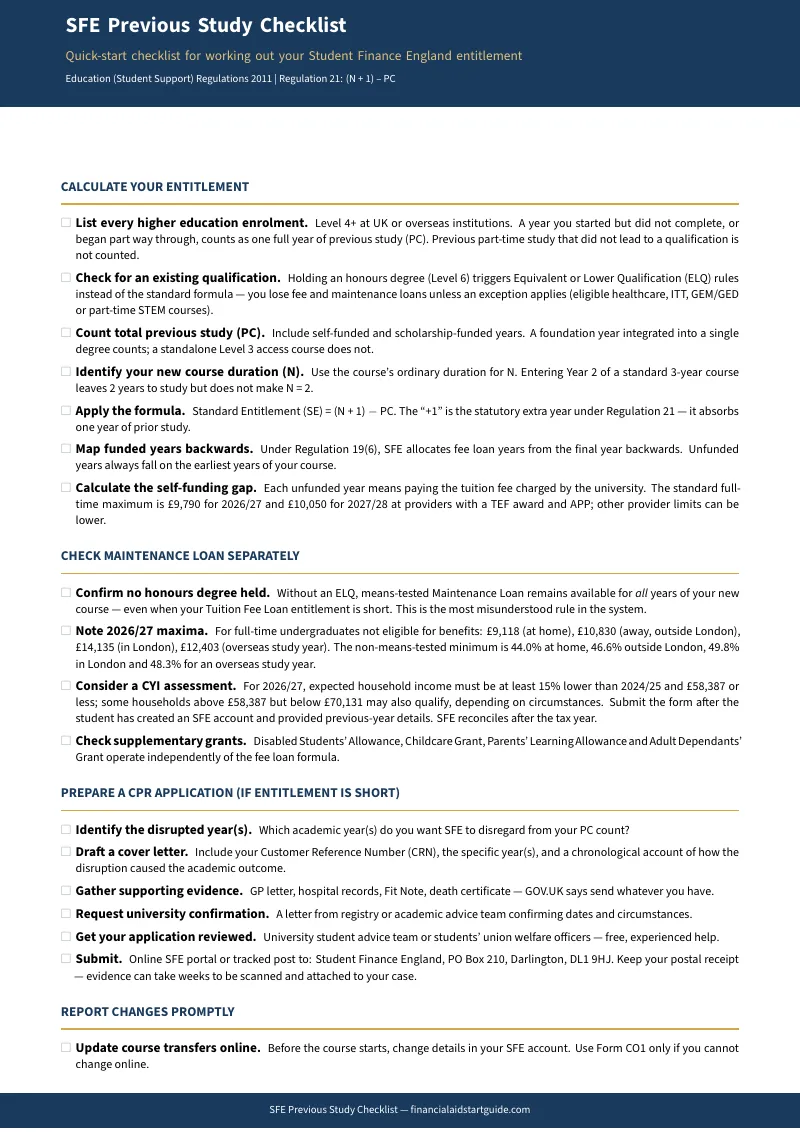
Not sure yet? Download the free SFE Previous Study Checklist — a printable overview of the entitlement formula, the CPR steps, the key deadlines and the essential contacts. It covers the what; the full guide covers the how.
If you are ready for the complete toolkit — the 51-page guide with 14 chapters, six printable worksheets (attendance-history-audit-worksheet.pdf, plus-one-entitlement-calculator.pdf, backwards-allocation-map.pdf, cpr-evidence-checklist.pdf, course-transfer-workflow-checklist.pdf, suspension-planning-checklist.pdf), three worked entitlement examples, the ELQ exceptions, and the LLE transition rules — it is available above, with a full refund, no time limit.
Frequently Asked Questions
What if the rules change after I buy?
We update the guide when the rules change. Email us any time, even years later, and we'll send you the current edition free.