The Official Rules Are All There — Spread Across Dozens of Pages You Do Not Have Time to Piece Together
You have a place on a Master's or doctoral programme, and Student Finance England will lend you up to £13,206 for a Master's or £31,122 for a PhD. The problem is not whether the money exists. The problem is that between GOV.UK guidance chapters, SFE practitioner notes, application form PDFs, and your university's registration process, no single document tells you — in order — which eligibility tests you need to pass, what evidence to gather, how to apply without triggering a hold, and what concurrent repayments will actually look like once you graduate.
Students who piece it together from fragments hit the same walls. An applicant on Reddit documented weeks of silence after SFE requested a handwritten letter proving English residence. Another discovered that their integrated Master's degree — an MEng — disqualified them from the standalone Master's Loan, a distinction GOV.UK mentions on one page and nowhere on the landing page that says "check if you're eligible." Career changers with a prior PgDip discover too late that credit transfer rules can reduce their course below the full-course threshold. And doctoral candidates find out mid-enrollment that a planned Research Council studentship bars them from the SFE Doctoral Loan entirely.
The SFE Postgraduate Application Organizer
This guide takes the eligibility rules, application steps, disbursement mechanics, and Plan 3 repayment parameters from the statutory instruments, SFE practitioner guides, and GOV.UK policy chapters and puts them in the sequence you actually need to follow — from checking your eligibility through to understanding what your payslip will look like with concurrent loan deductions. It is not an advice service. It does not write your appeal or negotiate with SFE on your behalf. What it does is replace the 30-tab research session with a single structured document so you can move through the process without missing a step.
What's Inside
- Eligibility Self-Assessment Worksheet — A printable pass/fail walkthrough of the residence, nationality, age, ELQ, course-designation, duration, and funding-overlap tests for both the Master's Loan and the Doctoral Loan. Complete it before you apply so a bar shows up on paper, not weeks into term as an SFE refusal.
- Application Document Checklist — Identity documents and three-year residence evidence organised by applicant category (UK passport, EU Settled Status, refugee, returning resident, armed forces), plus NINo, UK bank account, and course details. Tick each item as you gather it, and log anything SFE later requests.
- Payment Timeline Tracker — Map each 33% / 33% / 34% instalment against your university's fee dates. A one-year Master's is the 2026/27 cap of £13,206 in three termly payments; a two-year course splits that total across both years; a doctoral course running three to eight years divides the £31,122 cap, with an annual cap if you join after year one. The tracker also records registration, NINo, and bank details. The first payment follows the course start date and university registration confirmation; SFE cannot pay the full loan until it has your NINo.
- Repayment Calculator Worksheet — Blank tables for Plan 3 at several salary levels, plus concurrent undergraduate Plan 2 or Plan 5. Plan 3 is 6% above £21,000; an undergraduate plan takes 9% above its own threshold at the same time, so the combined marginal deduction can reach 15%. The guide's worked examples sit beside the worksheet so you can copy the method onto your own figures.
- Appeal Evidence Organiser — Spaces for the regulation you say SFE misapplied, a chronology, an evidence inventory, and a Compelling Personal Reasons section if you withdrew from an earlier postgraduate course. It does not write the appeal — SFE expects that in your own words — but it stops you sending a complaint to the appeals inbox, or an appeal with no independent evidence.
- Agency Communication Log — Date, channel, person, what was agreed, and the follow-up, for every call or email with SFE, SLC, or your university. Use it when a registration confirmation is late or an evidence request is sitting in a queue.
- DSA for Postgraduates — Disabled Students' Allowance is a separate non-repayable grant available alongside the postgraduate loan. For postgraduate courses starting before 1 January 2027, apply with the DSA1 form each year; for courses starting on or after that date, apply through the Lifelong Learning Entitlement (LLE). Standalone Master's and Doctoral degrees stay on the existing SFE postgraduate loan system; they are not funded through the Lifelong Learning Entitlement.
- Six Practical Scenarios — First-time applicant, adult returner with a PgCert, part-time distance learner, PhD with a university scholarship, estranged student, and dual-loan payroll shock at £35,000, each worked through the same tests you will use.
Who This Is For
- Students in England applying for a Postgraduate Master's Loan or Doctoral Loan for the first time and wanting every eligibility test, form, and deadline in one place
- Parents helping a son or daughter navigate postgraduate funding who assumed it works like the undergraduate system (it does not — postgraduate loans are non-means-tested, and household income is not assessed)
- Career changers and adult returners checking whether a prior postgraduate qualification, an incomplete earlier course, or years spent abroad affects their eligibility
- Part-time and distance learners confirming the intensity and residence rules that apply to their specific study mode
- Doctoral candidates understanding how the total loan splits across a multi-year programme and how Research Council funding or healthcare bursary eligibility interacts with SFE funding
- Anyone who already has undergraduate student loan repayments and wants to see worked examples of what concurrent Plan 2 and Plan 3 deductions look like in practice
Why Not Just Use GOV.UK?
You should. GOV.UK publishes every statute, eligibility rule, and application form for free. University money advice teams offer one-to-one support. The SFE helpline answers application status queries; calls to its 0300 number cost no more than calls to 01 or 02 numbers and count towards inclusive minutes. MoneySavingExpert has accessible summaries of thresholds and interest rates.
The gap is in how the information is organised. GOV.UK spreads the Master's Loan eligibility rules across one page, the Doctoral Loan rules across another, the application notes in a separate PDF, the repayment terms in a third document, and the appeal process in guidance that does not appear on any of the loan landing pages. University sites focus on their own registration deadlines and institutional bursaries, not on the SFE administrative process. Consumer finance portals cover undergraduate plans in depth but treat postgraduate specifics — the age limit, integrated degree exclusions, multi-year doctoral payment splits — as an afterthought.
The SFE Postgraduate Application Organizer consolidates the rules into one document in the order you will encounter them. It is the preparation step that free sources assume you have already done.
What This Guide Does Not Do
It does not write your SFE application or appeal letter. SFE expects applicants to explain their own circumstances in their own words, supported by their own evidence. The guide organises the rules and evidence requirements so you know what to prepare — you do the applying.
It does not guarantee any funding amount or outcome. SFE assesses every application against statutory regulations, and loan amounts are set by Parliament. No guide, consultant, or service can alter what the regulations provide. What this guide does is help you submit a complete application that meets the requirements, rather than an incomplete one that triggers a hold.
It is not affiliated with Student Finance England, the Student Loans Company, GOV.UK, HMRC, or any university.
Your Guarantee
Full refund, no time limit. If the guide does not help you navigate the postgraduate loan process, email [email protected] and we will refund your purchase. No forms, no waiting period.
Start With the Free Checklist
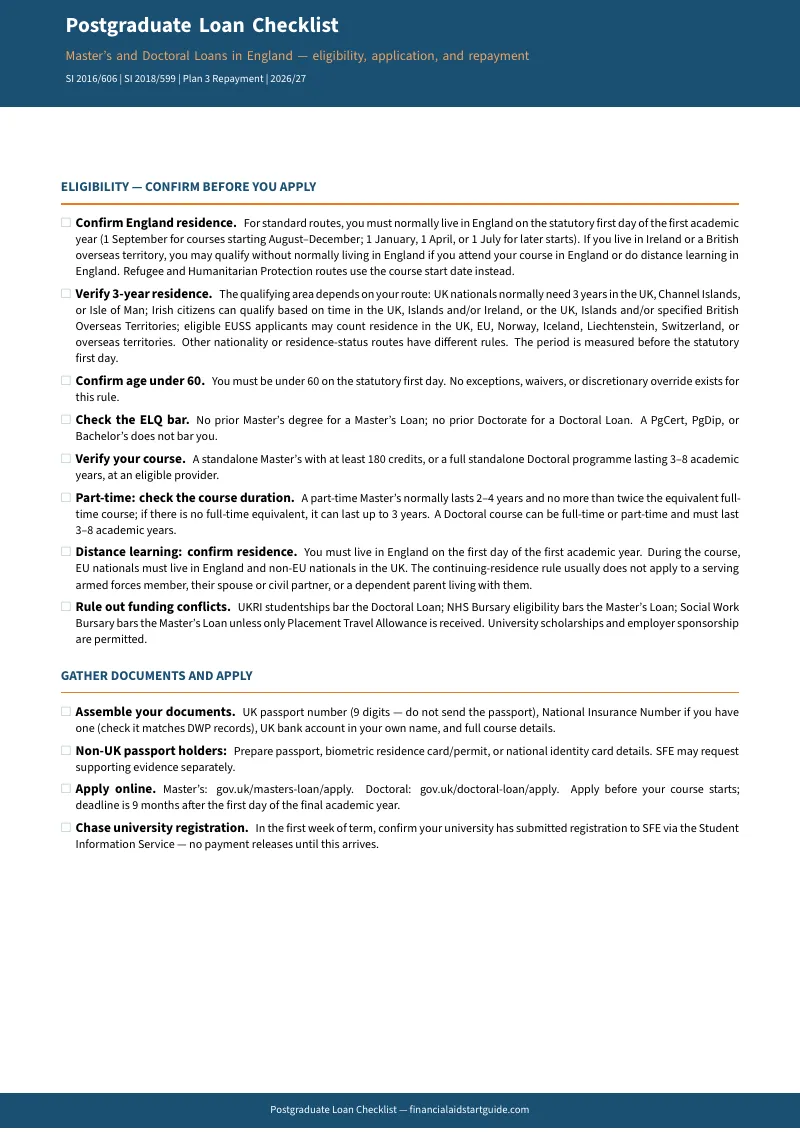
Not sure yet? Download the free Postgraduate Loan Checklist — a printable overview of the eligibility tests, key application steps, deadlines, and links to the official SFE portals. It covers the what; the full guide covers the how.
If you are ready for the complete 15-chapter, 55-page guide plus the six printable worksheets, the paid kit is available above — with a full refund guarantee and no time limit.
Frequently Asked Questions
What if the rules change after I buy?
We update the guide when the rules change. Email us any time, even years later, and we'll send you the current edition free.