SFE keeps asking for your parents' income — but your situation doesn't fit their default form
You have supported yourself for years, or you meet SFE's care-leaver criteria, or your parents live outside the UK, Gibraltar or EU where an income assessment would put them in jeopardy or it is not reasonably practicable for them to send a contribution to the UK. Student Finance England may still ask for a parental income declaration. If SFE cannot confirm your independent status and the details are not provided, you will not get the full Maintenance Loan — potentially thousands of pounds less than the maximum award your living costs actually need.
The rules for independent student status exist, scattered across GOV.UK pages, PN1 form notes, and forum threads that contradict each other. The age-25 threshold sounds simple until you realise SFE uses the first day of the academic year, not your course start date. The 36-month self-support test sounds straightforward until SFE queries a gap in your P60s. The care leaver route is clear in law but murky in practice when your records cross council boundaries.
The SFE Independence Evidence System — every route, every document, in one place
This guide maps every non-estrangement route to independent student status and pairs each one with the exact evidence SFE needs. It does not repeat what GOV.UK already says for free. It takes those statutory rules and turns them into practical tools: the Independence Route Decision Tree, the Self-Support Evidence Tracker, the Care Leaver Verification Checklist, the Application Timeline Planner, and the SFE Communication and Escalation Log.
Everything is written for the 2026–2027 academic year, with the correct reference dates, income thresholds, and form versions.
What's inside the guide
- Independence Route Decision Tree — a one-page printable that walks each qualifying route (age 25+, 36-month self-support, SFE's care-leaver criteria, marriage, dependent children, overseas or untraceable parents, deceased parents) and points you to the matching chapter and worksheet
- Self-Support Evidence Tracker — a printable two-page planner for tracking continuous or broken periods of employment, P60s, benefit letters, and earnings records so your evidence covers the full 36-month threshold before you submit
- Care Leaver Verification Checklist — what your local authority letter must confirm, how to request it when you have moved between councils, and the specific three-month qualifying period SFE checks
- Partner income rules decoded — when SFE assesses a spouse, civil partner, or cohabiting partner's income, the £25,000 full-loan threshold, how income above it reduces your maintenance loan, and the 15% current year income drop threshold and income limits for reassessment
- Overseas and untraceable parents guidance — the jeopardy rule, what counts as "not reasonably practical," and the secondary evidence SFE accepts when standard financial documents are unavailable
- Application Timeline Planner — PN1 and PR1 forms for courses starting before 1 January 2027, September 2026 full-time undergraduate apply-by dates, evidence queries, formal reviews, and the escalation path to the Independent Assessor for Student Finance
- SFE Communication and Escalation Log — a document log for recording submission dates, reference numbers, assessor responses, and follow-up actions so nothing falls through the cracks during processing
Who this guide is for
- Students under 25 who have supported themselves financially — you have three years of employment or benefits behind you and need to prove it to SFE with the right documents in the right order
- Students who meet SFE's care-leaver criteria — you can choose the maximum Maintenance Loan without household-income means-testing, but the paperwork and council letters need to confirm the qualifying dates and care status
- Mature students (25+) and their partners — you qualify automatically by age if you are 25 or over on the first day of the academic year, but partner income assessment, unearned income rules, and previous study calculations can still reduce your funding if you are not prepared
- Parents helping with a non-standard application — you are trying to support your child through an SFE application that does not follow the standard parental income path, and the official guidance is not written for your situation
- Anyone whose parents cannot be contacted — they live abroad, they are deceased, or they simply cannot be traced, and SFE needs evidence before it will assess you independently
Why free resources leave gaps
GOV.UK explains the legal rules — it does not give you the Self-Support Evidence Tracker for 36 months of broken employment. UCAS lists the qualifying categories — it does not walk you through what happens when SFE rejects your evidence and you need to escalate. University money advisers are excellent but stretched thin during September and October when thousands of students need help at once.
This guide fills the space between knowing the rules exist and having a practical system for meeting them. It is not a replacement for free advice — it is the preparation that makes free advice sessions more productive, because you arrive with organised evidence instead of a box of loose payslips.
What this guide is not
This is an independent educational resource. It is not affiliated with Student Finance England, the Student Loans Company, GOV.UK, or any university. It does not write appeal letters, offer legal representation, or guarantee any funding outcome. SFE assessors make all entitlement decisions based on statutory regulations.
If you are facing severe financial hardship or housing instability, free professional support is available through your university welfare team, Citizens Advice, Shelter England for housing advice, and Become.
Full refund, no time limit
If the guide does not help you, email [email protected] for a full refund. No time limit, no questions.
Get started now
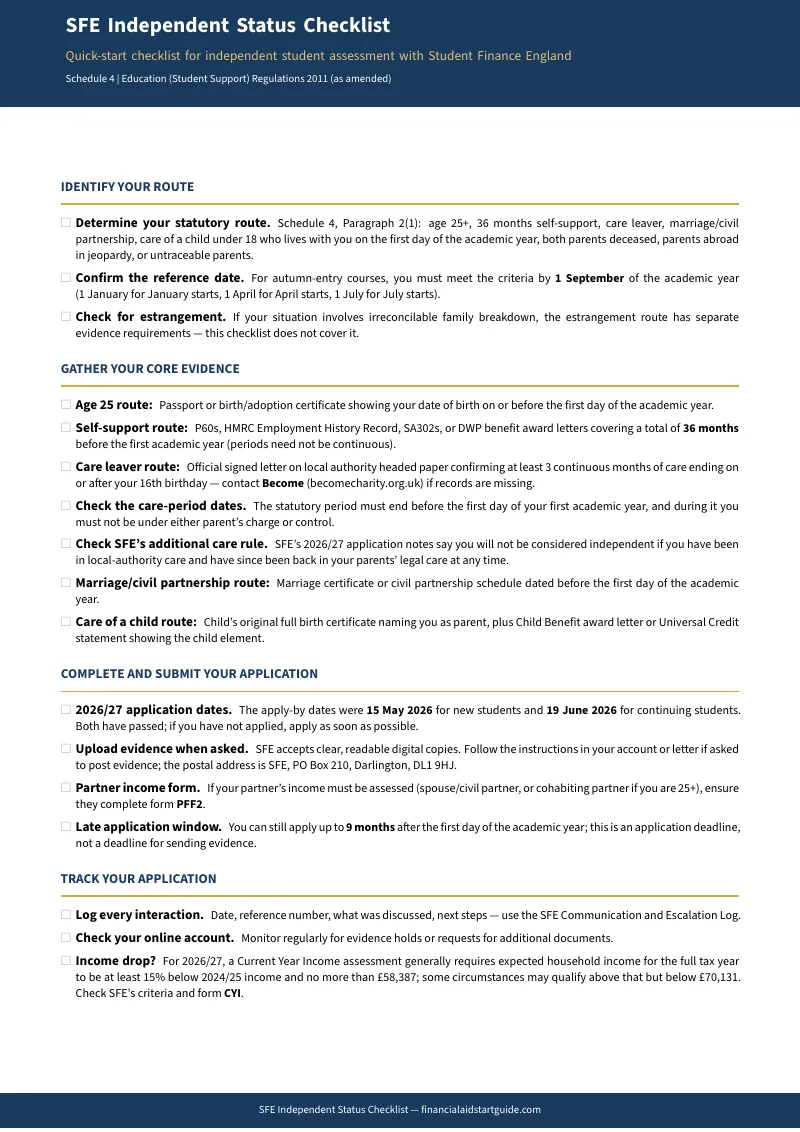
Download the free SFE Independent Status Checklist to see whether you qualify, or get the full guide for the complete evidence system, worksheets, and escalation framework. The guide costs less than one hour of a student finance adviser's time — and it is yours to keep and refer back to whenever your circumstances change.
Your maintenance loan assessment does not have to depend on documents you cannot get. The independent routes are there — this guide makes sure you use the right one with the right evidence.
Frequently Asked Questions
What if the rules change after I buy?
We update the guide when the rules change. Email us any time, even years later, and we'll send you the current edition free.