The DSA Evidence & Assessment Navigator
Your condition already makes studying harder. The last thing you need is an application process that rejects your evidence, sends you into an assessment unprepared, and then takes months to deliver the support you were promised.
Disabled Students' Allowance can fund up to £27,783 a year in specialist equipment, software, study skills tutoring and other support — and it is a grant, not a loan. But the gap between qualifying for DSA and actually getting help is filled with rigid evidence requirements, an assessment meeting most students walk into blind, and supplier delays that can stretch past your first set of exams.
The DSA Evidence & Assessment Navigator is a complete, printable guide that walks you through every stage of the process — from checking whether you qualify to chasing equipment that has not arrived — so you spend your energy on your degree, not on deciphering SFE's paperwork.
What's Inside
- Eligibility quick-check — conditions that count, courses that qualify, and the postgraduate and part-time rules, so you know where you stand before you fill in a form
- Evidence standards explained — exactly what SFE caseworkers look for in a medical letter or diagnostic report, the formats that get rejected, and what to ask your GP or assessor to include
- Application walkthrough — DSA1, DSA Slim, the online route, when to use each one, the supporting documents to include, and the deadlines that decide whether your support arrives before term starts
- Needs assessment preparation framework — how to describe the barriers your condition creates in lectures, exams, reading, note-taking and campus life, so the assessor recommends what you actually need rather than what fits their default list
- Assessment report audit checklist — a line-by-line check of the Needs Assessment Report before SFE acts on it, catching missing recommendations, wrong contact details and support that does not match your course
- £200 computer contribution guide — what the contribution covers, how to pay it, and where to look for hardship funds that can help
- Delay and dispute escalation paths — the difference between a funding appeal and a service complaint, the right email addresses, and how to escalate to the Independent Assessor when supplier backlogs stall your support
- Five worked scenarios — a dyslexic undergraduate, a student with anxiety applying mid-course, a wheelchair user, a postgraduate researcher, and a parent helping their child apply — each one traced through the full process
- Six printable worksheets — an evidence pre-flight checklist, a barrier-mapping matrix for the needs assessment, an assessment report audit checklist, an evidence chronology log, a support delivery tracker, and a quick-reference contacts card
Who This Is For
- Students in England with a disability, long-term health condition, mental health condition or specific learning difficulty (dyslexia, ADHD, autism and others) applying for DSA for the first time
- Parents or carers helping a student navigate the application
- Current students whose evidence was rejected, whose assessment report looks wrong, or whose equipment has not arrived
- Postgraduate students dealing with the annual paper re-application
Why Not Piece It Together for Free?
Every rule in this guide is public information. SFE publishes the forms, GOV.UK lists the eligibility criteria, UCAS describes the assessment, and Disability Rights UK explains your rights. The problem is not access — it is fragmentation.
The evidence rules are on one government page, the assessment guidance is on UCAS, the complaints procedure is buried in the Student Loans Company website, and the deadlines are scattered across half a dozen PDFs that change each academic year. Stitching it all together while managing a condition that affects your concentration, organisation or energy is exactly the kind of cognitive load DSA is supposed to reduce.
This guide puts the rules, the forms, the standards and the escalation paths in one printable document, in the order you will meet them, with worksheets you can fill in as you go. It saves the hours of cross-referencing and gives you a system to follow instead of a research project.
What This Guide Is Not
It does not provide medical diagnoses, clinical letters or a diagnostic assessment. It does not write appeal letters or guarantee any funding outcome. It is not affiliated with Student Finance England, the Student Loans Company or the Department for Education. It is an independent process navigation guide — it explains the rules, the steps and the options, and it links to the free help available from your university, SFE and charities.
Your Download
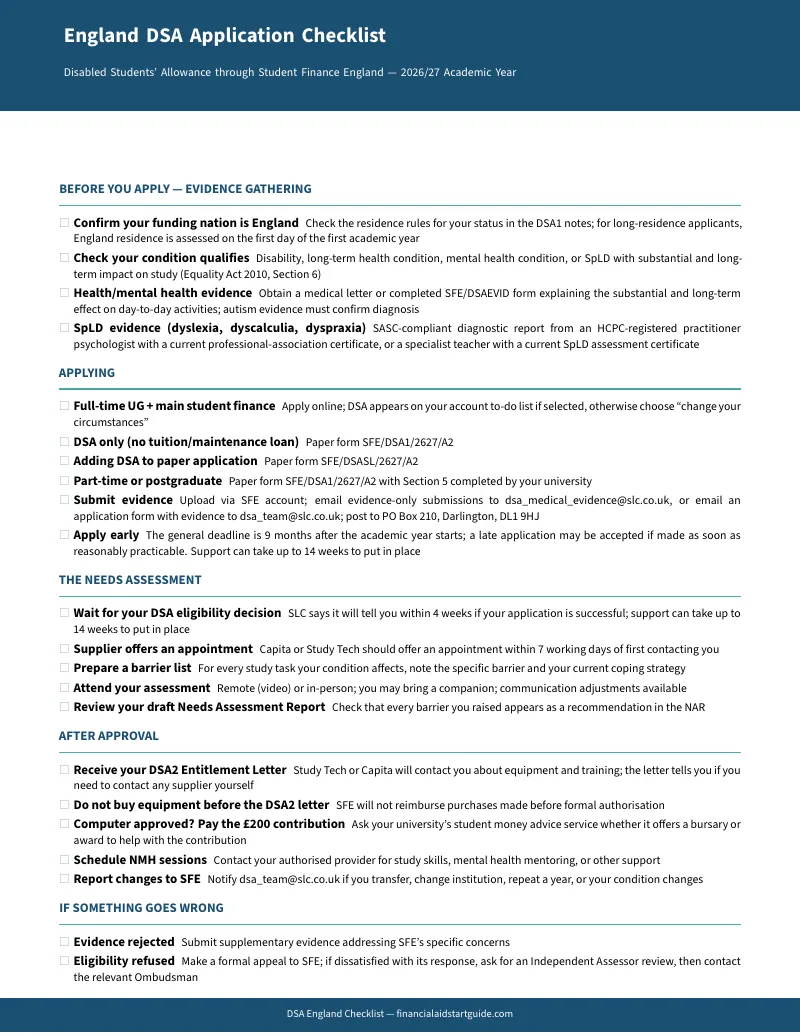
The paid download includes the full guide plus six standalone printable worksheets: an evidence pre-flight checklist, a barrier-mapping matrix, an assessment report audit checklist, an evidence chronology log, a support delivery tracker, and a quick-reference contacts card. The free checklist covers the steps in order, the forms you need and the key deadlines — enough to see whether you are on track.
Full refund, no time limit. Email [email protected] if you need anything.
Frequently Asked Questions
What is Disabled Students' Allowance?
DSA is a non-means-tested grant from Student Finance England for students whose disability, health condition or learning difficulty creates barriers to study. It can pay for specialist equipment, software, a non-medical helper such as a study skills tutor, and other support. The maximum for 2026/27 is £27,783 per academic year, and nothing is repaid.
Who qualifies?
You need to be an England-domiciled student on an eligible higher education course, with a disability, long-term health condition, mental health condition or specific learning difficulty that has a substantial and long-term effect on your day-to-day activities. Household income does not affect eligibility.
What evidence does SFE ask for?
For a physical or mental health condition, a letter or report from a doctor or medical professional that explains the substantial and long-term effect on day-to-day activities. For a specific learning difficulty, a diagnostic assessment from a practitioner psychologist registered with HCPC when the report was produced, or a suitably qualified specialist teacher with a current Assessment Practising Certificate at that time.
Does the guide cover postgraduate DSA?
Yes. The postgraduate route uses the same DSA1 form but requires a new application each academic year. The guide explains the differences and walks through the annual re-application.
Is this an official government publication?
No. This is an independent educational publication. It is not affiliated with, endorsed by or connected to Student Finance England, the Student Loans Company or the Department for Education. All statutory rules are cited to official sources.
What if I just need the checklist?
The free checklist is yours without buying anything — it lists the application steps, the forms and the key deadlines in order. The full guide adds the evidence standards, assessment preparation, report audit and escalation paths.
Can I get a refund?
Full refund, no time limit. Email [email protected].
Frequently Asked Questions
What if the rules change after I buy?
We update the guide when the rules change. Email us any time, even years later, and we'll send you the current edition free.