The Assessment Was Built on Income Your Household No Longer Earns
Student Finance England calculated your child's maintenance loan using a tax return from roughly two years ago. Since that tax year ended, a parent was made redundant. Or income halved because of illness, early retirement, a business downturn, or a separation that split the household in two. The maintenance loan letter arrived based on earnings that no longer exist — and the amount offered is the statutory minimum, not the amount the current-year income estimate may support.
You have seen the phrase "current year income assessment" on GOV.UK, but nobody has explained when PFF2 is needed alongside CYI, how to estimate income honestly when earnings are volatile, which parent's income SFE assesses after a separation, or what happens at year-end when SFE asks for the actual figures and recalculates entitlement.
The CYI Income Drop Navigation Kit
This toolkit walks through Student Finance England's current year income assessment from the 15% eligibility check to the year-end reconciliation. The process is not discretionary hardship funding — it is a statutory mechanism under the Education (Student Support) Regulations 2011 that substitutes estimated current-year income for the old baseline. A lower figure enters SFE's taper formula, and the maintenance loan rises to reflect the estimated current-year income, then is reconciled against actual income.
The guide is not a form-filling service and does not predict what SFE will decide. What it does is put the regulatory rules, the form pairings, and the evidence requirements into the sequence a household actually needs to follow — so you spend your time completing a correct submission, not piecing together conflicting forum advice about whether you qualify.
What's Inside
- 15% Threshold Eligibility Check — SFE generally requires estimated household income to be at least 15% lower than the 2024/25 baseline and £58,387 or less for the full current tax year, though some students may still qualify when household income is at least £58,387 but below £70,131. The guide walks through the arithmetic, explains what counts as residual income (not the same as take-home pay), and flags the situations where a CYI assessment may still matter even when the student already receives the full loan.
- CYI and PFF2 Walkthrough — SFE needs prior-year income details as well as the current-year estimate. If it does not already have a sponsor's 2024/25 details, the 2026/27 CYI form says to provide them on PFF2 and that the forms can be sent together. The guide maps which information each form collects and when PFF2 is needed.
- Worked Income Examples — The CYI form asks sponsors to estimate income for the full current tax year, but they rarely know that figure exactly mid-year. The guide uses worked examples to show how to project volatile income from its components — salary, overtime, shift allowances, statutory sick pay, redundancy pay (including why the full amount must be declared even when part of it is tax-free), self-employed trading profit estimates, pension drawdowns, and taxable benefits in kind — so the household can make an informed estimate.
- Evidence Checklist by Employment Type — Whether the sponsor is employed, self-employed, retired, or receiving benefits, the year-end reconciliation (Form PR2) requires evidence of actual income. The guide's table lists the documents by employment type, including P60 or final-month payslip, tax-return evidence, and pension or benefit evidence, so sponsors can prepare what SFE requests.
- Separated-Household Privacy Guide — SFE assesses the income of whichever parent the student is financially dependent on, including that parent's partner if they have one. SFE says it does not need income details from the parent the student is not dependent on or has less contact with. The guide explains which parent is assessed and how a parent and partner can provide PFF2 details separately.
- Year-End Reconciliation Steps — After the tax year ends, sponsors must submit Form PR2 alongside official proof of actual earnings. If they do not, the student is entitled only to basic student finance and must repay any extra amount received. The guide explains the year-end evidence sequence, what sponsors may need to provide, and what SFE does if actual income differs from the original estimate.
- Trigger-Event Scenarios — Redundancy, forced career transition, long-term illness, retirement, parental separation, and bereavement each change what a sponsor declares on the CYI form. The guide covers each trigger with worked examples showing how the income estimate changes and what documentation to keep.
- Formal Review and Escalation Stages — If SFE's calculation looks wrong, its appeals procedure assigns a case handler to investigate. If you remain dissatisfied, you can ask an Independent Assessor to review the appeal. The guide explains each stage, what additional evidence to include, and how this differs from submitting a revised CYI estimate when income changes mid-year.
Who This Is For
- Parents in England whose income dropped sharply after the 2024/25 tax year — through redundancy, reduced hours, illness, retirement, or a business downturn — and whose child received the minimum maintenance loan as a result
- Separated or divorced households where the assessed parent's income has fallen and the family needs to understand which financial details SFE uses
- Self-employed sponsors who need to estimate current-year trading profits for the CYI form before their tax return is complete
- Families approaching the year-end reconciliation deadline who need to understand what Form PR2 requires and what happens if actual income differs from the estimate
- Parents of returning students who need to submit a fresh CYI assessment for a new academic year after the household's income position changed again
Why Not Just Use the Free Information?
GOV.UK publishes the CYI form, the PFF2 form, and the PR2 form at no cost. University money advice teams offer free appointments. The SFE helpline (0300 100 0607) answers questions about individual cases. Save the Student and MoneySavingExpert explain the maintenance loan system in clear language.
The gap is in what happens between downloading the form and submitting a correct, complete application. GOV.UK publishes the CYI and PFF2 forms separately; the key question is whether SFE already has each sponsor's 2024/25 details. The CYI form says to provide missing details on PFF2 and that both forms can be sent together. Forum threads give contradictory advice about what counts toward the 15% threshold. The guide brings the income examples and year-end evidence steps into one sequence.
The CYI Income Drop Navigation Kit puts the forms, the threshold arithmetic, the income estimation, and the year-end evidence into one structured sequence. It is the preparation step that free resources skip.
What This Guide Does Not Do
It does not fill in your forms or submit anything on your behalf. SFE requires sponsors to complete and sign their own declarations.
It does not guarantee any increase in the maintenance loan. Entitlement is determined entirely by verified household income entering the statutory taper formula. No product, service, or adviser can promise a specific amount. What the guide does is help the household submit a complete, correctly paired application instead of one that stalls or leads to an overpayment.
It is not affiliated with Student Finance England, the Student Loans Company, the Department for Education, or any university.
Your Guarantee
Full refund, no time limit. If the toolkit does not help you prepare a stronger submission, email [email protected] and we will refund your purchase. No forms, no waiting period.
Start With the Free Checklist
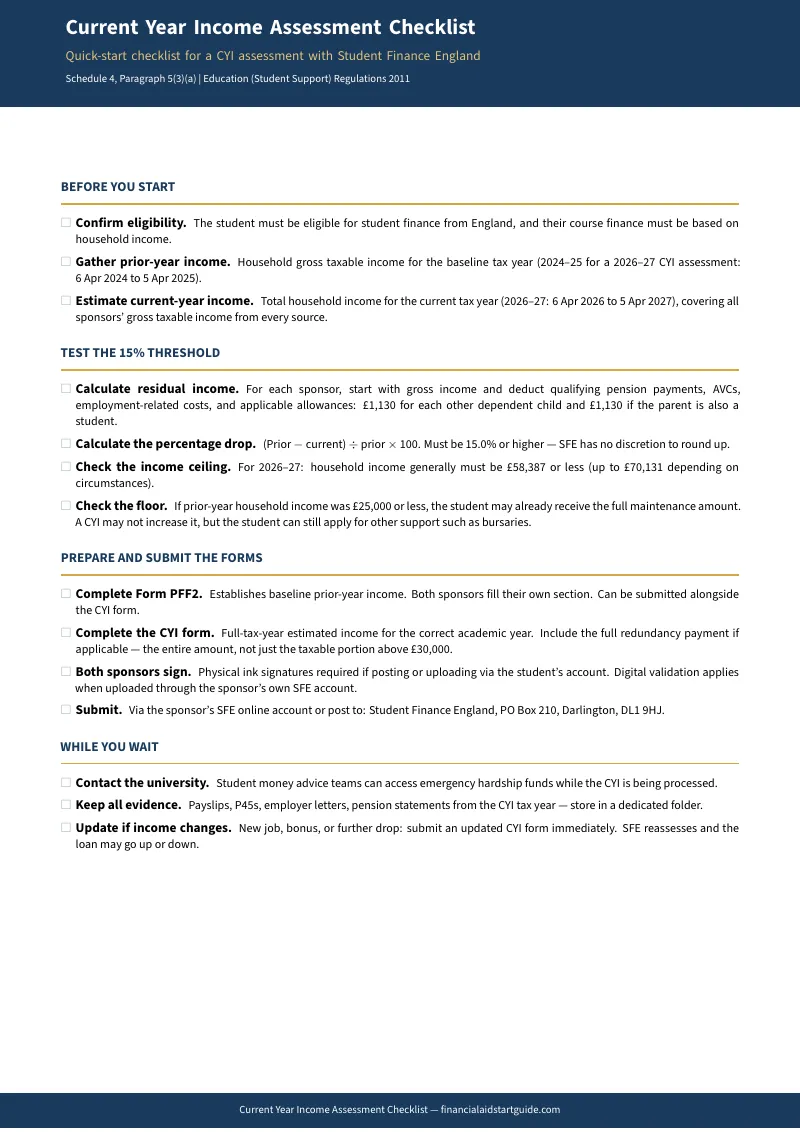
Not sure yet? Download the free Current Year Income Assessment Checklist — a printable overview of the 15% threshold test, the forms you need, and the evidence to keep for year-end. It covers the what; the full guide covers the how.
If you are ready for the complete toolkit — the 47-page guide, 9 printable worksheets and reference cards (threshold calculator, income estimation worksheet, form submission checklist, evidence tracker, taper reference, and more), worked income examples, the separated-household guide, and year-end reconciliation steps — it is available above, with a full refund, no time limit.
Frequently Asked Questions
What if the rules change after I buy?
We update the guide when the rules change. Email us any time, even years later, and we'll send you the current edition free.