
One Application, Two Governments, Zero Guidance on What Happens Between Them
You fill out one form on the Saskatchewan student aid portal. That form feeds Saskatchewan's Ministry of Advanced Education and the federal Department of Employment and Social Development Canada simultaneously. Two separate assessments — provincial and federal — come back in a single Assessment Summary Letter. When the number looks wrong or the money does not arrive, most applicants have no idea which office to contact, which form to submit, or whether the problem sits with the Ministry, the NSLSC, or their institution's enrolment office.
The Saskatchewan Student Aid Handbook is a detailed resource for applicants. It describes each rule on its own page without connecting the steps into a workflow. Canada.ca describes the federal side. The NSLSC describes the servicing side. Your institution describes its confirmation process. Nobody describes how these four systems interact — or what to do when one of them creates a hold that blocks the others.
The Saskatchewan Student Aid Navigation System
This guide maps the entire Saskatchewan student aid process — from residency verification through reviews and appeals — into a single sequential workflow. It is built around three core tools that do what no government portal does: connect the steps, explain the formula, and tell you which office to contact when something stalls.
The Document Assembly Map
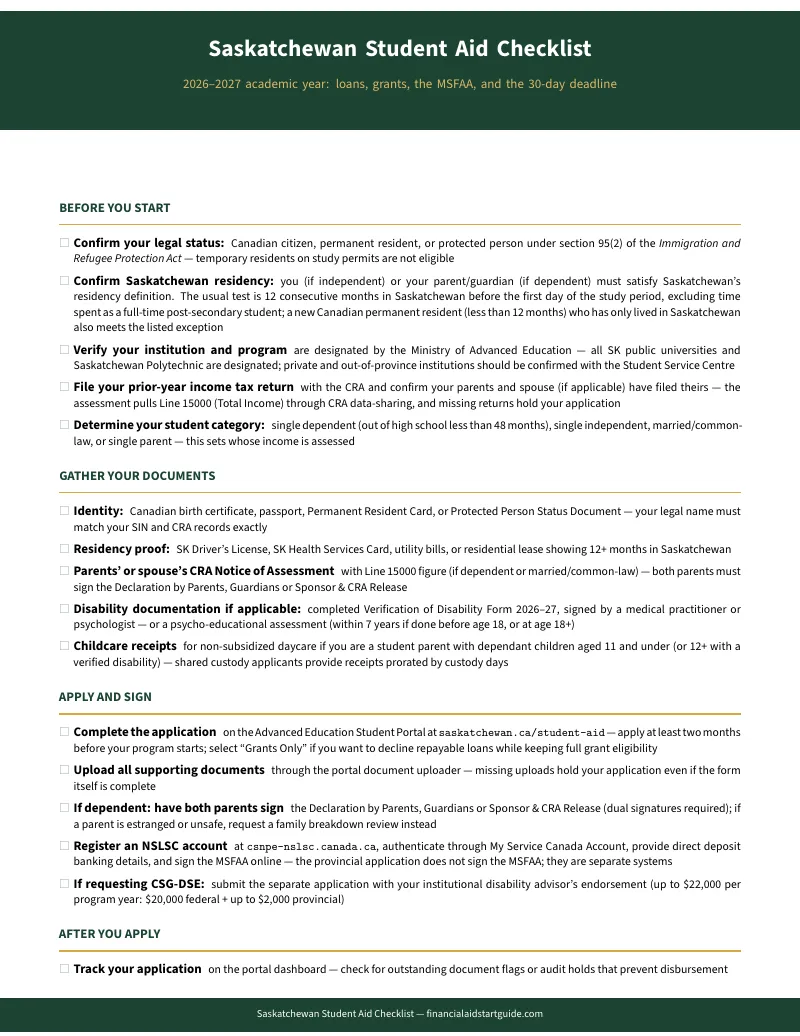
Every hold during August and September starts the same way: a missing document. The map lays out exactly which documents each party needs — your SIN, your Saskatchewan Health Card, your parents' CRA Notice of Assessment with the specific Line 15000 figure, the Declaration by Parents, Guardians, or Sponsor — and which party is responsible for supplying each one. Parents and dependent students can split the checklist between them so nothing falls through the gap between "I thought you did that" and a verification hold.
The Assessment Decoder
When your Assessment Summary Letter arrives showing less than you expected, the portal gives you a number with no explanation. The guide breaks down the assessment formula — allowable educational costs minus expected contributions, split between federal and provincial components — with two worked examples that follow the arithmetic from input to outcome. You can trace exactly where information changed or a program criterion may have been applied incorrectly before deciding whether to request a review.
The Hold Diagnostic Workflow
A payment hold can sit with the Student Service Centre (incomplete application or missing verification), the NSLSC (unsigned MSFAA or identity verification flag), or your institution (delayed enrolment confirmation). The guide maps each common hold type to the responsible body and the specific action needed to resolve it — so you stop calling three different offices and start with the one that can actually release your funds.
What's Inside
- The dual system explained — which decisions belong to Saskatchewan's Ministry of Advanced Education, which belong to ESDC, and which sit with the NSLSC, with a reference table you can check every time a question arises
- Every 2026–27 funding stream — Canada Student Loan ($300/week cap), Saskatchewan Student Loan, Canada Student Grants (up to $4,200 per eight-month year for eligible full-time students), Saskatchewan Student Grant, Saskatchewan Advantage Scholarship, and the disability and dependant grants, in one comparison table
- Eligibility and category rules — residency, citizenship, institution designation, the 60% course load threshold (40% for students with verified disabilities), and the student categories that determine whose income counts
- The assessment formula with worked examples — two full calculations showing how allowable costs and expected contributions interact to produce the Assessment Summary Letter figure
- Application step by step — the five-step portal sequence, the forms in the guide's reference list (including the Declaration by Parents, Guardians, or Sponsor and the Verification of Disability Form), and the documents needed at each step
- The 30-day deadline — when applications, changes to information, and written review requests for the current study period must be received, and how to submit a mid-year income change before the cutoff
- Family breakdown and estrangement — what qualifies, the third-party evidence standard, safety protections, and a worked example for an estranged 18-year-old applicant
- Disability supports — the reduced course load option, the Canada Student Grant for Students with Disabilities, and the services and equipment grant (up to $22,000 per program year)
- The review and appeal process — when changed or incorrect information can be reviewed, when exceptional circumstances go to the Ministry's internal appeal panel, and when Ombudsman Saskatchewan can step in
- Student parents — the Canada Student Grant for Full-Time Students with Dependants, childcare expense allowances, shared custody documentation
- Government loans vs. private credit — a side-by-side comparison showing why the integrated Canada-Saskatchewan system (interest-free during study, federal portion permanently at 0%, RAP safety net) nearly always beats a bank student line of credit
- Six printable worksheets — application pre-flight checklist, assessment decoder worksheet, reassessment evidence organizer, deadline tracker, hold troubleshooter, and agency communication log — each a separate PDF you can print and fill in
Who This Guide Is For
- First-time applicants and their parents — submit a complete application the first time and avoid the September hold that delays tuition payment
- Students whose assessment looks wrong — understand the formula, identify the gap, and check whether information changed or program criteria were applied incorrectly before requesting a review
- Adult returners and mature students — verify independent status, understand labour-force participation requirements, and confirm how prior academic standing affects eligibility
- Estranged students — navigate the family breakdown process with safe evidence pathways, without being forced to contact someone you have cut off for a reason
- Students with disabilities — work through the reduced course load threshold, the equipment grant application, and the disability verification form requirements
- Student parents — maximise dependant grants, document childcare expenses, and understand how shared custody affects the assessment
Why Not the Government Website Alone?
The Saskatchewan Student Aid portal publishes every rule you need. The problem is not missing information — it is the gap between reading a regulation and completing a workflow under a deadline. The portal describes each form on its own page without telling you which forms apply to your situation, in what order, or what happens if you skip one. The Student Service Centre answers questions during business hours, but August and September wait times stretch into days. Campus financial aid advisors at USask, the University of Regina, Saskatchewan Polytechnic, and the regional colleges can explain policies, but they cannot fill out your forms, structure your review request evidence, or change a provincial assessment decision.
This guide is not a replacement for those resources. It is the connective tissue that makes them usable: a single workflow that tells you which office to contact, which form to submit, which deadline to meet, and what evidence to attach — before you discover what was missing after a hold appears.
Backed by a Full Refund, No Time Limit
If the guide does not help you navigate your Saskatchewan student aid application, email [email protected] for a full refund. No forms, no time limit, no questions.
Start With the Free Checklist
The free Saskatchewan Student Aid Checklist covers the key steps, deadlines, and documents in a two-page format. Download it now and use it alongside the student aid portal. If you want the full guide — with the worked examples, the hold diagnostic workflow, and the appeal evidence organizer — it is available on this page for .
Frequently Asked Questions
What if the rules change after I buy?
We update the guide when the rules change. Email us any time, even years later, and we'll send you the current edition free.